

You've tipped flour into a bowl, started mixing your sourdough, and found small islands of dry flour hiding beneath the surface. Perhaps there are stubborn clumps, coarse bran flecks, or a pale cloud drifting across the worktop. You reach for a sifter for flour and wonder whether this simple tool will rescue the dough, or whether you're following an old cake-baking habit that sourdough doesn't really need.
That question matters because sourdough flours vary widely. A smooth white bread flour behaves differently from rye, stoneground wholemeal, or a freshly milled heritage grain. Sifting can make some mixtures more uniform, yet it can also remove bran and change the character you wanted in a rustic loaf.
This guide looks at the practical decision, not just the gadget. You'll learn what sifting changes, when it helps, which type of sieve suits different kitchens, how to sift without covering the room in dust, and how to clean the mesh properly. If you're still building your basic setup, the sourdough essentials guide for UK beginners offers useful context.
A sifter isn't a badge of serious baking. It's a situational tool. The right choice depends on your flour, your recipe, and whether you're chasing a delicate crumb or preserving the wholesome texture of the grain.
Table of Contents
- Introduction Why Sourdough Bakers Ask About Sifting
- What Sifting Actually Does to Flour and Dough
- How Flour Sifting Evolved in the UK
- Types of Sifter for Flour and Which Suits Sourdough
- When to Sift and When to Skip It for Sourdough
- How to Use and Clean Your Flour Sifter Properly
- Choosing Wisely and Baking With Confidence
Introduction Why Sourdough Bakers Ask About Sifting
A new sourdough baker often begins with a tidy recipe and an untidy bowl. The flour goes in, water follows, and the spoon catches on a dry pocket. You stir harder, add the starter, and notice bran specks floating through the mix. By the time the dough comes together, you're unsure whether those uneven patches will disappear during fermentation.
That uncertainty leads naturally to the question, “Should I have sifted the flour?” For a very light sponge, sifting can be part of building a delicate, even mixture. For a typical sourdough loaf, though, the answer is less dramatic. Fermentation, hydration, gluten development, shaping, and baking temperature usually have a much greater influence on the result than whether the flour passed through a mesh first.
The confusion comes from treating all flour as if it behaves the same way. A bag of refined white flour may need a quick stir to distribute it. A bag of rye or stoneground wholemeal may contain visible bran and germ that you deliberately want to keep. Removing those particles can make the dough feel smoother, but it may also take away some of the flavour and texture that make the flour distinctive.
Practical rule: Sift to solve a specific problem, not because every sourdough recipe demands the step.
A useful starting point is to ask what you're trying to improve. Are you breaking up a compacted bag of flour? Blending cocoa or icing sugar? Seeking a particularly fine crumb? Or are you making a rustic loaf where bran, colour, and grain character belong in the finished bread?
Once you frame the choice that way, buying becomes easier. Many home bakers need only a fine mesh sieve and a balloon whisk. Others, especially those making delicate cakes or handling clumpy mill-fresh flour, may appreciate a dedicated sifter for flour. There's no virtue in adding another drawer-filler to a small UK kitchen if your everyday dough behaves perfectly without it.
What Sifting Actually Does to Flour and Dough
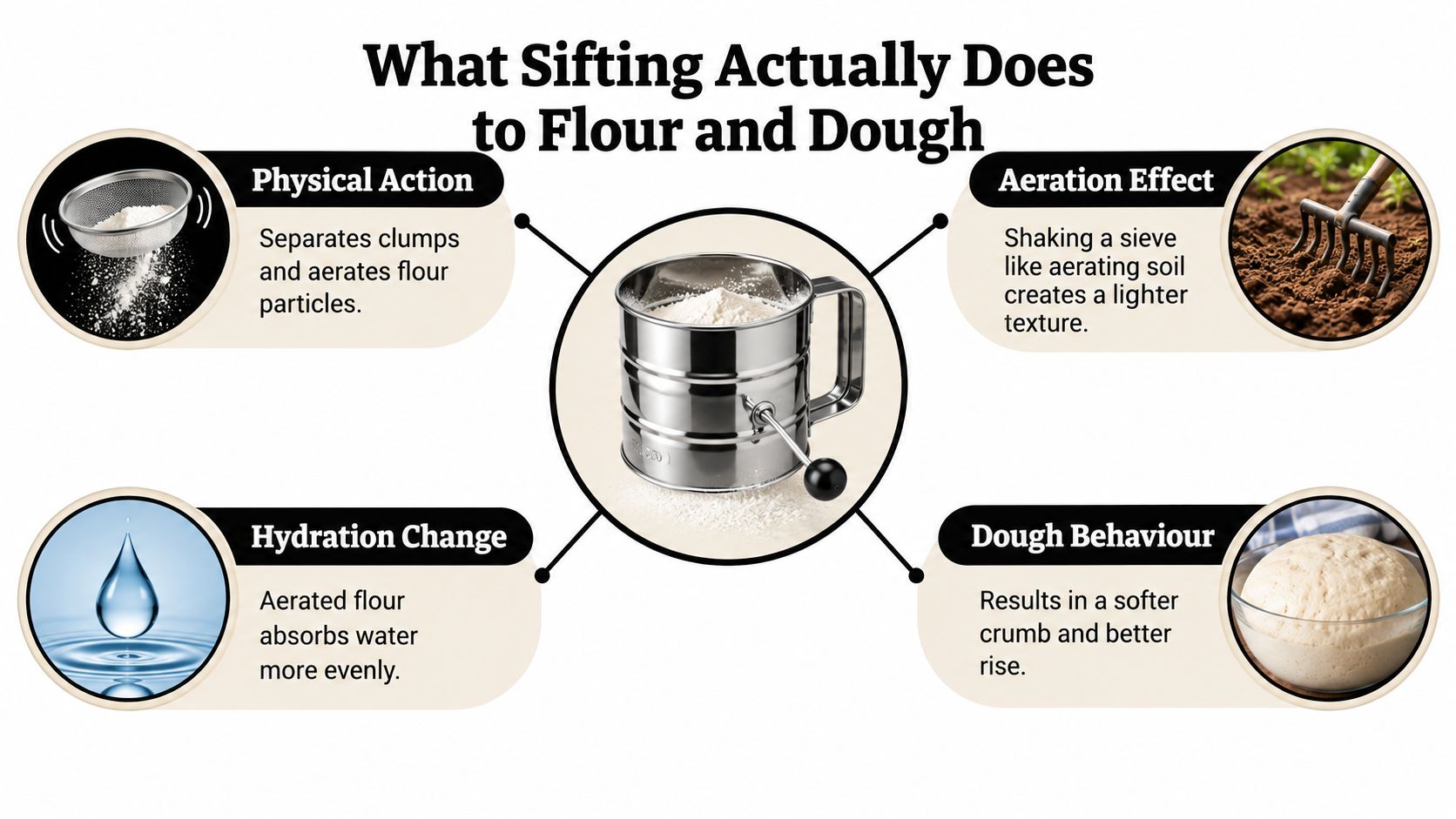
A sieve works like a small garden screen. When you shake soil through a mesh, fine particles pass through while larger pieces remain behind. A flour sifter performs the same basic action. It separates compacted lumps, spreads particles apart, and helps dry ingredients meet one another more evenly.
The physical change
Flour can settle during storage and transport. Moisture may encourage small lumps, particularly around the edges of a bag or container. Passing it through a mesh breaks those compacted pieces into smaller particles, so water reaches more of the flour during mixing.
Sifting also introduces air between particles. That doesn't create fermentation, and it won't make a weak starter suddenly active. It changes the starting arrangement of the dry flour. Think of it as loosening a folded blanket before spreading it over a bed. The material hasn't changed, but it's less compact and easier to distribute.
What happens during hydration
When sifted flour meets water, the liquid can spread through the dry ingredients more evenly. That may reduce dry pockets during the initial mix and make the dough feel more uniform. The effect is most noticeable when the flour was lumpy or when you're combining several dry ingredients.
Sifting doesn't remove the need for rest. A short rest after mixing still gives the flour time to absorb water and allows the dough to become more cohesive. It also doesn't guarantee better gluten development. Gluten forms as flour proteins interact with water and movement, while sourdough structure develops through the combined work of mixing and fermentation.
The effect on texture
A more evenly mixed dough can produce a more consistent crumb, especially in delicate baked goods where large flour clumps would otherwise create dense patches. In a lean sourdough loaf, the difference may be subtle. You might notice smoother handling rather than a dramatic increase in rise.
The flour itself remains the main character. Sifting won't turn wholemeal flour into white flour, won't make rye behave like strong wheat flour, and won't remove the need to judge dough by feel. For guidance on choosing flour before you reach for a sieve, see this UK sourdough flour guide.
How Flour Sifting Evolved in the UK
The household sieve has a long industrial backstory. British millers needed reliable ways to separate flour from bran and other larger particles, and their equipment changed as mills pursued more efficient flour dressing.
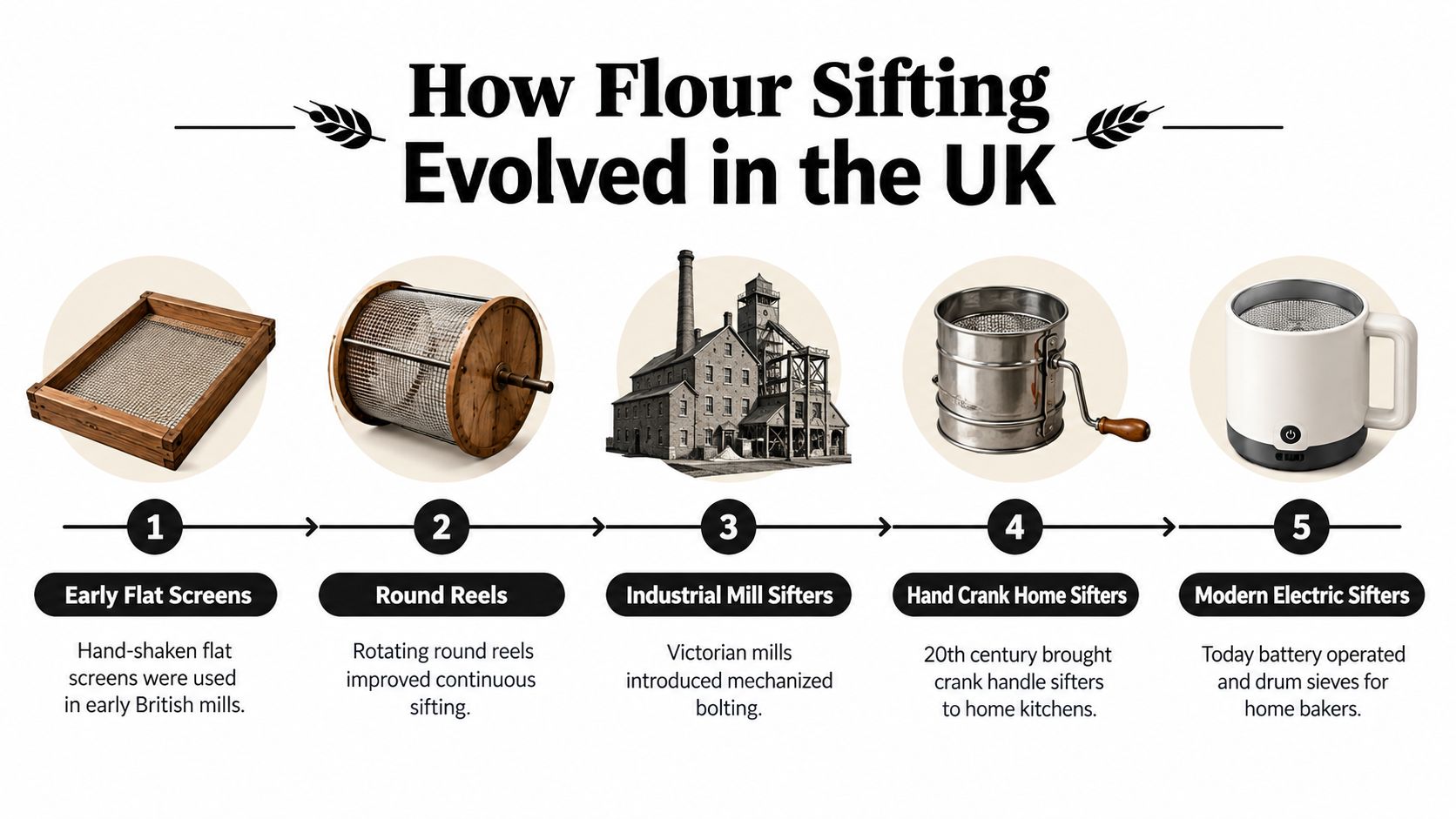
Historical accounts describe early millers using flat screens. Around 1730, many operations moved towards rotating round reels or cylinders, which allowed flour to pass through a continuous moving surface. By about 1870 to 1880, the industry returned to flat-screen technology in the form of the plansifter, a machine designed for more controlled, repeatable separation. This progression is documented in the history of British bolting and flour-dressing equipment.
From mill machinery to kitchen cupboards
Flour dressers appeared in UK water-powered mills as early as the 17th century, and the technology continued into the 20th century as mills moved from water to steam and later power sources. In a mill, the purpose was production and consistency. In a home kitchen, the same basic idea became a way to prepare flour for cakes, sauces, and baking mixtures.
The domestic flour sifter became especially visible during the Victorian period. Joseph Baker patented a combined flour scoop and sifter in Canada in 1870, travelled to England in 1876, and established operations in London and Liverpool. By 1879, the business had opened a factory in Finsbury, and British business histories describe the Baker flour sifter as successful enough for the company to focus on it. The history of Joseph Baker and Sons records this transition from invention to a notable kitchen product.
Why the history still matters
Modern home sifters are not random kitchen curiosities. They reflect a longstanding effort to control how flour moves, separates, and combines. The difference is that a home baker usually works with a single bowl rather than an industrial stream of milled flour.
That distinction helps keep expectations realistic. Industrial plansifters were built to process flour repeatedly and consistently. A hand sifter is a small preparation tool. It can improve distribution and break clumps, but it doesn't reproduce the full process of milling, grading, or flour formulation.
UK flour preparation remains connected to a substantial domestic milling system. The country's mills produce about 5 million tonnes of flour each year, using approximately 85% UK-grown wheat, according to the historical business account cited above. A kitchen sieve is modest by comparison, but it belongs to the same broader story of preparing grain for a particular kind of baking.
Types of Sifter for Flour and Which Suits Sourdough
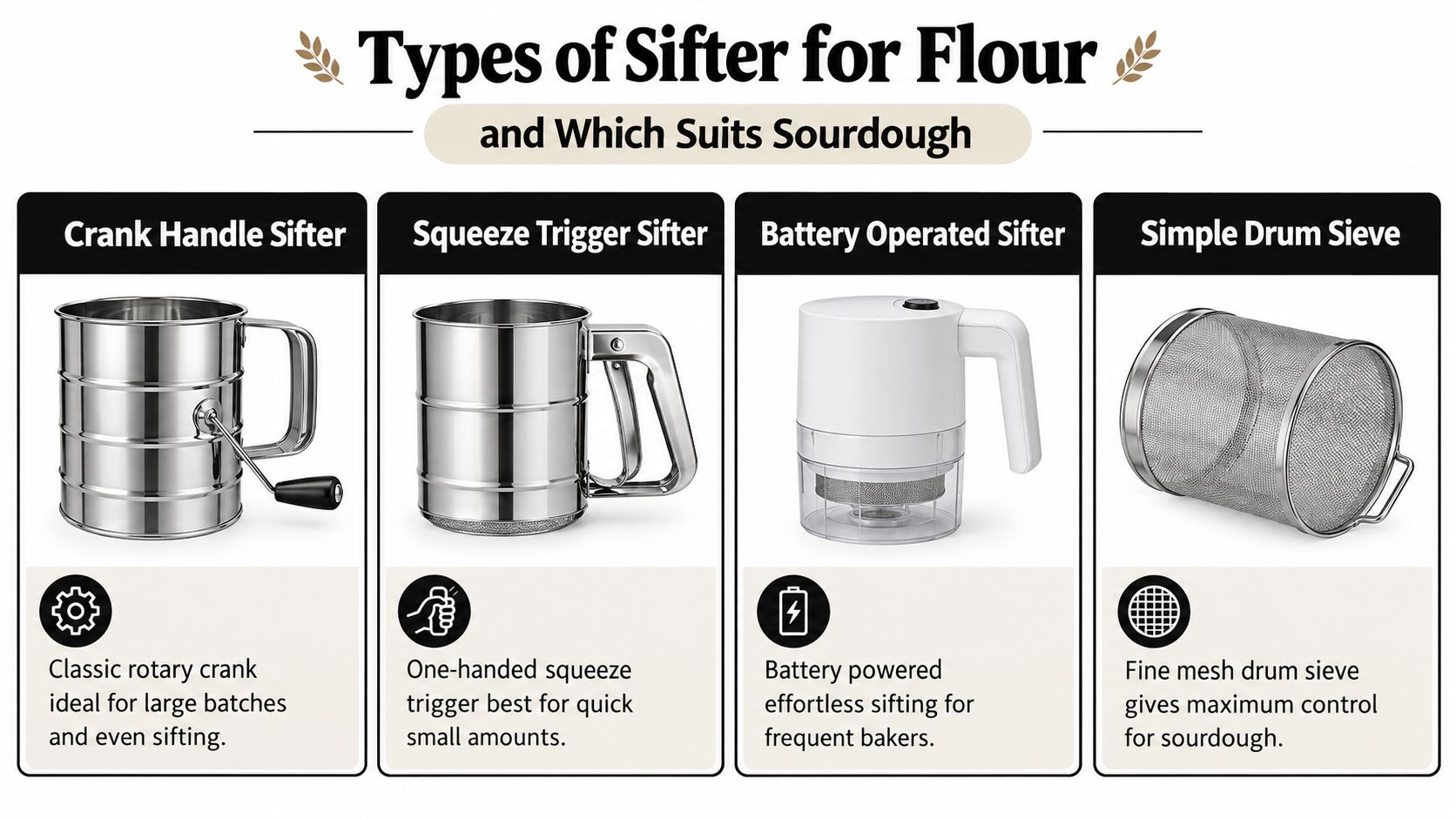
The best sifter for flour depends less on its appearance than on how much control you need. A frequent cake baker may value speed and repeatability, while an occasional sourdough baker may prefer a tool that also handles cocoa, icing sugar, and small amounts of wholemeal flour.
Crank handle sifters
A crank sifter uses a rotary handle to move an internal paddle or agitator across the mesh. It's comfortable for steady batches because one hand can turn the handle while the other adds flour or holds the bowl.
The trade-off is control. You may find it harder to see exactly how much flour is passing through, and internal parts can make cleaning less convenient. Choose one if you regularly prepare larger quantities or prefer a continuous motion to shaking.
Squeeze trigger sifters
A trigger model fits in one hand and activates when you squeeze. It's quick for a small amount of flour, cocoa, or icing sugar, and it often suits bakers who want to sift directly over a bowl.
Its capacity is usually limited, so it's less comfortable when you're preparing a large sourdough formula. Flour can also remain in corners if the internal mechanism isn't emptied carefully. For occasional use, that compactness may be an advantage rather than a weakness.
Battery-operated sifters
Battery-operated designs reduce hand effort. They can help if repetitive squeezing or cranking is uncomfortable, and they offer a consistent action during frequent baking.
They're more complex than a plain sieve, which means more parts to wipe, store, and keep dry. For most sourdough bakers, the convenience only becomes worthwhile if sifting is a regular part of several recipes rather than an occasional rescue step.
Drum sieves and fine mesh sieves
A drum sieve is a shallow circular frame with mesh stretched across it. You hold it over a bowl and shake, tap, or rub flour through the surface. It gives excellent visual control and has fewer moving parts to clean.
A useful UK benchmark is a 30 cm drum sieve with an 8 holes per cm mesh, marketed as suitable for flour. Its wider working area lets more flour pass per shake, while the medium-fine mesh breaks up clumps without producing an excessive dust cloud, as described by this UK flour mesh sieve specification.
For sourdough, a drum sieve is often the most flexible option. It lets you stop as soon as the flour looks evenly distributed, and it makes it obvious what remains in the mesh. Watch the demonstration below for a practical view of the different mechanisms.
If your baking is mostly bread, a fine mesh sieve may already cover your needs. Buy a dedicated sifter when you want speed, reduced hand effort, or a purpose-built tool for frequent delicate baking.
When to Sift and When to Skip It for Sourdough
Sifting earns its place when the recipe depends on uniformity or lightness. It's useful for a very delicate sponge, where clumps can create dense streaks, and for dry ingredients such as cocoa or icing sugar that commonly compact in storage. It can also help with mill-fresh or bran-heavy flour when the particles have gathered into lumps and you want a smoother initial mix.
Sourdough bread often asks a different question. A rustic loaf made with rye, heritage grain, or stoneground flour may benefit from keeping the bran and larger particles in the dough. Those elements contribute to colour, flavour, aroma, and the sense that you're eating a less-refined grain. Sifting can make the mixture feel more polished, but polished isn't always the goal.
UK bakers are also exploring pizza-grade flour, sourdough beyond bread, rye, heritage grains, and traceable British flour. Commentary on these UK home-baking trends highlights the growing interest in distinctive flours, while also pointing to the practical questions created by clumping, bran separation, and texture.
Use the bake as your guide
| Bake type | Sift recommendation | Why |
|---|---|---|
| Very light sponge | Usually sift | A fine, even dry mixture supports a delicate texture. |
| Cocoa or icing sugar mixture | Sift when lumpy | The mesh breaks compacted pockets before they reach the batter. |
| White sourdough loaf | Optional | Sift only if the flour is clumped or you prefer a particularly smooth mix. |
| Rye or heritage-grain loaf | Usually skip | Keeping the grain particles preserves the flour's rustic character. |
| Stoneground wholemeal | Usually skip | Bran and larger particles are part of the intended flour profile. |
| Everyday cookies or muffins | Often skip | A whisk can distribute dry ingredients without needing a dedicated tool. |
Your buying decision should reflect how often you bake. AHDB's UK consumer insight reports that flour consumption occasions fell 11% versus 2023, and that flour appeared in 46% of baking occasions in 2024, compared with 49.1% in 2020. The same report describes a shift towards convenience. If your household bakes intermittently, a fine sieve may offer more value than a single-purpose sifter.
Ask three questions before each bake:
- Is the flour visibly clumped?
- Does the recipe need a particularly light or delicate texture?
- Would removing larger particles take away flavour or texture I want?
If the first two answers are no, and the third answer is yes, skip the sifting. For a standard loaf, stirring the dry flour with a whisk before adding water may be all the preparation it needs.
How to Use and Clean Your Flour Sifter Properly
A sifter works best when you treat it as a preparation tool rather than a flour-storage container. Start by weighing or measuring the flour according to your recipe, then place the sieve over a bowl wide enough to catch the flour without allowing the rim to wobble.
A calm sifting method
- Load it lightly. Add a manageable amount rather than filling the mesh to the rim. Overfilling slows the flour and encourages you to press too hard.
- Keep it low. Hold the sieve close to the bowl. A short distance limits the flour cloud and keeps the worktop cleaner.
- Use a gentle rhythm. Shake a drum sieve with small movements, turn a crank steadily, or squeeze a trigger without racing. The flour should pass through progressively.
- Break stubborn lumps carefully. If a lump remains, rub it lightly against the mesh with a clean spoon. Don't crush aggressively, because force creates unnecessary dust.
- Add the sifted flour as directed. Fold or stir it into the recipe without undoing any aeration the mixture needs. In sourdough, combine it with water and starter according to your chosen mixing method.
- Check the residue. Bran and larger particles left behind aren't automatically waste. Return them to a rustic dough if you want their texture, or discard them only when the recipe specifically calls for a finer flour.
The Federation of Bakers treats repeated manual sieving as a flour-dust exposure issue in commercial settings. Where manual sieving and weighing lasts more than 30 minutes per shift, its guidance recommends local exhaust ventilation and at least FFP3 respiratory protection unless the ventilation system has been shown to work effectively. Read the Federation of Bakers dust guidance for workplace procedures. A home baker should still avoid shaking flour high above the bowl and should ventilate the room if dust becomes noticeable.
Cleaning without damaging the mesh
Empty the sifter immediately after use. Brush loose flour from the frame and mesh with a soft, dry pastry brush, then follow the manufacturer's instructions about washing. If water is suitable, rinse gently rather than scraping the mesh with a knife or stiff brush.
Dry the tool completely before storing it. Moisture can encourage rust on metal parts and may leave flour paste trapped around the frame. Store the sieve where other utensils won't bend the mesh, because a distorted screen won't sift evenly.
Never leave flour sitting inside a crank or battery-operated mechanism. Remove any detachable parts, brush out hidden corners, and keep electrical components dry. Clean tools produce clearer results and prevent old flour from affecting the aroma of a fresh bake.
Choosing Wisely and Baking With Confidence
A sifter for flour is best understood as a situational helper. Use it when you need to break clumps, combine dry ingredients evenly, or create a particularly fine texture. Skip it when you're making a rustic loaf and want to keep the bran, colour, and grain character that came with the flour.
For many UK home bakers, a fine mesh sieve is the sensible starting point. It handles occasional clumps, cocoa, icing sugar, and small baking jobs without adding a complicated mechanism. A drum sieve makes more sense if you want greater capacity and visual control, while a crank or battery model suits people who sift frequently or prefer reduced hand effort.
Try one simple comparison. Make two similar doughs with the same flour and method, sift one portion, and leave the other untouched apart from a quick whisk. Notice the mixing feel, hydration, dough strength, crumb, and flavour after baking. That small experiment will tell you more about your kitchen than a blanket rule ever could.
Your starter's condition and your fermentation decisions still matter more than owning another gadget. If you're choosing equipment for the wider bake, this guide to Dutch ovens for bread baking can help you keep the rest of your setup focused and useful. The simple decision rule is this: sift for a clear texture or mixing problem, and skip it when the flour's character is part of the loaf.
The Sourdough Cult offers live, active sourdough starter from a long-maintained Cheshire family culture, along with practical starter kits and clear feeding guidance for UK home bakers. Visit The Sourdough Cult to find the starter, kit, and straightforward tools that can help you make consistent bread without unnecessary gadgets.


