

You're probably here because you've already seen two extremes.
One kit is basically a pouch of dried starter and a vague promise that it'll “come to life”. The other throws in half a bakery's worth of gear, then leaves you guessing why your starter still sits flat on a cold kitchen counter in Leeds, Bristol or Glasgow. That's the problem with shopping for the best sourdough starter kit UK buyers can use. Most listings focus on what's in the box, not what helps your first loaf work.
In a UK kitchen, the failure points are predictable. Rooms run cool for much of the year. Tap water quality varies. New bakers don't know if their starter is active enough, underfed, too cold, or past its peak. A good kit solves those exact problems. A bad one gives you extras you won't touch after week one.
That matters because bread isn't some fringe hobby here. The Federation of Bakers says 99.8% of UK households purchase bread, with over 13 million loaves or packs sold every day, and values the UK bakery market at £5.74 billion with annual volume above 4.5 billion units in its UK bread industry market snapshot. Sourdough kits sit inside a country that already bakes, buys, and thinks in bread. You're not buying into a novelty. You're trying to make a reliable version of something already central to everyday life.
Table of Contents
- Introduction to Finding Your Best Sourdough Starter Kit
- What a UK Sourdough Starter Kit Should Include
- Detailed Comparison of Starter Kit Options in the UK
- How to Use Your Starter Kit for Reliable Results
- Choosing the Right Kit for Your Baking Goals
- Cost and Value Analysis Without Overbuying
- Our Recommendation for UK Home Bakers
Introduction to Finding Your Best Sourdough Starter Kit
The usual first-loaf story goes like this. You feed the starter, wait, see a few bubbles, assume it's ready, mix dough, and end up with a squat loaf that tastes good but looks defeated. The baker often blames themselves. Usually the kit deserves some of the blame.
A useful sourdough starter kit should remove uncertainty from day one. If the culture arrives alive and active, you skip the most frustrating part of sourdough, which is trying to build strength from scratch while second-guessing every smell, bubble and feeding. That doesn't guarantee brilliant bread instantly, but it gives you a proper head start.
Reliability beats complexity
The smartest way to choose is simple. Ask which kit gives you the highest chance of a working first loaf in a normal UK home. Not the prettiest jar. Not the longest accessory list. Not the one with the most rustic branding.
What matters most is whether you can answer three questions without guessing:
- Is the starter active enough?
- Can I track when it peaks?
- Do the instructions match an ordinary UK kitchen rather than an ideal warm studio kitchen?
If a kit makes those three things clear, it's probably worth buying.
A live starter with clear feeding guidance will do more for your first loaf than a luxury banneton ever will.
Why UK context matters
UK home baking had a very obvious surge, then a cooldown. Coverage from AHDB on baking behaviour notes that after the first national lockdown, half of Brits baked at home at least once a week and 27% baked more than once a week, while later reporting showed the boom easing, including 195 million fewer home-baked goods in the 52 weeks to 8 August 2021 than the prior year and homemade bread down 28% year on year in the same reporting, as summarised in this AHDB consumer insight article. To me, that says something useful. People still want the result, but many don't want endless trial and error.
That's where the right kit earns its place. Not by making sourdough look artisanal on Instagram, but by making it manageable on a wet Tuesday.
What a UK Sourdough Starter Kit Should Include
The best kits are boring in the right way. They include the bits you'll use every week and skip the theatre. If a listing is heavy on linen covers, recipe cards and decorative labels but light on starter quality and feeding clarity, move on.
The non-negotiables
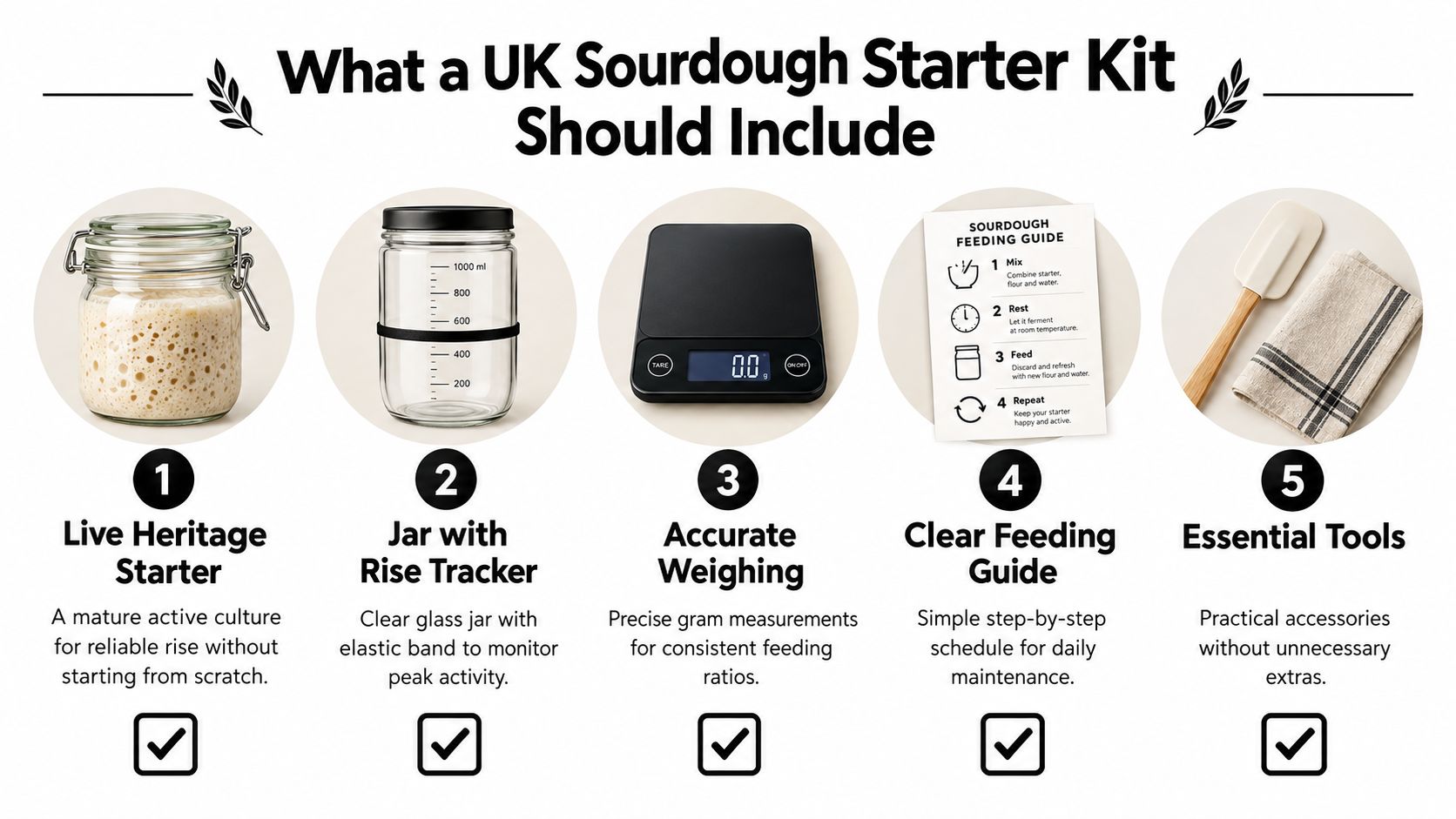
A UK sourdough starter kit should include these five things.
- A live, mature starter. This is the big one. You want an active culture, not a science project disguised as a shortcut.
- A clear jar with rise tracking. A starter doesn't just need feeding. It needs watching.
- Accurate weighing. Guesswork with tablespoons is how people drift into inconsistent feeding.
- A straightforward feeding guide. Not a wall of baking jargon.
- A couple of practical tools. A spatula or spoon, maybe cloth or lid guidance. Nothing more elaborate than that is essential at the start.
Why the jar matters more than fancy extras
UK-specific starter success comes down to monitoring fermentation properly. A useful technical benchmark from UK baking guidance is temperature and timing. Starter maintenance commonly sits around 18 to 25°C or 20 to 24°C, with active fermentation often peaking after 4 to 8 hours at room temperature and requiring daily or twice-daily feeds for countertop storage, according to this UK sourdough culture maintenance guide. That's why a plain glass jar with a marker band is so useful. It lets you see whether your starter is rising in that window.
If the starter doesn't rise as expected, you can respond. Warm the environment slightly. Adjust timing. Delay your mix. Without a visual marker, beginners just guess and bake too early.
Practical rule: buy the kit that helps you read the starter, not the one that tries to distract you from reading it.
Don't overvalue flour add-ons
People often assume a better kit means more flour included, or some special blend. That's not really the point. Guidance on flour and starter maintenance shows that strong white bread flour usually falls around 12 to 14% protein, while whole wheat is also high-protein but denser because bran interferes with gluten structure. A starter doesn't need bread-flour-grade strength in the same way dough does, because you're maintaining a microbial culture, not building final dough structure. A simple 1:1:1 feeding ratio by weight is the practical baseline, as explained in this flour and starter maintenance reference.
That's why I'd rather see a kit include a good jar and clear ratio guidance than a stack of flour accessories.
If you want a quick benchmark for what an essentials-led bundle looks like, this bread starter kit guide from The Sourdough Cult is close to the right idea. Focus on the culture, the jar, the instructions, and the weighing. The rest is optional.
Detailed Comparison of Starter Kit Options in the UK
Most UK options fall into three sensible categories. Starter-only, beginner essentials, and full gift-style bundles. That's a better way to compare kits than obsessing over brand names, because it matches how people buy.
| Kit Type | Best For | Key Inclusions | Guidance Level |
|---|---|---|---|
| Starter-only | Bakers who already own scales and jars | Live starter, basic instructions | Light to moderate |
| Beginner essentials kit | First-time bakers who want reliability without clutter | Live starter, jar with rise tracking, feeding guide, simple tools | Strong |
| All-inclusive boxed kit | Gift buyers or complete beginners starting from nothing | Starter plus broader equipment bundle | Varies, often uneven |
UK Sourdough Starter Kit Types Compared by Use Case
The simplest option is often the best if you already bake. If you've got a digital scale, a clean jar, and basic confidence, a starter-only option makes sense. You don't need another scraper or proofing basket in the cupboard. You need a dependable culture.
The weakness of starter-only kits is obvious. They assume you already know what “ready” looks like. If you don't, they can feel cheaper at checkout and more expensive in wasted flour and failed dough.
Starter-only kits
Starter-only is the cleanest purchase for experienced bakers.
Good if you:
- Already own scales and use them.
- Understand feeding rhythm and can tell the difference between active, peaked and overripe starter.
- Don't need hand-holding on storage or maintenance.
Not good if your real problem is reading fermentation.
If your first question after buying is “how high should this rise before I bake with it?”, you probably don't want starter-only.
Beginner essentials kits
This is the category I'd recommend most often. Not because it gives you the most stuff, but because it usually solves the most common beginner mistakes in one go.
A solid beginner kit includes:
- Live starter instead of dried flakes
- Jar with a visible tracker
- Clear feed ratio guidance
- Storage instructions for countertop and fridge
- A practical tool or two, not ten
This is the category where brands either understand home baking or they don't. If they've thought about cool kitchens, timings, and how a novice checks rise, that'll show up in the kit design.
Full boxed kits
These are easy to buy as presents and sometimes worth it if you need everything. But they're also where overbuying starts. Full kits often include bannetons, scoring tools, cloths, recipe extras and bits that look great on a product page.
Some of that gear is useful later. Very little of it matters before you can keep a starter healthy.
The trade-off
| What you gain | What you risk |
|---|---|
| Better gift presentation | Paying for tools you won't use yet |
| More complete unboxing | Mistaking accessories for actual baking support |
| Fewer separate purchases | Clutter and decision fatigue |
What I'd check before buying any kit
I'd ignore most marketing language and check these instead:
- Is the starter shipped live and ready to feed? That cuts out the hardest stage.
- Can you track rise visually in the jar? This matters more than decorative packaging.
- Do the instructions tell you what to do in a cool kitchen? Generic guidance often assumes warmer rooms than many UK homes have.
- Is the kit still useful after week one? Some bundles are built for unboxing, not ongoing use.
A sensible example in the middle category is an essentials-led setup such as The Initiation from The Sourdough Cult, which is built around live starter, a jar, and instructions rather than a pile of novelty extras. That's the right direction for most first-time UK bakers.
How to Use Your Starter Kit for Reliable Results
The first day matters more than people think. Not because sourdough is fragile, but because early habits either make things obvious or confusing. Your job is to create a repeatable routine and watch the starter properly.
Start with the visual process first.
Feed it on arrival and mark the level
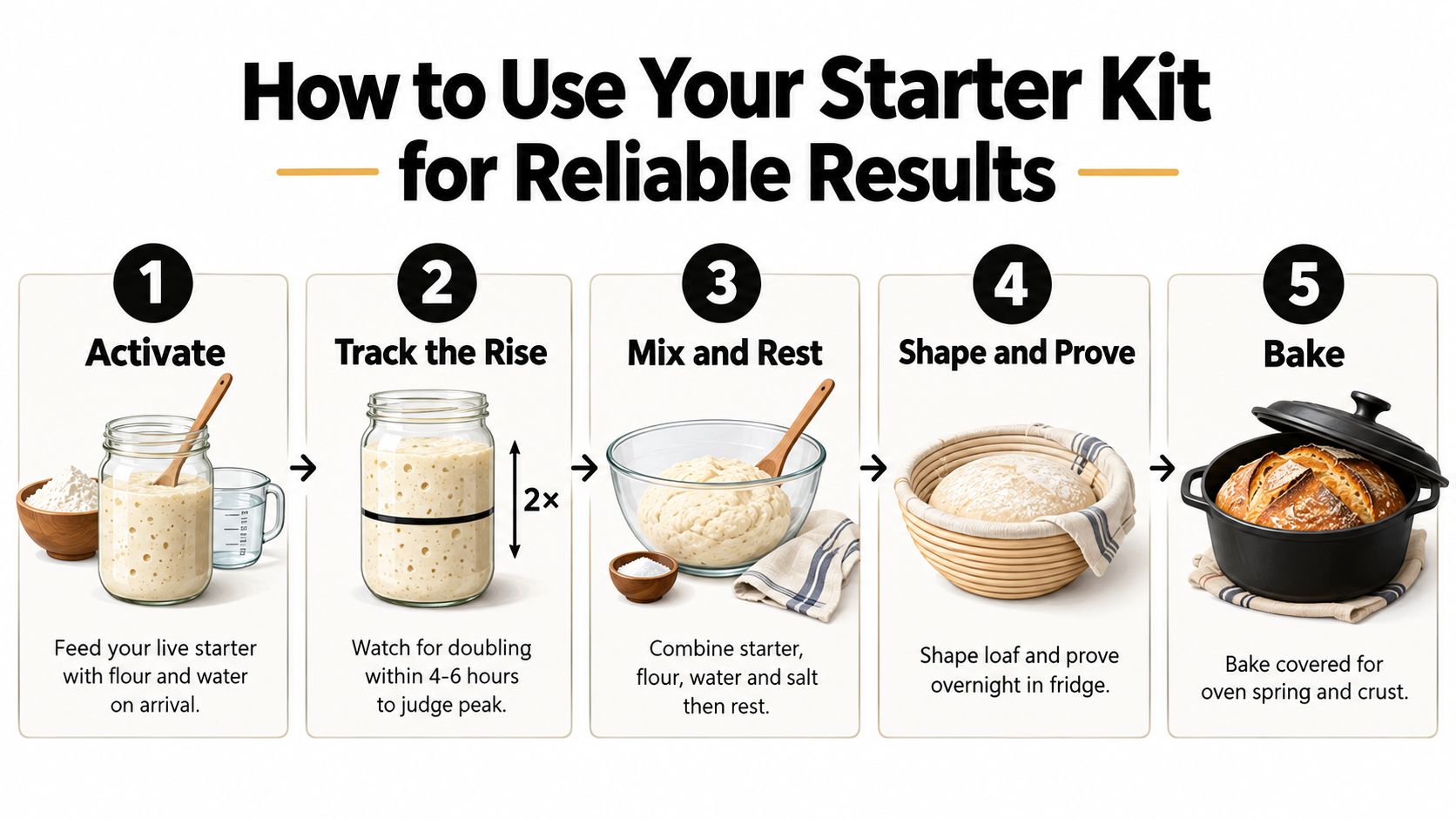
As soon as the starter arrives, feed it according to the included guide. If the kit uses a 1:1:1 ratio by weight, stick to that. Don't improvise on day one.
Mix thoroughly, clean down the inside of the jar if needed, and mark the starting height with the tracker or an elastic band. That mark tells you whether the culture is gaining strength or just showing a few bubbles on top.
Watch for rise, not just bubbles
Bubbles alone don't mean much. You want rise, structure and timing. In many home setups, a healthy active starter should peak within a few hours at room temperature. If your kitchen is cool, it may take longer and need a warmer spot.
A useful UK-specific issue here is water and room temperature. UK-facing guidance notes that chlorine can affect starter performance and suggests filtered or bottled water where possible, while warmth around 24 to 26°C can help a starter build more reliably in cooler homes, as explained in this Kilner guide to sourdough bread. If your starter seems sluggish, don't panic and don't keep changing flour every feed. First, look at the room and the water.
If the starter lives in a cold kitchen corner, the kit hasn't failed. The setup has.
Here's a practical routine:
- Choose one flour and stick with it for the first stretch.
- Use filtered or bottled water if your tap water seems to hold it back.
- Keep the jar somewhere gently warm, not blasted with direct heat.
- Feed consistently, instead of random top-ups.
Countertop or fridge
If you're baking frequently, keep the starter on the counter and feed on schedule. If you bake less often, chill it and maintain it more slowly. The key is matching the routine to your life rather than pretending you'll bake every other day forever.
This feeding walkthrough is a useful companion if you want a plain-English routine for maintenance: how to feed sourdough starter with a daily maintenance ritual.
A quick visual demo helps here too.
When it's ready for dough
Use the starter when it has clearly risen, looks aerated, and hasn't started collapsing back heavily. That's the moment the kit's rise tracker earns its place. You stop baking by guesswork.
If it hasn't doubled or come close in a reasonable window, don't force a loaf. Feed again, improve the environment, and wait for a stronger cycle. One extra feeding is cheaper than one wasted bake.
Choosing the Right Kit for Your Baking Goals
People buy sourdough kits for different reasons, but listings rarely separate those reasons properly. That's why buyers end up with either too little support or too much gear.
If you're a first-time baker
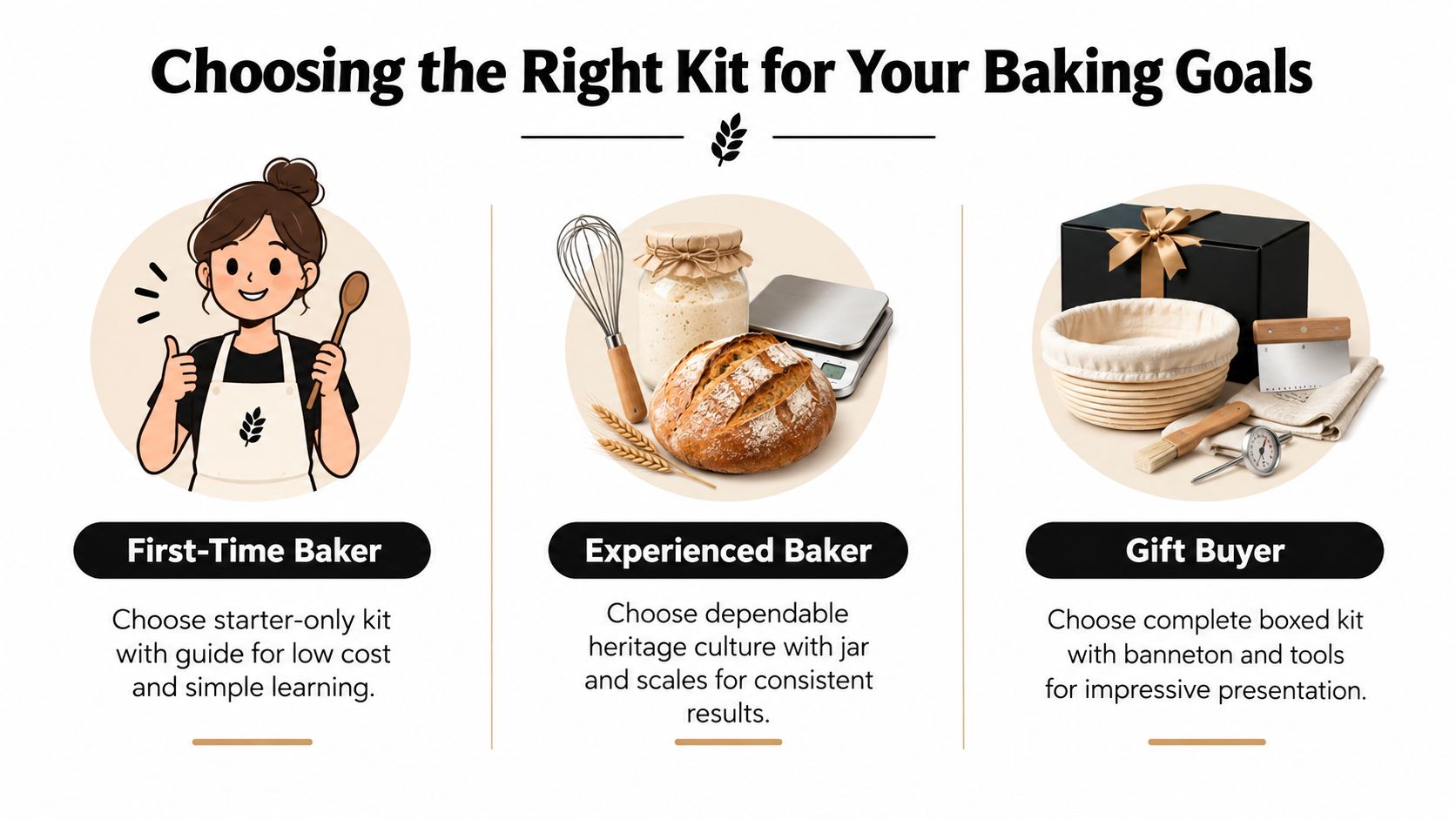
Choose a beginner essentials kit. You want the starter, a jar with visible rise tracking, and instructions that tell you exactly how to feed and store it. Skip the oversized bundle unless you also need every basic tool.
What you're buying here is confidence. Your first win is not elegant scoring. It's getting a starter to rise predictably and turning that into a loaf with proper lift.
If you already bake bread
Buy a starter-only setup or a very lean essentials kit. You don't need duplicate equipment if your cupboards already contain scales, bowls and scrapers.
Your main concern is culture quality. A mature, dependable starter is the point. The rest is replacement clutter.
If you're buying a gift
A full boxed kit makes more sense here than it does for a self-buy. Presentation matters when it's a present, and the recipient may not own any baking gear at all.
Still, I'd keep one standard. The gift should include a live starter and useful guidance, not just pretty accessories. A handsome box won't rescue a weak setup.
Buy for the recipient's kitchen, not your idea of a nice unboxing moment.
If you want a minimal, vetted setup
There's a specific buyer who doesn't want to collect hobby equipment. They want one good jar, one good culture, and enough guidance to avoid the obvious mistakes. For that person, the middle option wins again.
That's also the right choice for workshop hosts or anyone who values consistency. Fewer moving parts means fewer things to explain, replace or troubleshoot.
Cost and Value Analysis Without Overbuying
Most sourdough kits get judged the wrong way. People compare box size, not real usage. That's how they end up paying for linen covers, decorative labels and extra utensils that stay in a drawer.
What you'll actually use
For regular maintenance, a small set of items is commonly relied upon.
- Starter jar
- Scale
- Feeding guide
- Spatula or spoon
- Reliable culture
That's basically it. Once you accept that, value becomes easier to judge. A compact kit with those essentials can be better value than a larger bundle padded with low-use extras.
Where full kits still make sense
There are two situations where a bigger kit can justify itself.
First, you're starting from absolutely nothing. Second, you're buying a gift and want the full experience to feel complete. Outside that, bigger usually means pricier rather than more useful.
This is also where delivery and replacement policies matter. If a supplier includes UK delivery for starter products or offers support when starter viability is compromised on arrival, that affects value in a practical way. It reduces the risk of paying for a culture that doesn't help you bake.
If you're weighing whether to buy a live culture on its own, this guide to buying sourdough starter in the UK is a useful way to think through the trade-off between bare-minimum starter purchases and more supported kits.
The expensive mistake
The costly mistake isn't buying a modest kit. It's buying the wrong type.
- Too small for your experience level and you waste flour through uncertainty.
- Too large for your actual needs and you pay for storage clutter.
- Too generic for UK conditions and you spend the first week wondering why nothing rises properly.
Good value means the kit gets used repeatedly, not admired once.
Our Recommendation for UK Home Bakers
For those searching for the best sourdough starter kit UK options, the right answer isn't the biggest bundle or the cheapest starter packet. It's a beginner essentials kit built around a live culture, a proper jar with rise tracking, and clear feeding instructions that make sense in a normal UK kitchen.
If you're brand new, buy the kit that reduces ambiguity. You need to see the starter rise, know when to feed it, and have enough guidance to cope with a cool room or awkward tap water. That setup gives you the best shot at a first loaf that lifts.
If you already own the basic gear and just need a dependable culture, go lean. A starter-only option is enough, provided you already know how to judge readiness and maintain it without hand-holding.
If this is a gift, choose the full boxed kit only when presentation and convenience matter as much as function. Just make sure it still centres on the culture and the instructions, because those are what the recipient will rely on after the novelty fades.
The best kits solve failure points. They don't decorate them.
If you want a UK-based option built around a live active culture, practical starter kits, and straightforward feeding guidance, The Sourdough Cult is worth a look. It offers starter-only, beginner-friendly and more complete kit routes, all aimed at helping home bakers get from delivery to a starter that works in a real kitchen.


