

You've got the bag of flour on the counter, the jar is washed, and the idea of homemade sourdough still feels just far enough away to stall you out. A bread starter kit changes that moment. It gives you a live culture, the basic tools, and plain instructions, so you're not trying to guess your way through the first loaf while a jar of flour and water turns into a science project.
That matters in the UK kitchen, where bread starter kits now meet a real, mainstream appetite for sourdough rather than a passing fad. UK spending on sourdough reached £58.5 million in the 52 weeks to 17 March 2024, with 26 million packs sold and volumes up 4.3% year on year, according to Kantar data reported by BakeryInfo. Puratos also found that 22% of UK consumers bake bread themselves and 62% of those bakers use sourdough, which is why kit buyers want less trial and error and more early success, especially when they're baking at home between work, school runs, and Sunday jobs.
A kit is really a shortcut to confidence. It can't replace practice, but it can remove the two biggest blockers for first-timers, uncertainty about the starter itself and uncertainty about what to do next. You'll get a clearer sense of what a live starter is, what's usually inside a good kit, how to activate it, and why the right flour, water, temperature, and feeding ratio make the difference between a sluggish jar and a first loaf that rises.
Table of Contents
- Understanding What a Live Bread Starter Actually Is
- Inside a Bread Starter Kit What to Expect and Why Each Item Matters
- Setup and First Feed Walkthrough From Unboxing to Active Rise
- How a Bread Starter Kit Speeds Time to First Loaf
- Choosing and Caring for Your Kit Beyond the First Bake
Understanding What a Live Bread Starter Actually Is
A live starter isn't just an ingredient in a jar. It's a small, living ecosystem made up of yeasts and lactic acid bacteria, and both parts need regular food, time, and the right conditions to stay active. When you feed it flour and water, those microbes wake up, multiply, and create the gas and acidity that give sourdough its lift and flavour.
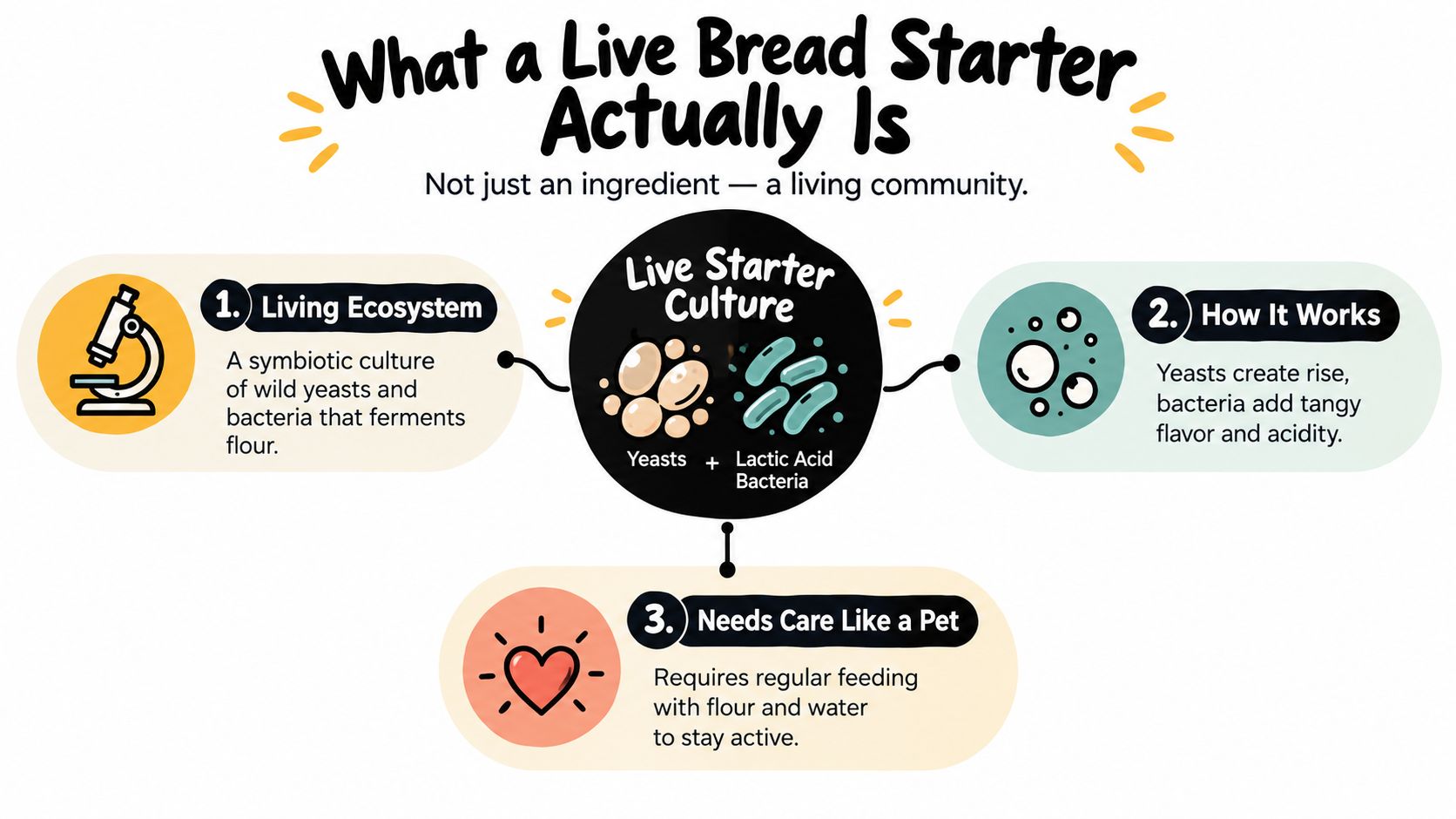
Think of it as a hungry jar, not a dry ingredient
The easiest way to understand starter is to stop thinking of it as “mix” and start thinking of it as a pet that happens to live in flour. It gets stronger when you feed it on a rhythm, and it gets sluggish when it goes too long without food. That's why live starter can behave differently from dried or from-scratch attempts, it already has an established microbial community that knows how to ferment.
The terms bakers use, like peak activity, acidity, and temperature sensitivity, all point to the same thing, timing matters. A starter that has risen and then fallen is not in the same state as one that has just reached its peak. The texture, smell, and rise all tell you something useful if you know what to look for.
Practical rule: if a starter is bubbly, puffy, and smells pleasantly tangy rather than harsh, it's usually telling you it's ready for a feed or a bake.
You can read more about live starter handling in The Sourdough Cult's starter guide, which is useful if you want a dependable culture rather than a guesswork project. Once that idea clicks, the rest of the process becomes much easier to follow.
Inside a Bread Starter Kit What to Expect and Why Each Item Matters
A good bread starter kit should do less, not more. The point is to remove friction, not add gadgets you'll never use again, so the important question is whether each item earns its place in a weekly bake cycle. The strongest kits focus on the live culture, a sensible jar, and the few tools that help you feed, track, and store it properly.
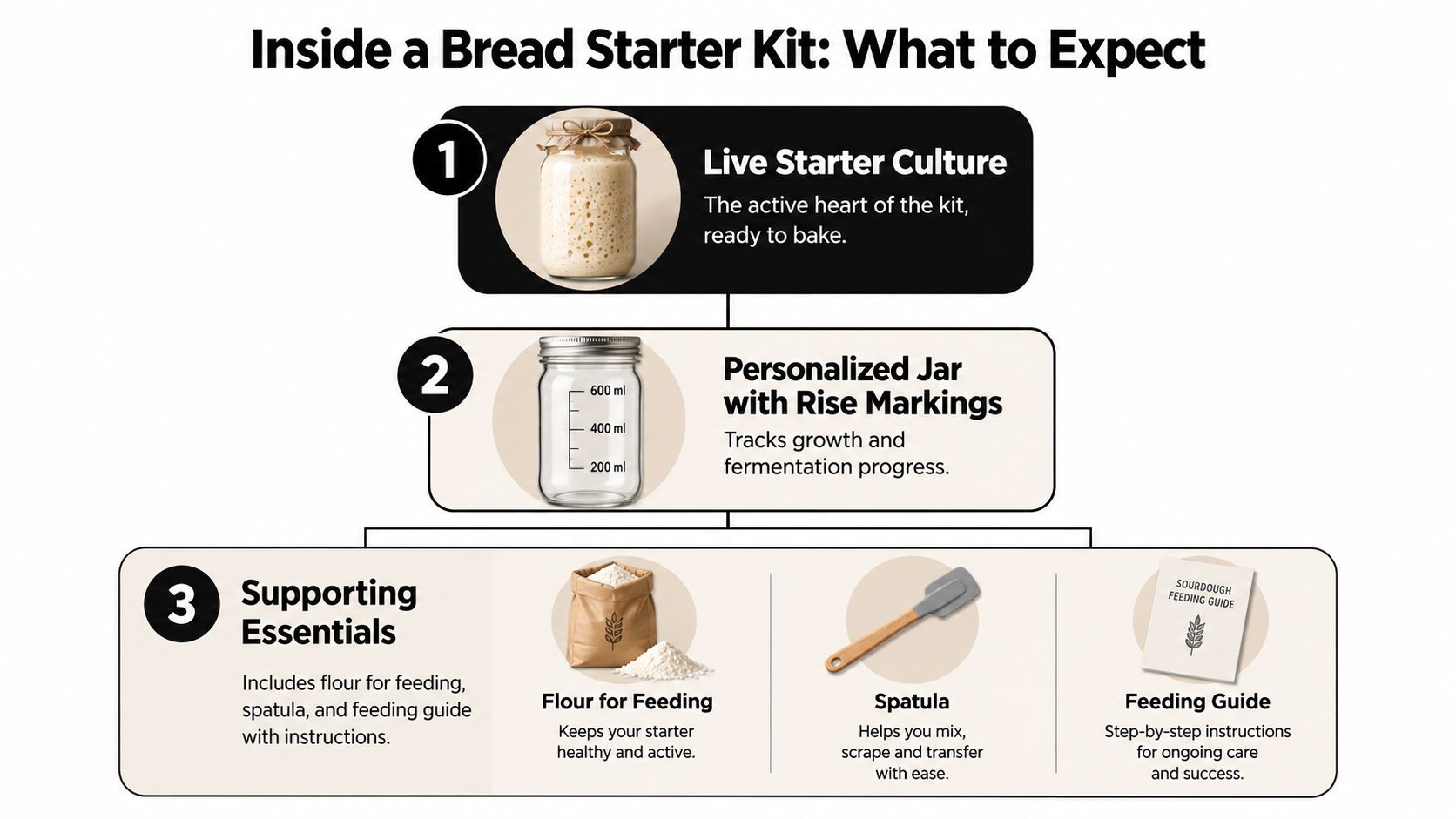
The parts that actually help you bake
The live starter is the centre of the whole setup. Without it, you're just holding flour and water in place. A personalised jar with rise markings matters because it turns an invisible process into something you can see, and that solves one of the most common beginner problems, not knowing whether the starter has really grown or just looks active on top.
Supporting essentials should be simple and specific. A spatula, feeding guide, and a little flour for feeding are more useful than a box full of one-off tools. The kit should also be packaged so it can travel safely, since live cultures need protection and a new baker needs confidence that the contents will arrive usable, not mysterious.
| Kit Option | Includes | Best For |
|---|---|---|
| Starter-only | Live starter and guidance | Bakers who already own jars, scales, and utensils |
| Beginner kit | Starter, jar, and core essentials | First-time bakers who want a simpler setup |
| All-inclusive kit | Starter plus a fuller home-baking setup | People starting from zero or buying a gift |
If you want to see how a starter-focused bundle is framed for beginners, this overview of starter essentials is useful context. The main test is still the same, whether the kit helps you bake sooner with fewer decisions.
Good kit design reduces the number of things you have to remember between feedings. That's what makes the first loaf feel manageable instead of fragile.
Setup and First Feed Walkthrough From Unboxing to Active Rise
Start by opening the box and checking that everything looks clean, sealed, and ready to use. The starter should be alive and active on arrival, and if you're unsure, the first clue is usually whether it responds after feeding rather than whether it looks dramatic straight out of the packaging. Keep the jar, spoon, and flour nearby before you begin, because sourdough rewards tidy prep.
Feed it like a routine, not a rescue mission
For a first feed, the simplest ratio to understand is 1:1:1, which supports a fast turnaround of about 4 to 6 hours, while 1:5:5 slows the cycle to an overnight 10 to 12 hours. Technical guidance also notes that a room-temperature starter is commonly refreshed daily or twice daily, while refrigerated storage is usually weekly, and the starter's peak pH typically sits in the 3.8 to 4.5 range, with dough often targeted at 26 to 28°C because warmer dough ferments faster. That's why a clear feeding guide and a rise-tracking jar matter so much, they stop you from underfeeding, over-acidifying, or missing the peak.
UK kitchens add a few practical wrinkles. Central heating can make one corner of the room much warmer than another, winter counters can feel cool, and softer water can behave differently from hard water, so your starter needs watching rather than blind trust in the clock. Wholegrain or rye flour can also help beginners establish a starter more reliably because it carries a higher native microorganism load than white flour, and that can make the first 4 to 5 days of culture development more dependable.
Use this order in the first day:
- Unbox and inspect. Make sure the starter looks viable and the jar is intact.
- Mix with care. Combine the starter with flour and water until fully hydrated.
- Feed and stir. Use the ratio recommended for your timing window.
- Mark the level. Put the jar on a flat surface and note the starting point.
- Wait and watch. Leave it at room temperature and look for a steady rise.
If the starter seems slow, don't panic and don't keep fiddling with it. A calm, warm corner and the right feed often do more than extra handling ever will.
How a Bread Starter Kit Speeds Time to First Loaf
A starter made from scratch asks for patience while the microbes establish themselves. A live kit skips that waiting period by giving you a mature culture that's already been maintained, which means your first job is to wake it up, not build it from nothing. For a beginner, that difference is huge, because the hard part isn't mixing flour and water, it's knowing whether you're on day one of a healthy process or day one of a stalled one.
Faster because the culture is already established
The UK market data helps explain why this shortcut matters. Sourdough has moved into the mainstream, with Tesco selling over 40 million sourdough products annually and industry reporting saying sourdough accounts for about one in every 13 bread products sold in the UK, according to BakeryInfo. Puratos also reports that sourdough searches rose 178% in Q2 2025, which suggests more beginners are entering the category with high expectations and very little patience. In that context, a ready-to-feed starter is less about luxury and more about avoiding early disappointment.
The speed advantage comes from predictability. A mature starter tends to behave more consistently than a fresh scratch starter, so you can build a routine around feed timing, storage, and dough temperature instead of guessing whether the culture has enough strength to rise bread. That's especially useful for gifts, because the person receiving the kit doesn't also need to learn how to diagnose a weak starter from scratch.
A few questions come up again and again:
- Is it safer? It's not “safer” in a special sense, but a stable live culture is easier to manage than a brand-new one.
- Is it more reliable? Usually, yes, because the starter already has an established fermentation pattern.
- Does it reduce effort? Yes, mainly by removing the longest and least predictable part of the process.
The clearest benchmark is simple. With a live kit, you're aiming to get from unboxing to an active, rising starter in a much shorter and more confident path than starting from zero, which is why beginners often find the first loaf feels reachable instead of distant.
Choosing and Caring for Your Kit Beyond the First Bake
Once you've got one loaf in mind, the next decision is matching the kit to your setup. If you already own scales, jars, and a spatula, a starter-only option makes sense. If you want something giftable or you're building from zero, a beginner kit or a fuller setup saves time and reduces the chance of missing a key piece.
For ongoing care, the rhythm depends on how often you bake. If you bake daily or every few days, room-temperature storage keeps the starter active, but it also needs more frequent feeds. If you bake weekly or less, fridge storage slows everything down and makes maintenance easier to fit around real life. The Sourdough Cult's feeding guide is the kind of plain-English support that helps here, because the same starter behaves differently depending on temperature and timing.
Simple decision check: choose the smallest kit that gives you the jar, guidance, and starter you'll actually use, then add only what your kitchen is missing.
That approach keeps your attention on fermentation instead of shopping. A well-chosen bread starter kit should help you bake, track, and maintain without creating clutter, and that's the best sign you've bought the right one.
If you want a live starter, clear feeding guidance, and a kit built around real home-baking use, visit The Sourdough Cult and choose the starter setup that fits your kitchen. It's a straightforward way to move from curiosity to your first loaf with less uncertainty and more confidence.


