

Stop overcomplicating your kitchen. Most sourdough guides are a mess of conflicting advice and elitist jargon designed to keep you confused. You don't need a degree in microbiology or a cupboard full of plastic gadgets to bake a masterpiece. You just need the truth. This guide reveals everything you need to make sourdough, focusing on the essential tools and the living cultures that actually matter. We're cutting through the noise. No fluff. No wasted money. Just the pure, ancient ritual of bread.
It's natural to feel overwhelmed by the endless blogs and the fear of killing your first starter. We've all been there, staring at a jar of flour and water like it is a ticking time bomb. We promise to replace that anxiety with absolute confidence. You'll master the art of slow fermentation using a curated list of essentials that respect your time and your budget. We're diving into the "why" behind every tool, the secrets of our signature heirloom starter, and the exact kit required to pull your first golden, crusty loaf from the oven.
Key Takeaways
- Ditch the dry packets and learn why a live heirloom starter is the true soul of every successful loaf.
- Stop guessing with volume and embrace the precision tools that turn messy experiments into consistent artisan bread.
- Discover everything you need to make sourdough without the fluff, the jargon, or the expensive, useless gadgets.
- Unlock the secret of the Dutch oven to master heat and steam for a professional, bakery-quality crust at home.
- Transform from a confused beginner to a confident baker with a clear, 24-hour roadmap for your first bake.
The Living Legacy: Why Your Starter is the Soul of the Loaf
Sourdough isn't a recipe. It's a relationship. Your starter is a symbiotic culture of wild bacteria and yeast. It's the engine. Without it, you've just got wet flour. Understanding the history of sourdough helps you realise this isn't a modern fad. It's an ancient lineage. Most blogs tell you to catch wild yeast from the air. They don't tell you that wild yeast is fickle. It's unpredictable. It often fails. You don't want a science project. You want bread.
When gathering everything you need to make sourdough, the starter is your most critical choice. You can spend ten days praying over a jar, or you can start with a proven heirloom culture. Our Cheshire recipe isn't just old. It's resilient. It offers a superior rise and a complex, tangy flavour that "new" starters simply can't match. It's the difference between a thin, flat disappointment and a towering, airy masterpiece.
Live Culture vs. Dried Starter
Dried starters are popular because they're easy to post. But they're sleeping. They need a "resurrection" phase. You have to wake them up, feed them, and hope they regain their strength. Whilst they're convenient, they add another layer of potential error. For the impatient artisan, this is a barrier. A live, active starter is ready to work immediately. It's bubbly. It's hungry. It's alive. This is why The Peace of Mind Kit: Live Sourdough Starter is a game changer. You skip the first 10 days of frustration and go straight to the bake. You get the confidence of knowing your culture is already strong.
The Importance of Provenance
British kitchens are temperamental. One day it's a heatwave, the next it's a drafty centre of cold air. A starter with history has seen it all. It's stable. It's tough. Using "The Fresh Start(er)" means you're inheriting a legacy that has already adapted to these fluctuations. It's the shortcut to success. A mother sponge is the perpetual engine of your bread making, a small portion of dough kept back to start the next batch. It never dies if you treat it right. It just gets better with age. Having this established culture is the most vital part of everything you need to make sourdough with absolute certainty.
The Precision Armory: Measuring and Mixing Essentials
Precision is your best friend. Sourdough isn't about "vibes" or "feeling the dough" until you've mastered the basics. You need a setup that removes the guesswork. This is where your armory comes in. When people ask about everything you need to make sourdough, they often overlook the boring stuff. They shouldn't. The right tools turn a stressful experiment into a repeatable ritual. You want consistency. You want results. You want to stop wasting flour and time on failed loaves.
Why a Digital Scale is Non-Negotiable
Volume measurements are the enemy of the artisan. A "cup" of flour changes every time you scoop it. It compacts. It shifts. It lies. If you use cups, you're guessing. A digital scale is the only way to track your "Baker’s Percentage". This is a simple concept; every ingredient is measured as a weight relative to the flour. It sounds like maths. It's actually just freedom. A mere 10g of water can shift the entire hydration profile of your dough. It's the difference between a loaf that holds its shape and a puddle in your Dutch oven. Organise your space before you start. Weigh every gram. Precision breeds confidence.
Beyond the scale, you need to see what's happening inside your dough. Use glass or ceramic mixing bowls. Avoid opaque plastic. You need to observe the fermentation behaviour from all angles. Watch for the tiny bubbles. Note the rise. Control the environment with a thermometer. Sourdough is temperature-sensitive. Aim for water between 26-28°C. It's the "magic" zone where the yeast is most active. If you're tired of guessing, our curated essentials help you get your temperature and weights right every time.
The Danish Dough Whisk Ritual
Stop using a wooden spoon. It's a clumsy tool for a delicate job. Dough clings to wood like glue. It's a nightmare to clean. The Danish dough whisk is different. Its unique design features three stainless steel loops that cut through thick, sticky dough with ease. It aerates the mixture without clogging. It keeps your hands cleaner for longer. This tool is the functional centrepiece of the Sourdough Starter Kit for Beginners: The Artisan Initiation. It turns the messy mixing phase into a controlled, satisfying ritual. It’s simple. It’s effective. It just works.
Shaping and Proofing: Tools for the Transformation
Shaping is the moment your wet mess of flour and water finally starts to look like bread. It is a test of tension. If you don't have the right tools, this stage becomes a sticky, frustrating battle. Most beginners quit here because they lack the "extension of their hand". This is why a metal dough scraper is essential. It allows you to manage high-hydration dough without it gluing itself to your worktop. It keeps the dough moving. It builds the surface tension required for a magnificent rise.
Monitoring your bulk fermentation is the next hurdle. Stop watching the clock. Time is a liar in sourdough baking. Instead, use clear, straight-sided vessels. This allows you to monitor the rise by percentage. When gathering everything you need to make sourdough, visibility is your greatest asset. If you can see the bubbles and the exact volume increase, you stop guessing. You start knowing exactly when the dough is ready for the basket.
Choosing Your Banneton
Competitors often suggest using a simple bowl lined with a tea towel. They're wrong. A proper banneton, or proofing basket, does more than just hold the shape. It wicks moisture away from the surface of the dough. This creates a "skin" that leads to a superior, professional-grade crust. Whilst rattan is the traditional choice, wood pulp bannetons are often better for the damp British climate. They offer incredible structural support and thermal stability. Seasoning your basket with rice flour is the secret to preventing a sticky dough disaster. It ensures your loaf slides out perfectly, revealing those iconic, flour-dusted rings that define the artisan initiation look.
Scoring: The Signature of the Cult
The final act before the oven is scoring. Many people try to use a sharp kitchen knife. It doesn't work. A knife is too thick; it drags and tears the delicate skin you've worked so hard to build. You need a lame. This is a dedicated razor tool designed for surgical precision. Scoring isn't just about aesthetics or looking good on social media. It creates a controlled path for gas to escape. Without a deep, confident cut, your loaf will burst at its weakest point, usually the bottom. A proper "ear", that beautiful raised crust, is a sign that you've mastered the expansion. Scoring is the final ritualistic act before the fire. It is your signature on the loaf. Including a professional lame in your list of everything you need to make sourdough ensures your bread doesn't just taste right, it looks like a masterpiece.
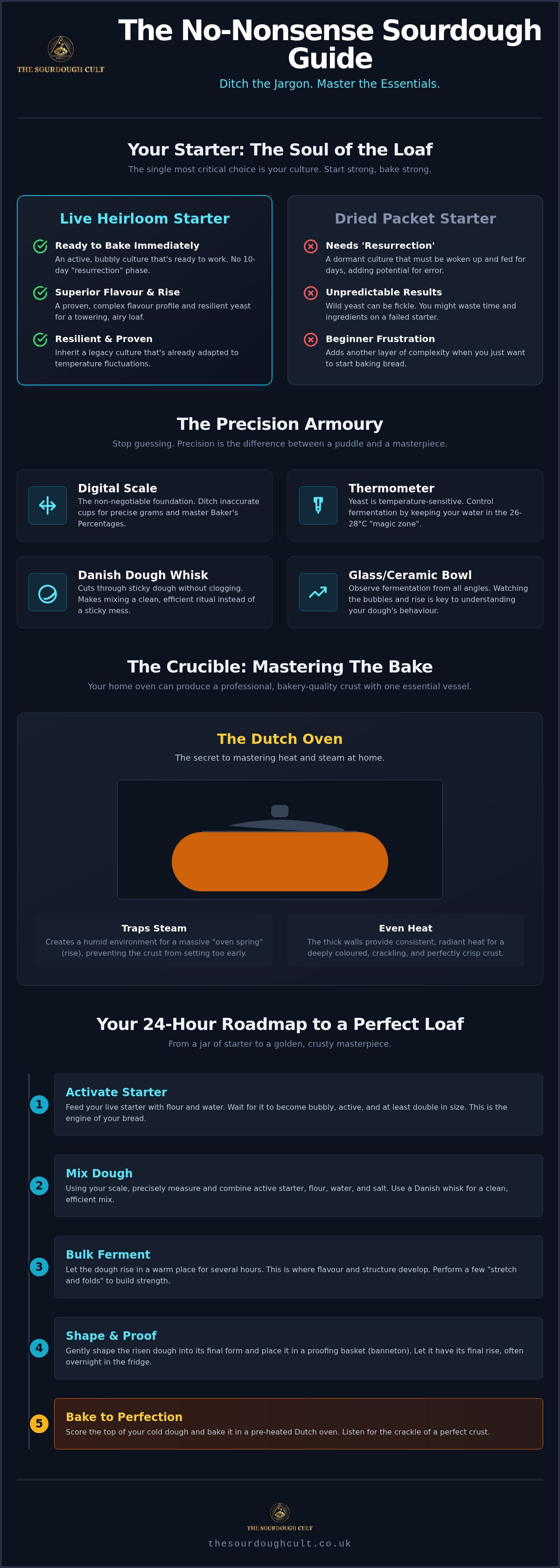
The Crucible: Mastering the Bake with the Right Vessel
The oven is the moment of truth. You've spent twenty four hours nurturing your culture and shaping your dough. Now, you enter the crucible. This stage is where the "magic" happens, but it relies on cold, hard physics. To get that professional, bakery-quality finish, you must control two things: heat and steam. Without them, your bread will be dull, tough, and flat. When you've gathered everything you need to make sourdough, the vessel you choose for the bake is your most important hardware decision. It is the difference between a hobbyist's loaf and an artisan's masterpiece.
Trapping moisture is the secret to a thin, crispy crust. In a professional bakery, ovens inject steam at the start of the bake. At home, you have to get creative. Steam keeps the surface of the dough supple. It allows the bread to expand fully before the crust sets. If the surface dries out too quickly, the expansion is stunted. You end up with a dense crumb and a thick, leathery exterior. Beyond the vessel, don't overlook the unsung heroes. Parchment paper ensures your loaf doesn't bond to the pot. High-quality, heat-resistant gloves are essential. You're dealing with scorching temperatures. Safety isn't optional.
Why the Dutch Oven Wins
Cast iron is the favourite material for consistent results. It is heavy. It is reliable. It doesn't flinch when the temperature rises. A Dutch oven acts as a "mini-bakery" inside your home oven. It provides incredible heat retention, radiating energy into the dough from all sides. Most importantly, the lid mimics a professional steam-injection system. It traps the water evaporating from the dough itself, creating a humid micro-climate. Pre-heating is mandatory. Give your vessel at least 45 minutes at full heat. You want a scorching hearth, not a lukewarm bowl. This thermal shock is what triggers the spectacular "oven spring" every baker craves.
Managing the Heat
Ignore the "cold start" myths. Sourdough thrives on the reality of a scorching hearth. You want that initial blast of energy to wake up the yeast for one final, explosive growth spurt. But how do you know when it's truly finished? Don't rely on the "thump" test. It's subjective. It's unreliable. Use your digital thermometer to check for a perfect internal temperature of 98°C. This ensures the crumb is fully set and not gummy. Mastering this final stage requires the right gear and the right mindset. Our flagship collection, The 1%: The All Inclusive Sourdough Kit, is designed to prepare you for this exact moment, providing everything you need to make sourdough with total authority.
Your Initiation: Putting Everything Together
The theory ends here. Your journey begins. The first twenty four hours with your new kit are a rite of passage. You aren't just following a recipe anymore. You're learning to read the dough. You're feeling the tension. You're smelling the fermentation. It’s a transition from being a student to becoming an initiate. This guide has provided everything you need to make sourdough, but the real wisdom comes from the flour on your hands. Don't worry about perfection. Your first loaf is a milestone, not a final exam. Even a flat loaf tastes better than shop bought bread. It's about the process. It's about the ritual.
Most beginners fail because they treat sourdough like a chemistry experiment. They panic over minutes and grams. We want you to move beyond that. Use the digital guide included in "The Initiation" to navigate the common pitfalls. It’s designed to keep you on track without the elitist fluff found on most blogs. We've stripped away the nonsense. We've kept the soul. You're joining a community that values results over jargon. Welcome to the movement.
The First Feed
Your "Peace of Mind" starter is a living legacy, but it needs a wake up call. This is the first ritualistic act of your bakery. Waking up an active culture is simpler than starting from scratch. You aren't fighting against nature; you're partnering with it. For a deep dive into the mechanics of this process, consult our Sourdough Starter Kit with Instructions: The Beginner’s Guide to Artisan Baking. Remember that your choice of grain matters. The quality of your input determines the strength of your output. Check the Best Flour for Sourdough Starter UK to ensure your mother sponge has the best possible fuel for the fire.
The "Everything" Checklist
Before you begin the fire, ensure your armory is complete. You don't want to be hunting for a tool mid-mix. Here is your final checklist for success:
- Starter: Active, bubbly, and ready to work.
- Scale: Zeroed and precise.
- Whisk: Clean and stainless.
- Bowl: Glass or ceramic for clear observation.
- Banneton: Seasoned and dry.
- Lame: Sharp and surgical.
- Heat: A pre-heated crucible.
Searching for these items individually is a chore. It's an invitation for distraction. "The 1%" is the only kit that truly provides everything you need to make sourdough in one definitive package. It removes the friction. It guarantees the gear. Join the Cult and secure your All-Inclusive Sourdough Kit today. The oven is waiting.
Claim Your Place at the Hearth
You've moved past the noise and the conflicting blogs. You now understand that sourdough isn't about luck. It's about a living legacy, a precise armory, and the courage to begin. We've covered the soul of the loaf, the tools that remove the guesswork, and the science of the bake. This guide provides everything you need to make sourdough without wasting time on poor-quality kits or dead cultures. Success is now a matter of action, not theory.
Every Initiation kit comes with our active live culture and expert digital guides to ensure your success. We offer UK-wide shipping on all artisan kits, bringing the Cheshire tradition directly to your kitchen. Stop overcomplicating the process and start trusting the ritual. Order The 1%: The All Inclusive Sourdough Kit and start your journey today. Your first golden loaf is a rite of passage you've already earned. Don't overthink it. Just bake.
Frequently Asked Questions
Is it cheaper to make your own sourdough starter or buy a kit?
Buying a kit is an investment in success rather than a gamble on chance. Making your own costs pennies in flour but often results in weeks of failed loaves and wasted ingredients. A kit provides a proven, active culture that removes the ten day failure window entirely. When you consider the cost of premium flour wasted on a weak wild starter, a kit like The Fresh Start(er) pays for itself by guaranteeing results.
Can I make sourdough without a Dutch oven?
You can, but you must work harder to manage steam. You might use a heavy baking stone combined with a tray of boiling water at the bottom of the oven. However, these methods are less consistent at trapping moisture. A Dutch oven remains the gold standard because it creates a perfectly closed environment. It is the most reliable way to secure everything you need to make sourdough with a thin, crispy crust.
What is the most important tool for a sourdough beginner?
A digital scale is the single most important tool in your armory. Sourdough is a game of ratios, not volumes. Measuring by cups is far too inaccurate; a tiny difference in hydration can ruin your dough structure. Without a scale, you are just guessing. If you want to master the artisan ritual, precision is your only path. It turns a messy experiment into a repeatable process that yields professional results every time.
Do I really need a digital scale for bread making?
You absolutely need one if you want consistent results. Flour density changes based on how it is packed or the humidity in your British kitchen. A digital scale removes these variables completely. It allows you to follow Baker’s Percentages accurately, which is the secret to understanding how your dough behaves. Don't waste your time with spoons and cups. Invest in a scale and start baking with the authority of a professional artisan.
How long does a live sourdough starter last?
A live starter can last forever if you feed it regularly. It is a biological legacy that grows stronger with age. Some heirloom cultures are over a hundred years old. If you keep it in the fridge, it only needs feeding once a week. If you leave it on the counter, feed it daily. It is a resilient, self-perpetuating engine. Our Cheshire starter is a living testament to this incredible longevity and biological strength.
What is a Danish dough whisk and why is it better than a spoon?
A Danish dough whisk features three stainless steel loops designed to cut through thick, sticky dough without clogging. Standard spoons are clumsy; the dough clings to them like glue, making mixing a nightmare. The whisk aerates the flour and water efficiently whilst keeping your hands cleaner for longer. It is a functional, pragmatic tool that simplifies the messy initial stages. It is the essential centrepiece of any serious beginner's precision armory.
Can I use normal bread flour for my starter?
You can, but high protein strong white bread flour or wholemeal flour is better for long term health. These flours provide more fuel for the wild yeast and bacteria to thrive. Avoid bleached or low protein cake flours as they lack the nutrients required to maintain a vigorous culture. Choosing the right flour is a foundational part of gathering everything you need to make sourdough that rises and tastes complex.
Why did my sourdough loaf not rise?
The most common reason is an inactive or weak starter. If your culture isn't bubbly and doubled in size before mixing, it won't have the strength to lift the heavy dough. Other factors include under-proofing or using water that is too cold, which slows fermentation to a crawl. Ensure your mother sponge is peak active and your kitchen temperature is stable. Sourdough requires patience and a lively, proven culture to succeed.


