

You've probably stood at a small kitchen counter, flour on the tea towel, a hot Dutch oven on the hob, and a loaf that looked good until the crust cracked sideways instead of opening where you wanted. The bake might still taste fine, but the cut told the story, the dough found its own weak point, and the neat ear you hoped for never really appeared. That's where a bread scoring blade stops being a niche gadget and starts being a decision about control, safety, and the look of the finished loaf.
Table of Contents
- The Loaf That Wouldn't Stop Splitting
- What a Bread Scoring Blade Actually Does
- Straight, Curved, Serrated, and Razor Blades Compared
- How to Score Sourdough with a Lame
- Is a Bread Scoring Blade Worth It for Occasional Bakers
- Choosing the Right Lame for Your Baking Style
- Storing, Replacing, and Keeping Blades Safe at Home
- Building a Consistent Scoring Routine
The Loaf That Wouldn't Stop Splitting
The first time this goes wrong, it usually feels unfair. You shaped the boule carefully, proofed it as best you could, then lifted the lid and saw a jagged split racing across the side instead of a tidy expansion along the top. The crumb still looks promising, but the crust has that deflated, slightly disappointed look that makes you stare at the loaf for a bit longer than necessary.
A lot of new bakers blame the dough, when the actual issue is often the score. A loaf wants a planned opening, because the cut gives the dough a weak line to expand along during oven spring. If that line is too shallow, too flat, or made with a blunt tool, the pressure pushes somewhere else.
That's why scoring is a decision, not an afterthought. You're choosing where the loaf can burst, how cleanly it can open, and how much control you want over the final shape. On a small UK counter, that choice usually comes down to blade type, blade angle, how deep you cut, and whether the tool is safe enough to live in a drawer you open every day.
If you're baking in a Dutch oven, the whole setup matters too, because the lid traps steam and gives the cut time to expand before the crust sets. A good Dutch oven makes scoring more visible, not less, which is why the blade deserves some attention before the loaf goes in. Dutch oven baking basics are useful context, but the scoring decision is still the bit that determines whether the loaf opens with intention or just gives up sideways.
What a Bread Scoring Blade Actually Does
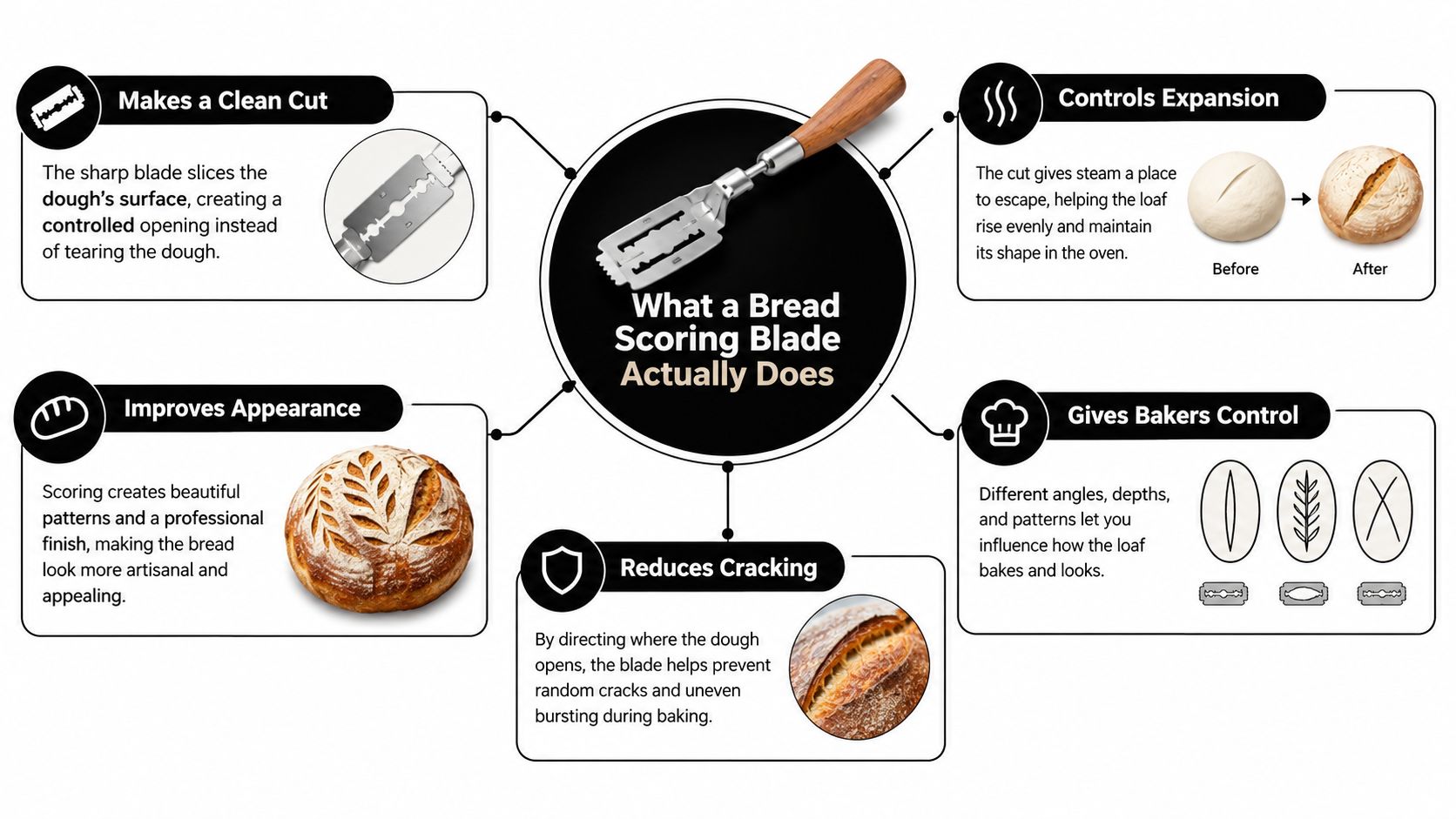
A bread scoring blade, often called a lame, makes a fast, shallow cut in proofed dough just before baking. The point isn't decoration for its own sake. The point is to guide the loaf so it expands along the cut during oven spring instead of tearing open wherever the crust happens to be weakest. UK baking guidance describes the function plainly, and the useful scoring depth is usually around 0.5 to 1.0 cm when the cut needs to release the dough cleanly Bread lame guidance.
Why the cut matters
Think of the dough skin as a stretched surface. As heat hits the loaf, trapped gases expand, the crust firms up, and pressure builds inside. A deliberate score gives that pressure somewhere to go, which is why the cut shape influences ear formation, oven spring, and the final crust line. A kitchen knife can sometimes do the job, but a purpose-made lame is built for speed and control on a soft, proofed surface.
Practical rule: a clean score should look almost effortless. If you're pressing hard or sawing back and forth, the blade is probably doing too much work for you.
The UK context matters more than many realise. The Bread and Flour Regulations 1998 created the current national legal framework for bread composition and labelling across Great Britain and Northern Ireland, and that framework has remained stable through later amendments, including the Bread and Flour (Amendment) (England) Regulations 2024 Bread and Flour Regulations 1998. That continuity doesn't tell you how to score a loaf, but it does explain why breadmaking here sits inside a long, standardised tradition rather than a passing trend.
Straight, Curved, Serrated, and Razor Blades Compared
Different blade shapes solve different problems. If you mainly want a neat functional score, the blade profile you choose changes how easily you get there, how much control you keep, and how likely the loaf is to open with a proper ear rather than a messy crack. The right answer depends less on brand and more on your loaf shape, your confidence, and how often you want to replace the blade.
The four common profiles
Straight blades suit long, clean cuts. They're a good fit for batards and baguettes, but they do ask for a steadier hand because the blade wants to travel exactly where you point it. Curved blades are common in UK retail because the arc encourages the flap that helps form an ear on round loaves. Serrated blades grip the dough surface a little more, which can help on tight or highly hydrated dough, but the cut often looks rougher and the ear tends to be less dramatic. Razor-style blades, including snap-off utility blades, are extremely sharp and good for thin or decorative scoring, though they increase handling risk and don't last as long in normal home use.
| Bread Scoring Blade Profiles Compared | Ear Quality | Control | Beginner Suitability | Best For |
|---|---|---|---|---|
| Straight blade | Clean, but depends on hand angle | High if your stroke is steady | Moderate | Batards, baguettes, long slashes |
| Curved blade | Often strongest on round loaves | Good once you learn the arc | High | Boules, classic ear formation |
| Serrated blade | More textured, less defined | Can resist slipping, but less precise | Moderate | Tight dough, firmer surfaces |
| Razor-style blade | Very sharp, good for fine detail | High cutting power, less forgiving | Low to moderate | Decorative cuts, thin scoring |
The simplest choice for most first-time bakers is a curved lame, because it balances control and ear formation well on a standard sourdough boule. If you mainly bake longer loaves, a straight blade can feel more natural. If you're still nervous about scoring, the safest blade is the one you can hold confidently without fighting it.
How to Score Sourdough with a Lame
Timing comes before technique. A loaf should feel puffy, hold some tension, and spring back slowly when you press it lightly with a finger. If it rebounds instantly, it usually needs more proofing; if it doesn't recover at all, it may be past the point where scoring can help much.
The stroke that works
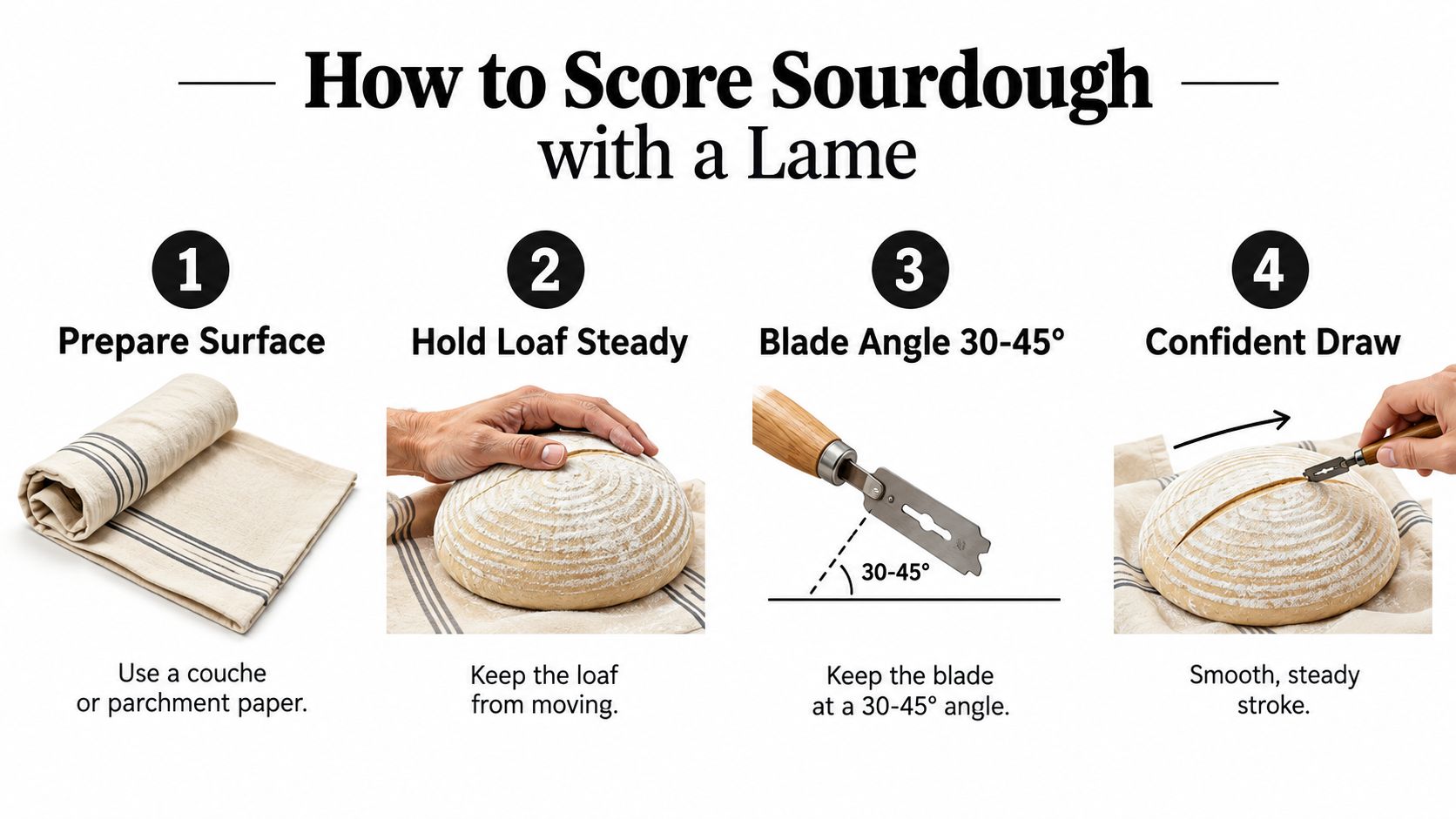
Set the loaf on parchment or a dusted couche, then hold it firmly enough that it doesn't shift. Keep the blade at roughly 30 to 45 degrees to the dough surface for the main expansion cut, not flat, because the angled cut helps create the flap that becomes an ear Sourdough scoring guidance. Aim for a single decisive stroke rather than a sawing motion, and keep the depth around 0.5 to 1.0 cm if you want the crust to open cleanly.
For a boule, a tight arc or one central slash usually gives the loaf room to bloom. For a batard, 3 to 5 diagonal overlapping slashes can help the loaf open evenly along its length. The exact pattern matters less than making the cut in one confident movement.
The main mistakes are easy to recognise. Too much flour on the surface makes the blade skip. A shallow cut can close over and leave no ear. Dragging the blade tears the gluten skin and makes the loaf look ragged instead of open.
A sharp lame should feel like it's parting the dough, not scraping it.
If your starter routine still feels shaky, that's normal. A reliable scoring hand tends to come after you've made feeding and proofing more predictable, and starter care habits are part of that stability.
Is a Bread Scoring Blade Worth It for Occasional Bakers
For an occasional UK baker, the question isn't whether a lame is stylish. It's whether it saves enough frustration to justify another tool in the drawer. The short answer is yes for bakers who care about the finish, and maybe not if you only bake very rarely and are happy with a rougher cut.
Cost against the result
UK trend data suggests sourdough is still pulling in new bakers, with one industry source citing 46% year-on-year growth and another forecasting 33% growth in 2026 UK bakery trends. That doesn't mean everyone needs a premium tool, but it does explain why first-time buyers want clearer buying rules than “just use a sharp knife”.
A basic lame is usually cheaper than the mistakes it helps avoid. A kitchen knife or serrated knife is already in the drawer, but it's less likely to give a clean ear and more likely to produce a jagged cut. A razor blade in a handle can work well for a low-cost setup, though the handling risk rises if the tool lives loose in a drawer or gets used carelessly.
| Cost and outcome comparison, lame vs kitchen alternatives for occasional UK bakers | Approx. Cost (£) | Blades Per Loaf | Ear Quality | Injury Risk |
|---|---|---|---|---|
| Basic bread scoring blade | Low to moderate | One short stroke per loaf | Good to very good | Lower when stored properly |
| Sharp kitchen knife | Already owned | One or more passes | Mixed | Moderate |
| Serrated knife | Already owned | One or more passes | Often jagged | Moderate |
| Razor-style handle | Low to moderate | One short stroke per loaf | Good, especially for fine cuts | Higher if mishandled |
If you bake once in a while, consistency is the key. A proper lame gives you cleaner cuts, a better chance of oven spring, and less chance of the dough tearing in the wrong place. If you bake less than monthly, a simple handle and replaceable blade still makes sense, because the payoff is control, not gadgetry.
Choosing the Right Lame for Your Baking Style
The easiest way to choose is to match the tool to your loaf and your confidence, not to chase the fanciest handle. A beginner who wants fewer surprises needs a different tool from someone who bakes every week and already knows how their dough behaves.
A practical match-up
| Which lame matches your baking style | User Type | Recommended Blade | Holding Angle | Best For |
|---|---|---|---|---|
| Which lame matches your baking style | Beginner | Curved disposable razor lame with a moulded plastic handle | 30 to 45 degrees | Safer first cuts, low-cost learning |
| Which lame matches your baking style | Intermediate weekly baker | Straight or curved replaceable-blade lame in wood | 30 to 45 degrees | Steady scoring, repeatable ears |
| Which lame matches your baking style | Gift buyer | Wooden-handled set with replacement pack | 30 to 45 degrees | Presentable kit, simple storage |
| Which lame matches your baking style | Instructor or workshop host | Slim balanced handle with snap-off blades | 30 to 45 degrees | Multiple users, quick blade swaps |
What matters most in the hand
A curved blade is usually the best first buy if you mainly bake boules. A straight blade makes more sense once you know you want longer, cleaner slashes. Wooden handles feel pleasant and stable, but the handle itself won't improve a weak stroke. What improves the result is matching the blade to the loaf and using it the same way each time.
A gift kit can be lovely, but presentation shouldn't be confused with performance. If you're buying for yourself, comfort and safe storage matter more than decorative packaging. The best lame is the one you'll use calmly, without hesitation, when the loaf is ready.
Storing, Replacing, and Keeping Blades Safe at Home
The safety question is where many guides go quiet, especially for small UK kitchens. That matters because a scoring blade is sharp enough to do its job with very little force, and sharp tools need a proper home the moment they leave your hand.
Simple storage that doesn't become a chore
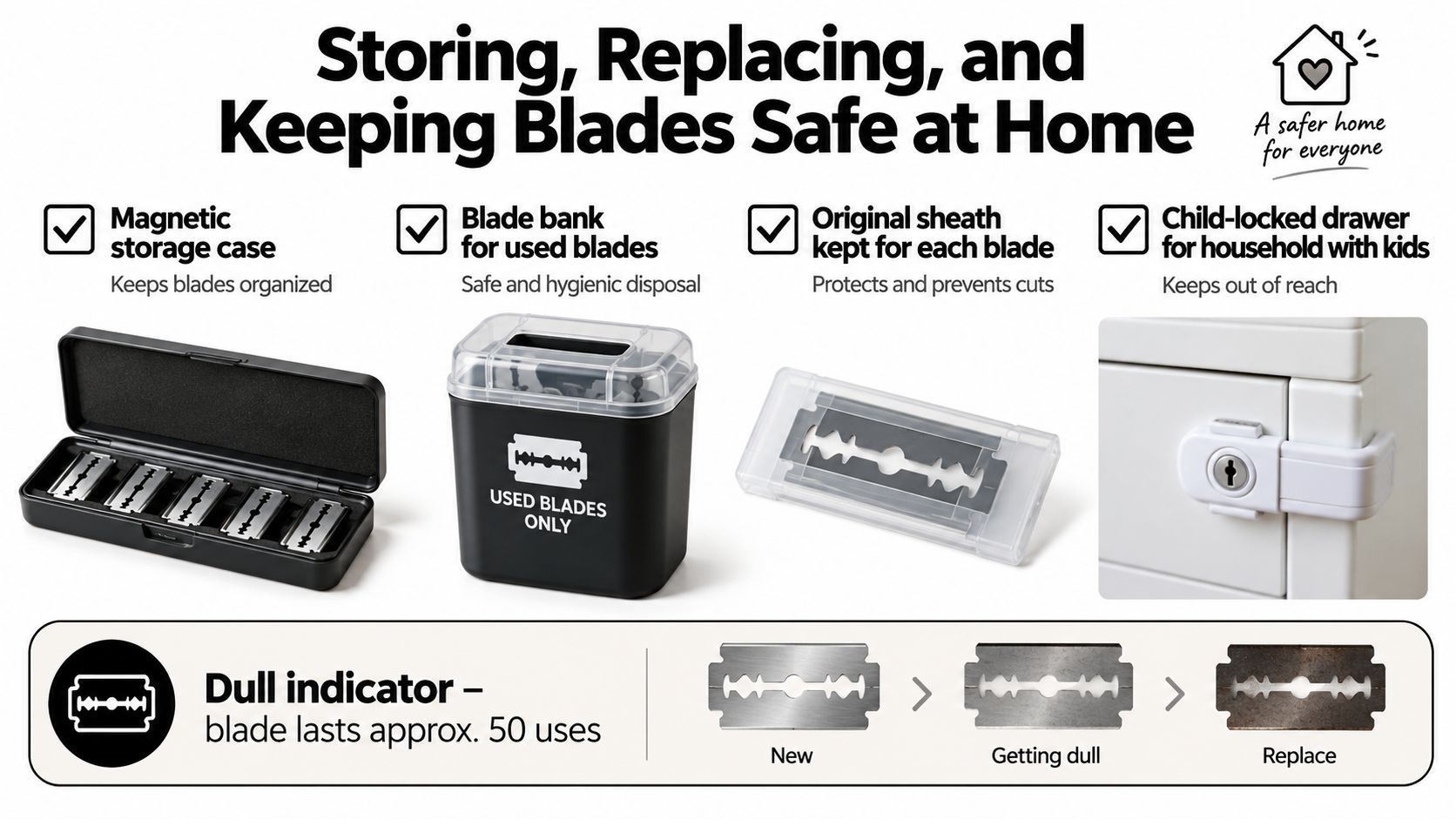
Keep the blade in its guard or sheath when it's not in use. A magnetic case, blade bank, or original sleeve all work better than leaving a loaded lame on a tea towel, where it can vanish under flour and get picked up by mistake. If children are in the house, a child-locked drawer is the low-fuss option that many can stick to.
Replacement rhythm matters too. In normal sourdough use, one blade tends to stay reliable for roughly 8 to 12 scoring sessions before ear quality drops, and it may last longer on enriched dough. When the cut starts to drag instead of slice, the blade is telling you it's time to change it. A dull edge tears the skin instead of parting it, which usually shows up as flatter opening and more ragged crust lines.
Practical rule: if the blade catches, hesitates, or requires extra pressure, replace it before your next bake.
Disposal and handling
Used blades belong in a sharps container where possible, or wrapped thickly in tape before binning if you're dealing with a simple home setup. Cut away from your body, keep the tool loaded only when you're about to score, and don't set it down loose beside the flour jar. If you're sharing a kitchen, especially with children around, the safest routine is the one that removes the blade from circulation as soon as the loaf is in the oven.
For a fuller home-safety lens, bread lame storage and replacement advice is worth reading alongside your own kitchen habits. A clean cut starts with a sharp edge, but it also starts with not mishandling the tool before and after the bake.
Building a Consistent Scoring Routine
Consistency beats guesswork. A good routine turns scoring from a nervous last-minute move into a predictable part of the bake, which is exactly what you want when the oven is hot and the dough is ready.
A simple loop that works
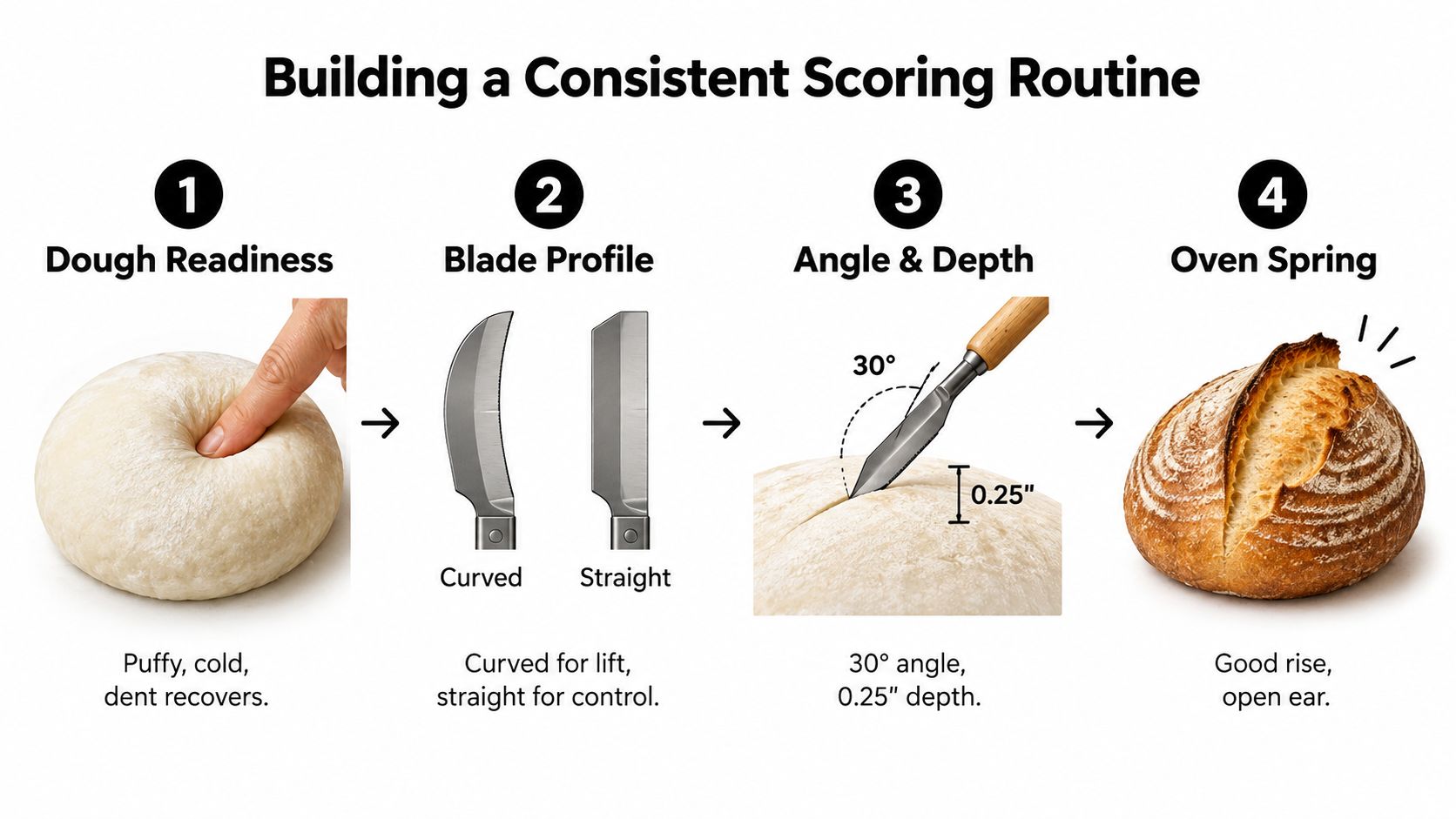
First, check the dough readiness. A cold, puffy loaf that recovers slowly from a finger dent is usually a better candidate than one that springs straight back. Second, pick the blade profile that fits the loaf shape, curved for many boules, straight for long cuts, and razor-style only if you want that level of sharpness and detail.
Third, make the cut at 30 to 45 degrees and around 0.5 to 1.0 cm deep. Fourth, note what happened, because the next bake is where the lesson becomes useful. If the ear is weak, replace the blade or change the angle. If the loaf opens too aggressively, shorten the stroke or reduce the depth.
The habit becomes easier when you treat your scraper and scoring tools as a small system instead of loose objects in a drawer. A tidy bench, a sharp blade, and a steady hand do more for a loaf than a pile of extra gadgets. Dough scraper and handling basics fit neatly into that same workflow, because shaping and scoring are really part of the same control sequence.
Protect the cut, protect the dough, protect your fingers.
If you want practical sourdough guidance that keeps the kit simple and the learning curve manageable, visit The Sourdough Cult for starter supplies, clear instructions, and baking tools that suit real UK home kitchens. It's a useful place to start if you're choosing your first scoring blade and want the rest of your sourdough setup to feel just as straightforward.


