

You've mixed the dough, watched the starter bubble, and slid a proud-looking loaf into the oven. Then the door opens, the loaf spreads instead of springing, and the crust stays pale where you wanted that deep, crackly finish. That moment usually isn't about bad flour or a weak starter, it's about the baking environment, which is why dutch ovens for bread baking have become such a useful home tool.
A covered cast-iron pot acts like a tiny bakery oven inside your regular oven. It holds heat close to the dough, traps moisture that would otherwise escape, and gives the loaf a better chance to expand before the crust sets. The old idea isn't new either, since the Council for Object and Art of Man notes that bread baking in Britain moved from brick ovens to enclosed metal cooking vessels over time, and that enclosed-heat logic sits very close to the way modern bread baking works today (COAM history reference).
That matters if you're trying to make sourdough at home in a UK oven that runs dry and loses heat when the door opens. The good news is that you don't need to treat the pot like a mystery gadget. If you understand what the vessel is doing, you can choose the right material, the right size, and the right bake method with much more confidence. For a wider starter-and-tools overview, the practical guide from The Sourdough Cult's initiation article sits in the same beginner-friendly space as this one.
Table of Contents
- Introduction Why Your Sourdough Needs Enclosed Heat
- How a Dutch Oven Transforms Sourdough Results
- Choosing the Right Material and Finish
- Finding the Ideal Size and Shape for Your Loaf
- How to Bake Sourdough in a Dutch Oven for Consistent Results
- Dutch Oven Versus Bread Cloche and Other Alternatives
- Conclusion Your Next Loaf Starts With the Right Setup
Introduction Why Your Sourdough Needs Enclosed Heat
The most frustrating sourdough loaf is often the one that looked ready before it went in. The dough was well fermented, the shaping felt neat, and the oven was hot, but the finished loaf still came out flatter than you expected and lighter in colour than the bakery version in your head. That's usually the point where bakers start changing flour or fermentation, when the issue is often the baking vessel.
A Dutch oven fixes a specific home-oven problem. Your kitchen oven leaks heat the moment you open the door, and it also dries the surface of the dough quickly. A covered cast-iron pot changes that environment by creating a tight little chamber around the loaf, so the bread bakes in its own steam and stays protected long enough to expand properly.
Why the pot matters before the crust sets
Think of the loaf as needing a short window where the outside stays flexible while the inside pushes upward. If the crust firms too soon, that push stops early and the loaf looks dense or lopsided. Enclosed heat gives you more control over that early stage, which is why people keep coming back to the same basic setup for sourdough, even when they own plenty of other bakeware.
Practical rule: if a loaf is strong in the proofing basket but weak in the oven, the problem often starts with heat loss and moisture loss, not with the dough itself.
The shape of the vessel, the weight of the lid, and how well the base holds temperature all affect the result. That is why bread bakers talk about the Dutch oven less like a container and more like a small thermal system. Once that idea clicks, the rest of the buying and baking decisions become much easier.
How a Dutch Oven Transforms Sourdough Results
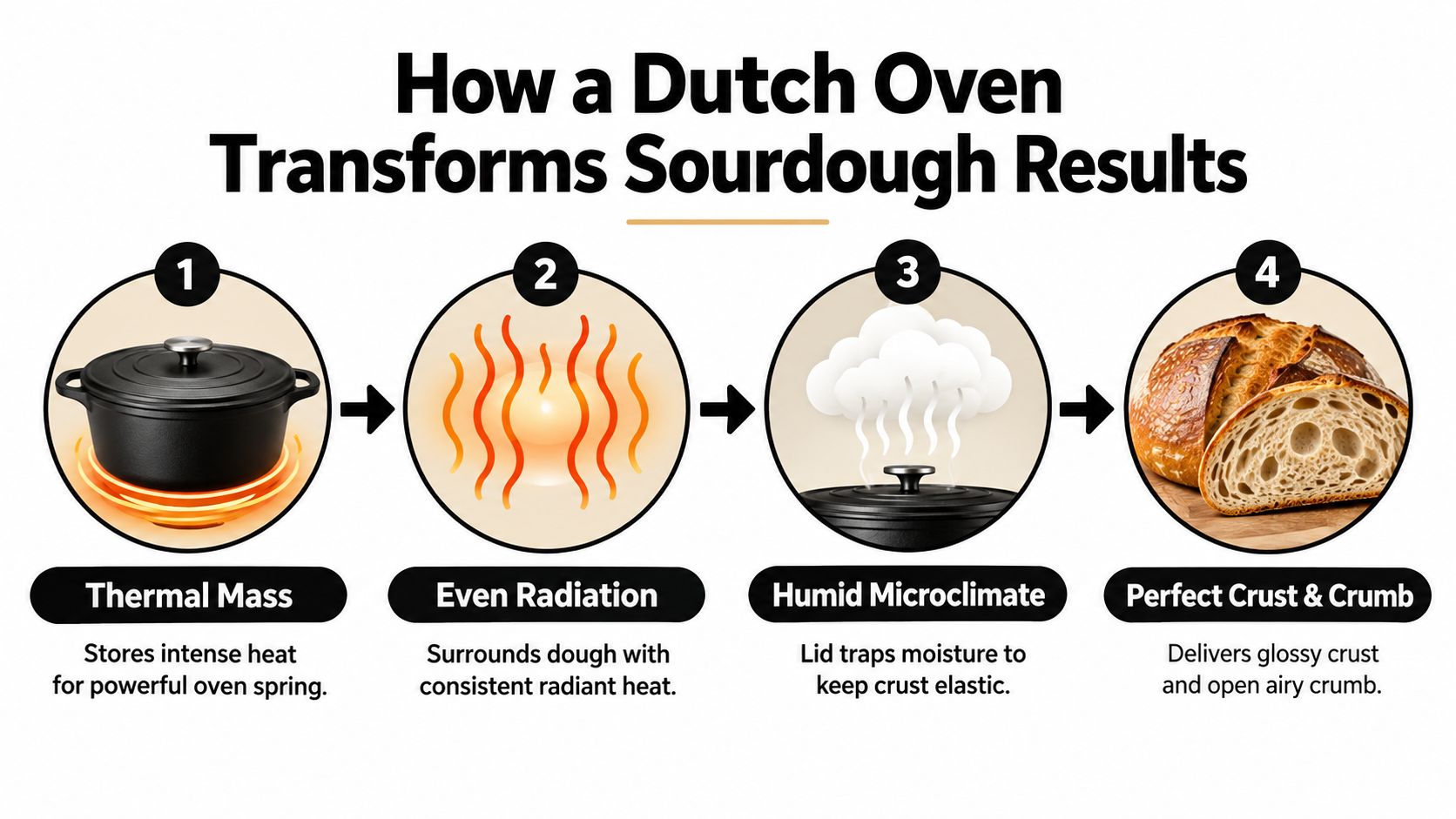
A Dutch oven works because it does three jobs at once. It stores heat, spreads that heat evenly around the dough, and traps moisture released by the loaf itself. That combination creates the sort of humid, high-heat environment a bakery deck oven gives to commercial bread, just on a small domestic scale.
The simplest way to picture it is a sauna inside a brick house. The bricks hold warmth, the enclosed room keeps the heat from escaping quickly, and the moisture stays inside instead of drying out the air. Your sourdough behaves better in that kind of space because the crust remains elastic long enough for the loaf to expand before it hardens.
Thermal mass and oven spring
Cast iron matters because it has serious thermal mass. Once it has absorbed heat during preheating, it gives that heat back to the loaf more steadily than a thin tray or a lightweight tin. In practical terms, that means the dough gets a strong heat pulse the moment it goes in, which helps drive oven spring before the crust has time to lock.
If the pot is under-preheated, that first push weakens. Cold dough steals heat fast, and the vessel can't replace it quickly enough, so the early rise drops off. The loaf still bakes, but the result is usually less dramatic and less open.
Steam and surface control
The lid does the second and third jobs. It traps the steam that comes off the dough and keeps the air around the loaf humid, while also reflecting heat back down into the pot. That humid microclimate slows crust formation, which gives the loaf time to expand, and then the later uncovered phase lets the surface dry and brown properly.
The lid is not just a cover, it is part of the heating system.
That is the core reason home bakers get better results with covered baking. The setup protects the loaf during the most delicate part of the bake, then lets it finish with a dry, crackly exterior once the structure has set.
Choosing the Right Material and Finish
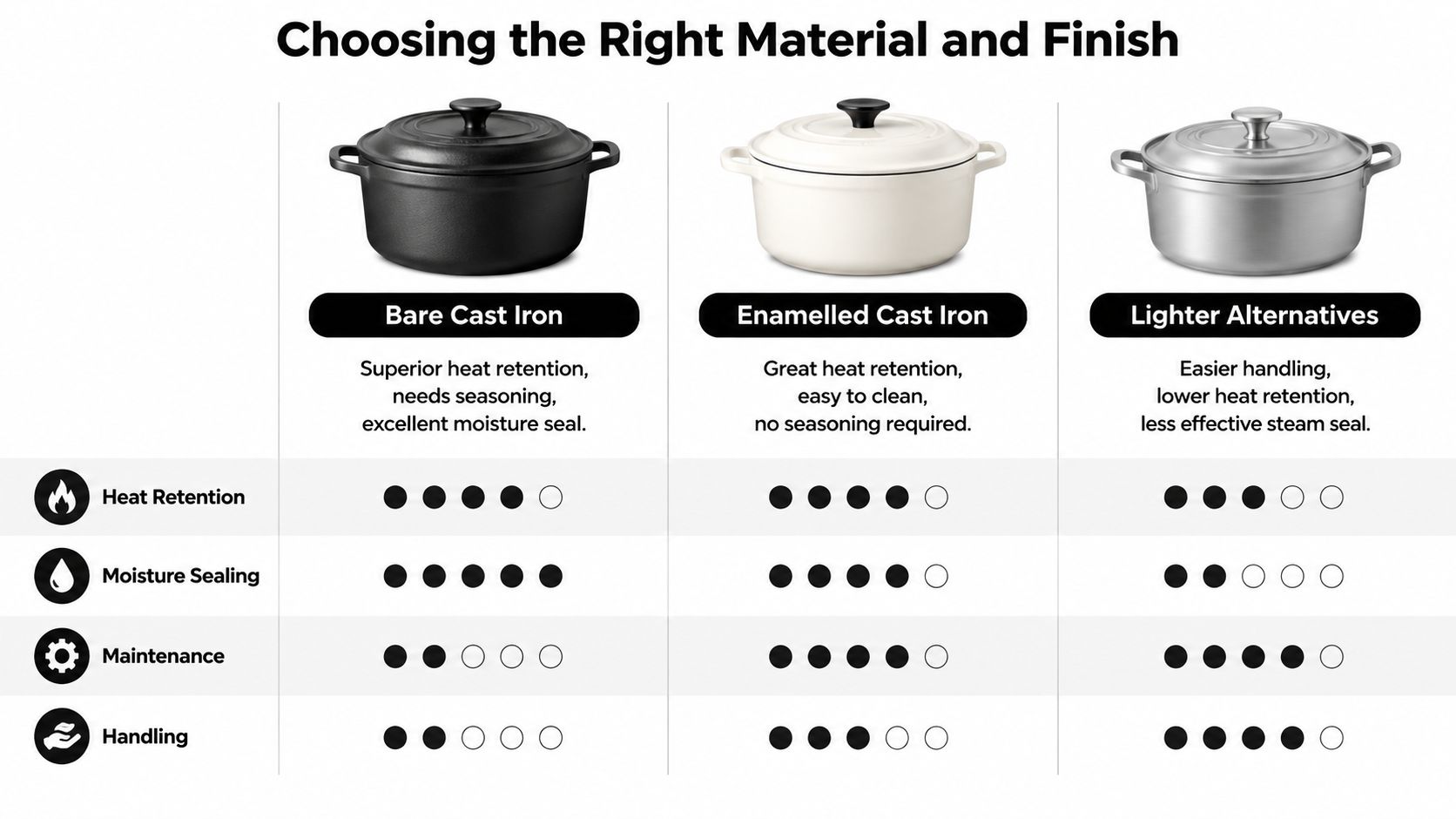
A Dutch oven works like a small heat chamber. The material and finish decide how well it stores heat, how evenly it releases that heat, and how much attention it needs between bakes. That matters because bread responds to the pot as much as to the oven itself.
Bare cast iron versus enamelled cast iron
Bare cast iron holds heat very well and gives a strong steam seal when the lid fits tightly. It does ask for more care, because seasoning and cleaning affect how well it keeps performing. Enamelled cast iron keeps the same heavy heat storage, but it is easier to clean and does not need seasoning in the same way.
For bread, both can work well because both hold heat and create an enclosed baking chamber. UK guidance from Le Creuset bread baking guide describes enamelled cast iron as giving steady heat inside the pot and trapping steam to support oven spring and a crisp crust. That makes enamelled cast iron a practical choice if you want strong results with less upkeep.
Lighter alternatives and their limits
Lighter casseroles and generic lidded pots are easier to lift, which helps if your oven shelf sits awkwardly or the weight of cast iron is a strain. The trade-off is that they usually cool faster after the dough goes in. That weaker heat reserve can reduce the early push that sourdough needs before the crust sets.
They can still bake bread. They are just less convincing as a steam chamber.
Use the heaviest pot you can handle safely. A pot that feels impressive but is awkward to lift will be used less often, and bread baking rewards regular use.
A generic casserole can be enough if you bake now and then and want one vessel for several jobs. A heavy enamelled cast-iron pot earns its place when you want more even heat and less fuss from bake to bake. The choice is not brand prestige. It is whether the pot can act as a steady thermal system in your kitchen, preheat well, hold steam, and fit the way you bake.
Finding the Ideal Size and Shape for Your Loaf
Geometry changes the bake more than many people expect. A pot can be made of the right material and still give disappointing results if it's too wide, too shallow, or the wrong shape for the loaf you proofed.
Round pots and oval pots serve different loaves
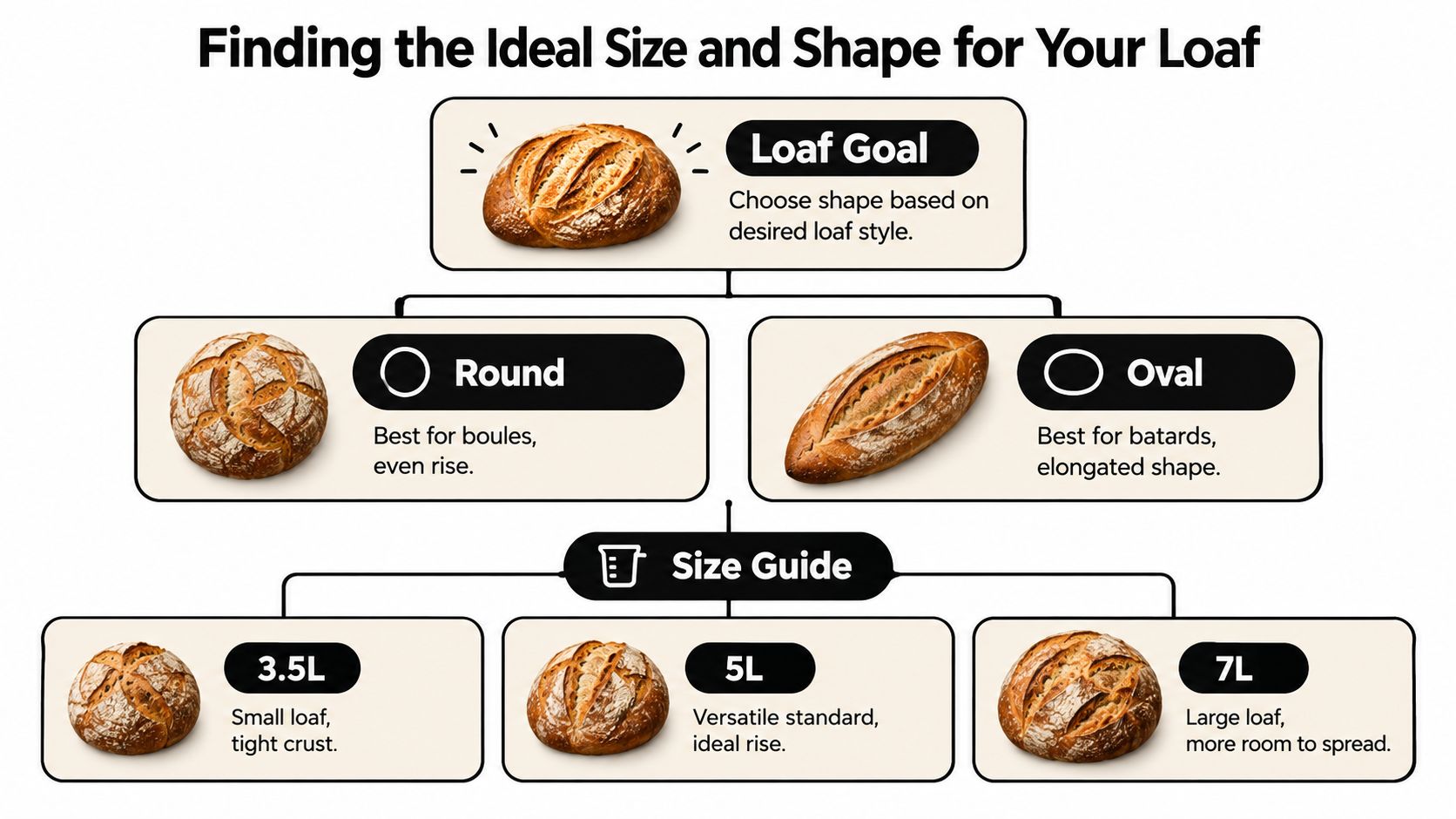
A round Dutch oven suits boules because it supports a rounded loaf shape and lets the dough rise evenly. An oval vessel suits batards because it matches the longer profile and gives the dough room to expand along its length. If the vessel shape fights the loaf shape, the dough has less predictable room to spring.
The UK product guidance most useful for home bakers often centres on a 5.7-litre round cast-iron Dutch oven as a good fit for a 1kg boule, with the preheated iron body absorbing oven heat and the lid trapping steam for an even rise and crackly crust (Chefarone Dutch oven guidance). That scale matters because a 1kg loaf is a common domestic benchmark, and a pot that size usually leaves enough headroom for oven spring without making the loaf feel lost inside.
Why too much space or too little space both cause trouble
Too much internal space spreads heat and steam too thinly, so the loaf doesn't get the same concentrated effect. Too little space can crowd the dough, limit expansion, and make sticking more likely. The ideal pot gives the dough breathing room without turning the chamber into an empty cavern.
A useful mental check is simple. If your dough routinely rises close to the lid before baking, the vessel is probably too tight for comfortable oven spring. If the loaf sits low in a very broad pot, the enclosed environment may be weaker than it should be.
How to Bake Sourdough in a Dutch Oven for Consistent Results
Consistency starts with treating the bake as a sequence. Each stage has a job, and once you understand that job, you can adjust the method to suit your own oven without losing the pot's benefits.
Start with a thorough preheat
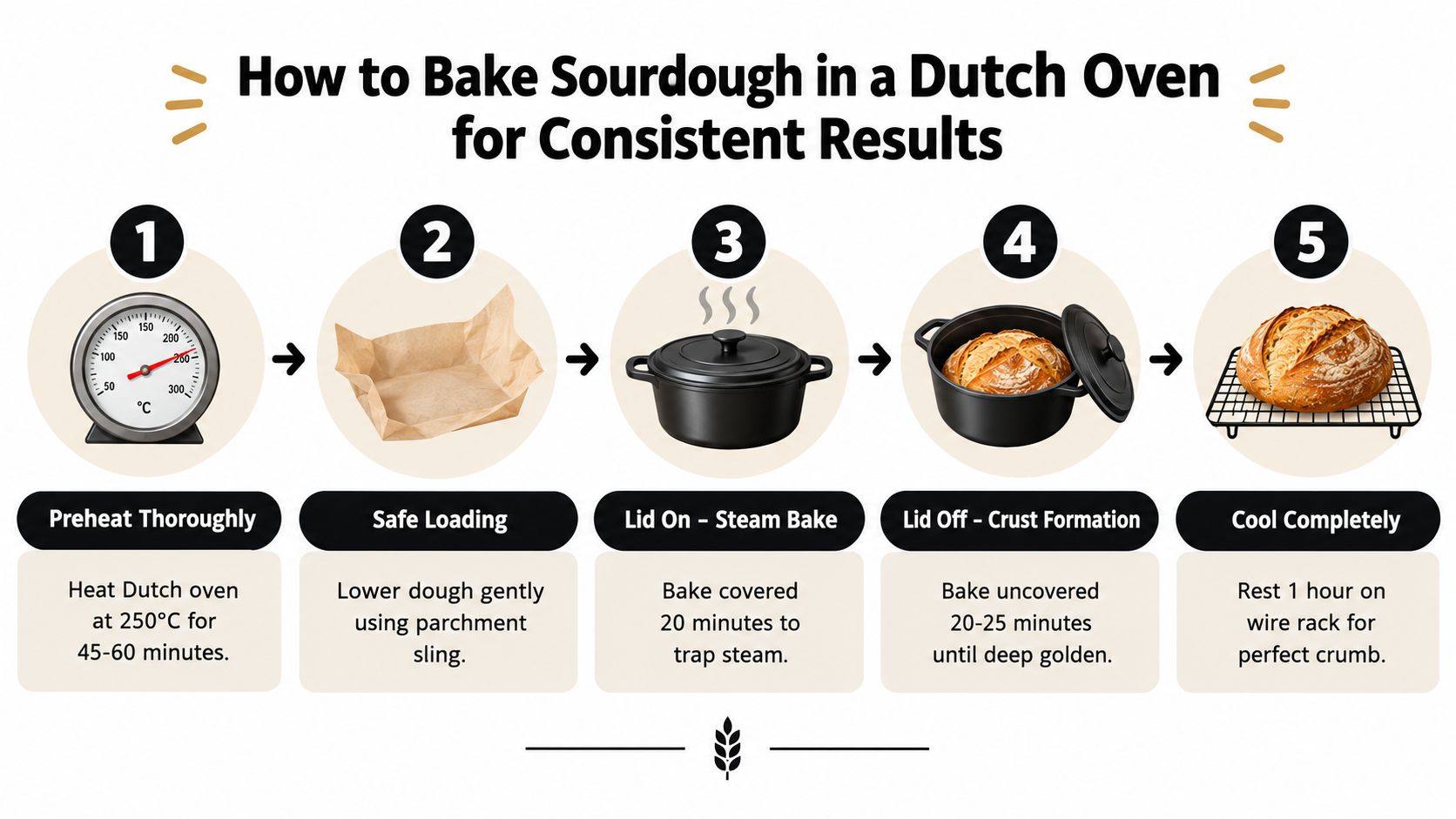
A heavy pot needs time in the oven so the base and walls store enough heat for the bake. Once the cold dough goes in, that stored heat acts like a warm tiled floor after a shower. It keeps radiating energy back into the loaf instead of letting the temperature drop too quickly.
UK cookware guidance from Gastrotools notes that enamelled cast-iron casseroles can withstand oven temperatures up to 290°C and hold heat better than most stock pots (Gastrotools casserole guidance). That matters because the pot is doing more than holding dough, it is acting as a small heat chamber. If the vessel goes in underheated, it will not give the loaf the sharp burst of heat that helps with oven spring.
A practical way to judge your setup is to match the pot to the loaf and the oven to the job. A round vessel around 24 cm gives a boule enough room to rise without feeling lost, while a hot, sturdy pot keeps the baking environment concentrated. A generic casserole can work well if it seals tightly and retains heat. A purpose-built bread oven earns its price when you bake often and want more predictable results from the same setup each time.
Load gently, then bake in two phases
A parchment sling makes loading simpler and helps protect the loaf shape. If you use one, lower the dough into the hot pot carefully, close the lid quickly, and let the covered stage do its work. The lid traps steam, which keeps the crust flexible while the loaf expands, then the uncovered stage sets colour and texture.
Practical rule: the lid-on stage protects rise, the lid-off stage builds crust.
You do not need to fixate on one exact minute count, because home ovens vary. A fully preheated pot, a quick and careful load, then a covered bake followed by an uncovered finish gives you a repeatable method that works better than placing dough straight on a tray.
For a simple handling aid that helps with the loading step, The Sourdough Cult's dough scraper and silicone guidance fits neatly into the same workflow.
Dutch Oven Versus Bread Cloche and Other Alternatives
A lot of UK bakers are really asking a value question, not a gear question. They want to know whether a covered cast-iron pot is enough, whether a purpose-built bread oven adds something real, or whether a simpler casserole can do the job at a lower cost.
| Feature | Dutch Oven | Bread Cloche | Lidded Casserole |
|---|---|---|---|
| Steam control | Strong, especially when preheated well | Strong, often designed specifically for bread | Good if the lid fits tightly |
| Heat stability | High thermal mass helps hold temperature | Often optimised for bread-focused heat delivery | Varies by make and wall thickness |
| Ease of use | Familiar and versatile | More specialised, sometimes easier for bread-only baking | Simple and widely available |
| Cleaning and care | Depends on finish, enamel is easier | Depends on finish and design | Usually straightforward |
| Best use case | Home bakers who want one pot for many tasks | Frequent bakers who want a bread-first tool | Bakers who want a lower-cost option |
A Dutch oven is part oven, part steam chamber. A bread cloche does the same job, but the shape is tuned for bread rather than general cooking. A lidded casserole can sit in the middle, provided the lid seals well and the walls hold heat without cooling too quickly.
Specialist UK product pages now market cast-iron bread ovens and cloches as purpose-built for bread, which tells you the category has moved beyond generic cookware. That matters because UK sourdough demand has been rising, with Circana data reported as showing sourdough up 56% year on year in the 12 weeks to 18 January 2025 (UK sourdough equipment guide). More first-time buyers are now weighing whether a bread-focused vessel is worth the space it takes up in a home kitchen.
When a generic casserole is enough
If you bake occasionally, a covered casserole that seals well and holds heat can perform very respectably. It still gives you the main advantage, a hot enclosed chamber that traps steam and protects the loaf while the crumb is expanding.
For many households, that is all they need. If the lid fits snugly and the base is heavy enough, the loaf sees a stable heat bath rather than a dry, airy oven cavity.
When a dedicated bread vessel earns its place
A dedicated bread cloche or bread oven starts to make sense when you bake often, want a shape made for bread, and care about repeatability. The premium is not only about appearance. It is about a vessel built to hold heat and steam in a way that suits bread, especially in an oven that does not behave like a bakery deck.
If you are weighing the spending question directly, start with your loaf shape and how often you bake. For a lidded alternative designed for bread, see the bread pan with lid guide for when a pan suits your loaf shape. Choose the pot that fits your routine, your loaf, and the amount of weight you are happy to handle, because a fancy vessel still helps no one if it stays in the cupboard.
Conclusion Your Next Loaf Starts With the Right Setup
A Dutch oven isn't just a pot with a lid. It's a small thermal system that stores heat, reflects it back at the dough, and traps moisture long enough for the loaf to finish its first essential burst of expansion. Once you see it that way, the buying decision becomes clearer, because you can judge the vessel by how well it manages heat and steam, not by how impressive it looks on a shelf.
The main choices are straightforward. Pick a material that holds heat reliably, choose a shape that matches your loaf, and preheat the pot properly so it can do its job the moment the dough goes in. If you do those three things well, the loaf has a much better chance of opening up, colouring evenly, and finishing with the crust you wanted.
A good next-bake checklist is simple. Check the fit, check the preheat, and check that your loaf has enough room to spring without crowding the lid. That's a more useful way to think about dutch ovens for bread baking than treating the pot as a generic accessory.
If you want straightforward sourdough support, from starter care to practical equipment guidance, visit The Sourdough Cult. Their live starter, beginner kits, and clear feeding guidance are built for home bakers who want fewer guesses and steadier results.


