

You've mixed flour and water, placed the jar beside the kettle, and promised yourself a loaf by the weekend. Then the starter rises overnight, climbs the sides of an old jam jar, and leaves you wondering whether it has doubled or just spread. In a cooler UK kitchen, that uncertainty can turn every feed into guesswork.
A sourdough starter jar isn't decorative equipment. It's the tool that shows fermentation, contains expansion, releases pressure, and makes feeding easier to repeat. Choose the wrong one and you'll deal with dried starter around the rim, overflowing culture, awkward scraping and wasted flour. Choose a sensible jar at the start and your routine becomes far more manageable.
Table of Contents
- Why Your Starter Jar Matters from Day One
- Glass, Ceramic or Plastic Jars for UK Bakers
- Choosing the Right Jar Size for Your Routine
- Rise Markings, Lids and Visibility Features
- Cleaning, Feeding and Storing Your Starter Jar
- Personalised Starter Jars as Practical Gifts
- Picking the Right Sourdough Starter Jar for You
Why Your Starter Jar Matters from Day One
A first-time UK baker often starts on a Tuesday evening, with a bag of flour propped against a cool kitchen wall and a random jam jar pulled from the cupboard. That jar may hold the culture for months, so its shape and closure will affect every feed before you've shaped a single loaf.
A narrow, tapered jar makes the starter slump upwards rather than rise in a clean column. A tight lid can trap carbon dioxide during active fermentation, while dark glass or a crowded pattern on the outside makes it hard to judge whether the culture has expanded. The problem isn't that the starter has become mysterious. The container is giving you poor information.
Treat the jar as a measuring tool
A useful starter jar should let you:
- See the culture clearly: Transparent walls make bubbles, doming and collapse visible.
- Track expansion: A rubber band, printed scale or etched line gives you a reference point after feeding.
- Reach every corner: A wide mouth makes stirring, discarding and scraping much less irritating.
- Manage pressure: A loose or vented lid lets gas escape during countertop fermentation.
UK sourdough adoption has moved well beyond a niche among professional bakers. A 2022 Craft Bakers Association survey found that 64% of member bakeries sold up to three sourdough products, compared with 57% in an earlier 2022 survey, while another 10% planned to introduce sourdough products that year. The same industry coverage cites Innova data showing that 17% of bread-category launches in 2021 included the word sourdough, more than double the share in 2015. These figures are reported in Bakery&Food's coverage of sourdough's growth.
That growth matters at home because more people are maintaining cultures regularly, not just experimenting once. Yet UK baking remains uneven. Almost half of British people have never baked, and another 19% bake less than once a month, even though 99.8% of British households buy bread and around 11 million loaves are sold every day, according to Mordor Intelligence's UK-focused sourdough market report.
Practical rule: If you can't tell where the starter began and how high it rose, the jar is making the job harder than it needs to be.
Glass, Ceramic or Plastic Jars for UK Bakers
For most UK kitchens, clear glass is the sensible default. It handles fridge storage well, doesn't disguise the starter's condition, and gives you a clean view when a cooler room slows fermentation. A straight-sided Kilner jar or a plain wide-mouthed glass jar from a supermarket is usually more useful than a specialist vessel with clever branding but poor visibility.
Ceramic has a genuine use, but it's narrower. A thick crock can buffer the culture from a cold worktop, which helps if you bake in an unheated utility room, pantry or outbuilding. The trade-off is obvious: you can't see the rise directly, ceramic is heavier, and chips or crazing create awkward cleaning problems.
Plastic works when you need something light, cheap or hard to break. It's reasonable for travelling with a starter or keeping as an emergency spare, but it's a weak long-term choice. Scratches can retain residue, odours linger, and staining makes the rise harder to read. Don't choose it just because it's convenient today.
| Material | Pros | Cons | Best For |
|---|---|---|---|
| Glass | Clear, neutral, easy to clean, fridge-friendly | Can break, feels cold on a worktop | Most countertop and fridge routines |
| Ceramic | Helps buffer cold surroundings, sturdy when handled carefully | Opaque, heavy, can chip | Unheated rooms and consistently cool kitchens |
| Food-grade plastic | Light, inexpensive, travel-friendly | Scratches, stains and holds odours | Temporary use, transport and backup |
Match the material to your kitchen
A family kitchen with regular fridge-door opening suits glass because you can check the culture without disturbing it. A baker who feeds on the worktop and wants to see a slow rise should also choose glass. The visual feedback matters more than insulation for the majority.
Ceramic becomes worthwhile when the surrounding temperature is the main obstacle. It won't make an inactive starter strong by itself, but it can reduce the shock of sitting on a cold stone surface. Use a removable inner jar if you want ceramic's buffering effect without sacrificing visibility.
A plastic jar earns its place during travel, workshops or a messy flour day. Keep it clean, replace it when it becomes scratched or permanently stained, and don't mistake portability for superior fermentation control.
For food-safety handling, Scottish Borders Council guidance for small-scale food production recommends using clean, disinfected jars and inverting them after disinfection until filling. That principle applies directly to starter care: cleanliness includes the period when the empty jar is waiting to be used.
Choosing the Right Jar Size for Your Routine
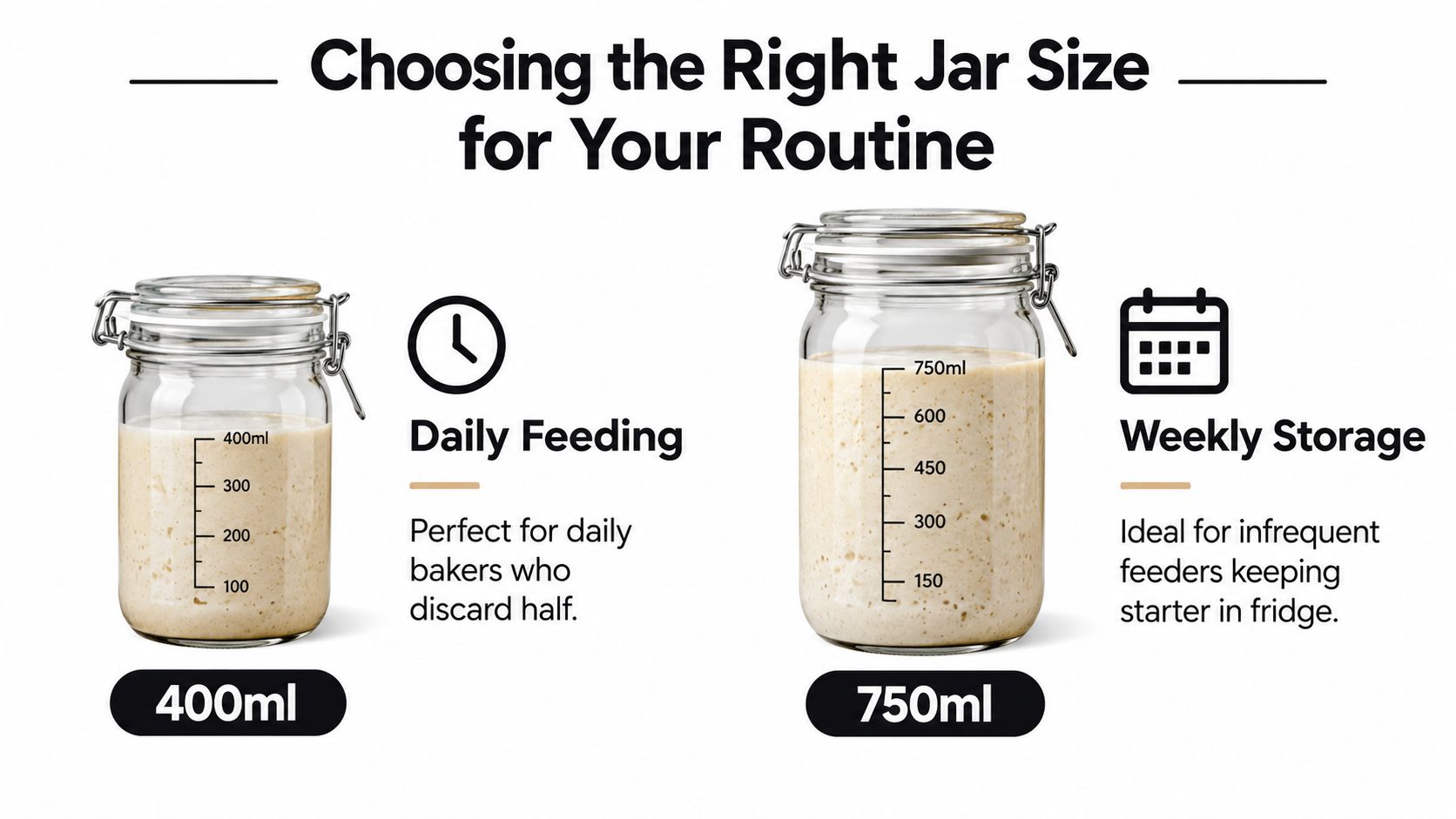
Jar size should follow feeding frequency, not your ambition to keep a huge amount of starter. A baker who feeds on the worktop each day needs a compact vessel that keeps the culture at a visible depth. A weekend baker who stores it in the fridge needs more headroom because the starter may continue fermenting slowly before the next feed.
A jar around 400–500ml suits daily countertop maintenance. After discarding and feeding, the culture sits high enough to read easily without spreading into a thin smear. It's also easier to stir thoroughly and scrape clean.
A jar around 700ml to 1 litre is more appropriate for a fridge-based routine or a baker who builds a larger amount before mixing dough. The extra space protects against overflow when the starter becomes active after removal from cold storage.
A simple size guide
| Your routine | Sensible jar | Why it works |
|---|---|---|
| Daily feeding on the worktop | Around 400–500ml | Keeps the culture deep enough to monitor |
| Small flat or occasional baking | Around 500ml | Avoids unnecessary bulk while leaving useful headroom |
| Weekly fridge storage | Around 700ml–1 litre | Allows slower fermentation and expansion |
| Family baking or larger builds | 1 litre or more | Gives room for a bigger pre-bake build |
The jar shouldn't be nearly full after feeding. Aim for the starter to occupy roughly one-third of the jar, leaving enough space for it to expand substantially without touching the lid. That rule is more useful than choosing a jar because it looks generous.
Oversizing creates its own problems. A small quantity in a tall, wide jar forms a shallow layer, dries around the edges and becomes difficult to judge. Beginners often buy the biggest jar available to avoid overflow, then struggle to see whether anything is happening.
The right jar makes the starter look active. The wrong jar makes a healthy culture look absent.
For a flat kitchen and daily feeds, choose the smaller jar. For a family kitchen where you build more starter or keep it chilled between bakes, step up in size. Weekend-only bakers should favour headroom, but they still need a jar whose base gives the starter visible depth.
Rise Markings, Lids and Visibility Features
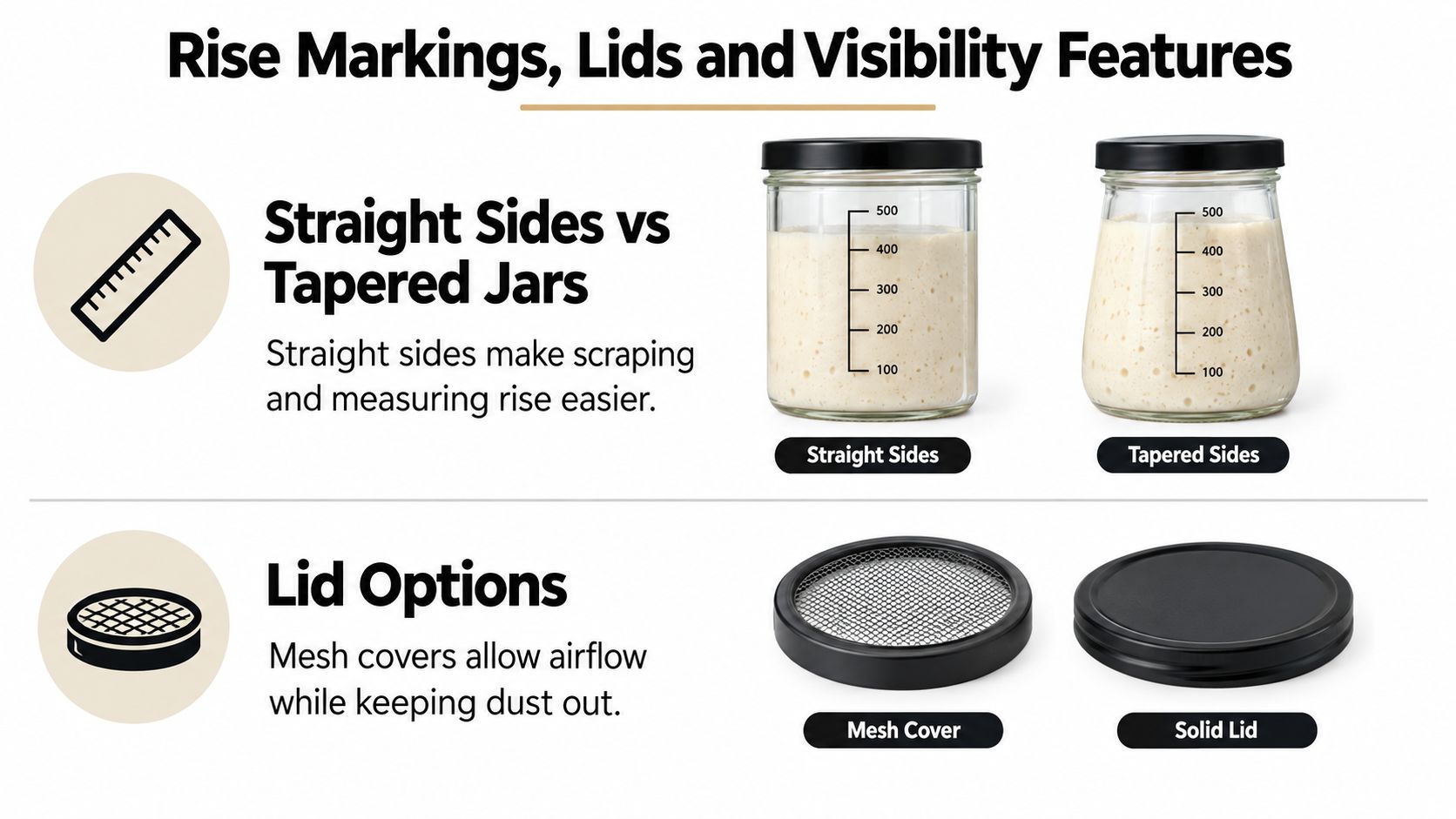
A jar becomes genuinely useful when it shows you what the starter is doing. Straight sides are more important than a fancy logo because they let you compare the culture's height before and after feeding. They also make it easier to scrape dried starter from the wall and remove the mixture without leaving a thick residue in a shoulder or narrow neck.
Tapered jars aren't unusable, but their changing width distorts your judgement. A starter can look as though it has risen dramatically only because the jar narrows upwards. Choose a straight-walled Kilner or mason-style jar if you want a dependable visual reference.
Mark the starting level
Rise markings can be etched, printed or improvised. Etched lines are durable and won't wash away, while millilitre markings can help when you're learning the relationship between volume and rise. A rubber band remains the cheapest reliable option: place it at the starter's height immediately after feeding, then watch for expansion.
A whiteboard marker works on smooth glass, although condensation and washing can remove it. Don't rely on a marking system that disappears when you need it most. In a cool UK kitchen, fermentation may look inactive for longer, so a clear starting line prevents premature feeding.
Choose the closure for the job
A countertop starter needs protection from dust while allowing gas to escape. A loose screw lid, pierced lid or breathable cover can work. A fabric cover keeps debris out but doesn't give the same protection against drying, so it needs sensible placement away from draughts and heat sources.
Clip-top wire-bail jars are convenient, but don't clamp them shut during active fermentation unless the closure is designed to vent. Carbon dioxide needs somewhere to go. UK jar guidance from Jars and Bottles recommends a non-airtight glass jar with a loose or vented closure, and notes that straight-sided designs simplify removal and cleaning.
For fridge storage, a lid can be more secure because fermentation slows, but don't tighten it immediately after a vigorous feed if the starter is still active. Check the culture after removing it from the fridge, particularly if it has formed a liquid layer or begun to deflate. Visibility helps you respond to the starter's condition instead of following a rigid timetable.
Cleaning, Feeding and Storing Your Starter Jar
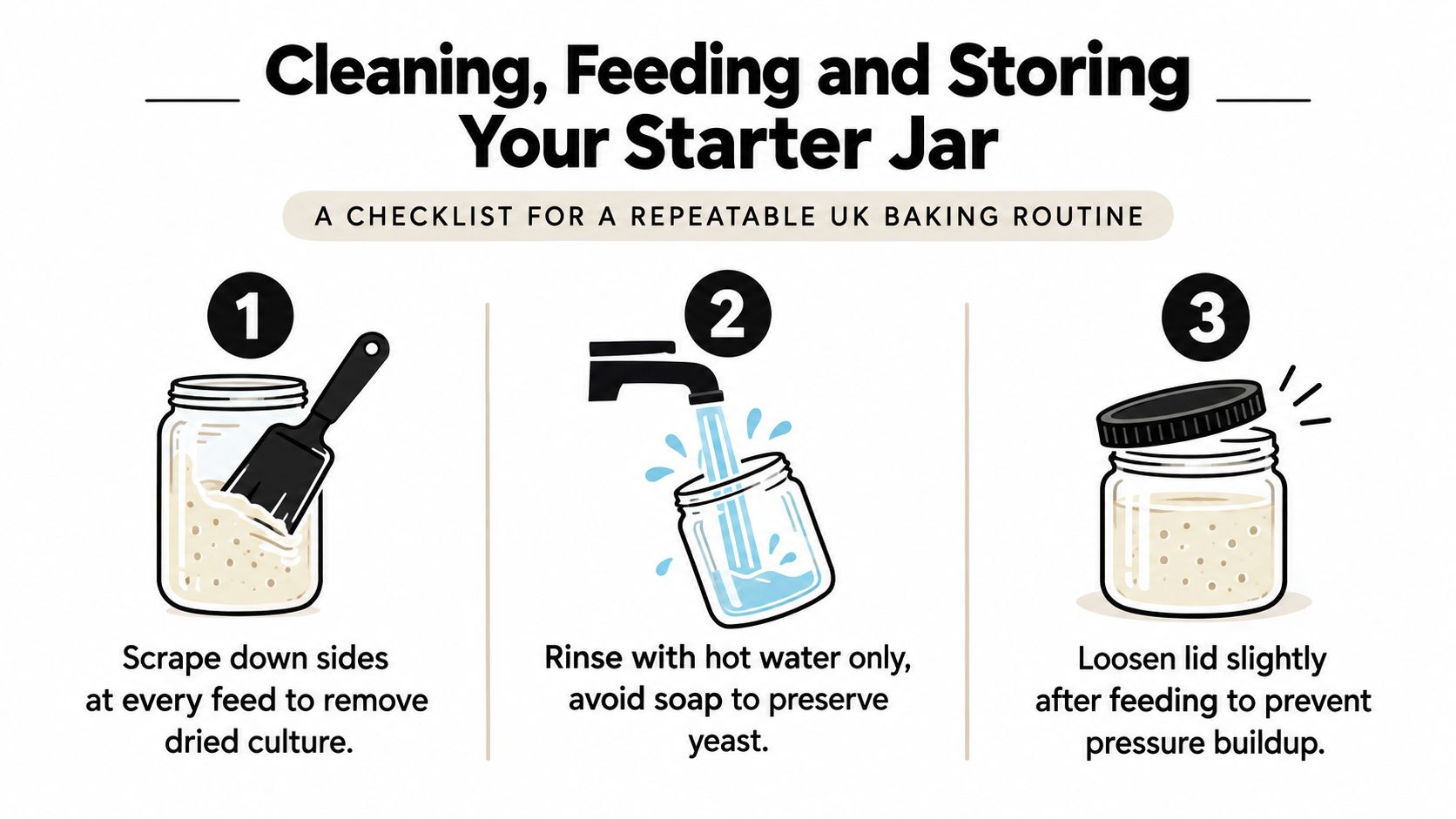
A good jar routine is simple: feed cleanly, scrape deliberately, rinse promptly and keep the lid appropriate to the fermentation stage. You don't need to sterilise the jar after every feed, but you do need to prevent old, dried starter building up around the shoulder and rim.
At each feed, scrape the sides down with a silicone spatula or bowl scraper. Remove the amount you don't need, then add weighed flour and water. A digital scale is more dependable than volume measures because flour and water don't pack into a cup in the same way.
The everyday cycle
- Scrape before discarding. Pull dried culture back into the mixture only if it's clean and fresh. Remove hard, crusted residue rather than letting it fall into the new feed.
- Keep the jar manageable. Discard enough to leave room for the next feed and the starter's expansion.
- Rinse promptly. Warm water and a bottle brush usually remove fresh residue without aggressive scrubbing.
- Deep-clean periodically. Wash the jar and lid thoroughly when smells linger or residue has built up. Bicarbonate of soda or an appropriate sterilising fluid can help, provided the materials are compatible.
- Refill a clean vessel when needed. Keeping a spare jar makes the changeover easy and stops you scraping at a dried crust when you're trying to bake.
A clean jam jar can be perfectly serviceable, but it shouldn't be treated as automatically suitable. The Borough Market sourdough starter guide reflects the practical appeal of a clean jam jar, while the jar itself still needs a shape, capacity and closure that suit your routine.
Countertop or fridge
Use a smaller straight-sided jar with a loose lid for daily countertop feeding. For weekly maintenance, a larger jar gives the chilled starter space and a more secure lid helps prevent spills in the fridge. Leave room at the top rather than filling the vessel to the shoulder.
Stuck starter responds better to soaking than force. If a jar smells sour but clean, wash it thoroughly and dry it fully. If you see mould, discard the culture and clean the jar before starting again. Limited ventilation in a UK kitchen makes dried spills and damp lids more likely, so wipe the rim and underside of the lid before closing it.
For a concise feeding routine, use The Sourdough Cult's guide to how often to feed sourdough starter.
Personalised Starter Jars as Practical Gifts
A personalised starter jar works as a gift because the recipient uses it repeatedly. An engraved name, start date or family name turns an otherwise interchangeable container into part of the baker's routine. In a shared kitchen, labels such as Daily, Fridge or Weekend can prevent jars being mistaken for preserves, pickles or another baker's culture.
The useful customisation is functional, not sentimental decoration. Mark the day the starter began, identify the owner, or distinguish a countertop culture from a refrigerated backup. Avoid designs that cover the main viewing area, because a jar that looks attractive but hides the rise has missed its most important job.
Choose the decoration carefully
Laser-etched glass usually gives a durable, understated finish because the mark is cut into the surface rather than applied as a surface sticker. Ceramic printing can look colourful and gift-like, but ask how the decoration should be treated before putting it through repeated dishwasher cycles. The lid deserves attention too. An engraved lid can carry a name while leaving the glass clear for rise monitoring.
A practical gift pairing might include:
- A measured scoop: Useful for adding flour consistently.
- A linen cover: Suitable for protecting a countertop jar from dust.
- A first bag of flour: Makes the present immediately usable.
- A care card: Removes uncertainty about feeding and fridge storage.
Birthdays, Christmas, housewarmings and wedding presents all suit this kind of gift, especially when the recipient has mentioned wanting to bake but hasn't started. The jar gives them a visible place to keep the culture, rather than another gadget that sits in a drawer.
Check the fulfilment details
UK engravers may need preparation time before dispatch, particularly around Christmas and other gifting periods. Confirm the spelling of names, the treatment of the lid, dishwasher guidance and whether the rise tracker remains readable after washing. Don't assume every personalised jar arrives ready for immediate use. Clean it before adding flour and water.
One relevant option is The Sourdough Cult's personalised sourdough starter jar with engraved lid, which combines customisation with a rise-tracking feature. Judge it by the same standards as any other jar: clear visibility, suitable capacity, a practical closure and care instructions the recipient can follow.
Picking the Right Sourdough Starter Jar for You
Choose your jar in this order: material, size, then monitoring features. That sequence stops you buying a novelty vessel first and discovering later that it's opaque, too large or impossible to close safely.
Start with material
Choose glass if you feed on the countertop or move the starter between the worktop and fridge. It offers the clearest view and is the easiest material for most home routines. Choose ceramic if the jar will live in a consistently cold room where insulation matters more than direct visibility. Choose food-grade plastic only for travel, workshops or backup use.
Match capacity to feeding
For daily countertop feeding, choose a jar around 400–500ml. It keeps the starter at a useful depth and leaves room for expansion without making the culture look lost. For fridge storage or a larger build, choose around 700ml to 1 litre, with enough headroom to prevent a lively starter reaching the lid.
The correct size is the one that leaves the fed starter around one-third full. If the culture barely covers the base, the jar is oversized for that routine. If it sits near the shoulder, you'll spend your time watching for spills.
Add only the features that help
Prioritise:
- Straight sides: Easier rise comparisons and cleaner scraping.
- Clear markings: Etched lines, a printed tracker or a simple rubber band.
- A loose or vented lid: Suitable for active fermentation and pressure release.
- A wide mouth: Better access for stirring and washing.
- Fridge-safe construction: Essential if you store the culture between bakes.
The right sourdough starter jar UK bakers can rely on isn't necessarily a specialist product. It's a clear, appropriately sized working container that suits the room, schedule and storage method you really use. Identify your feeding routine today, select the material and capacity that match it, then add a rise marker if you want faster day-to-day decisions.
The Sourdough Cult supplies live sourdough starter, practical starter kits and reusable jars with rise-tracking features for UK home bakers. Visit The Sourdough Cult to choose a starter, jar or gift-ready kit that fits your baking routine.


