

There isn't one feeding schedule for every starter. An active room-temperature culture needs feeding daily or twice daily, while a refrigerated maintenance culture typically needs feeding weekly.
That answer sounds simple, but it leaves out the part that confuses most bakers. Your starter isn't a timer. It's a living ecosystem of yeast and bacteria, and it behaves differently depending on where you keep it, how often you bake, and how warm your kitchen feels that week.
Many guides teach feeding by calendar alone. Feed every day. Or feed once a week. Done. But that can make beginners feel like they've failed the moment their jar rises too fast, peaks too slowly, or smells sharper than expected. The better way to think about how often to feed sourdough starter is this: start with a reliable routine, then learn to read the signals your culture gives you.
If you can do that, sourdough becomes much less mysterious. You don't need lots of equipment. You don't need a laboratory mindset. You need a jar, flour, water, and a clear sense of what your starter is telling you.
Table of Contents
- The Two Paths of Sourdough Maintenance
- How Temperature Controls Starter Metabolism
- Countertop and Refrigerator Feeding Schedules
- Adapting Your Routine to Seasonal Changes
- Sample Schedules for Different Bakers
- Reading Signs That Your Starter Needs Adjustment
- Common Misconceptions About Starter Feeding
The Two Paths of Sourdough Maintenance
Most bakers end up choosing between two very different lifestyles for their starter. One jar lives on the counter and stays busy. The other rests in the fridge and wakes up when needed.
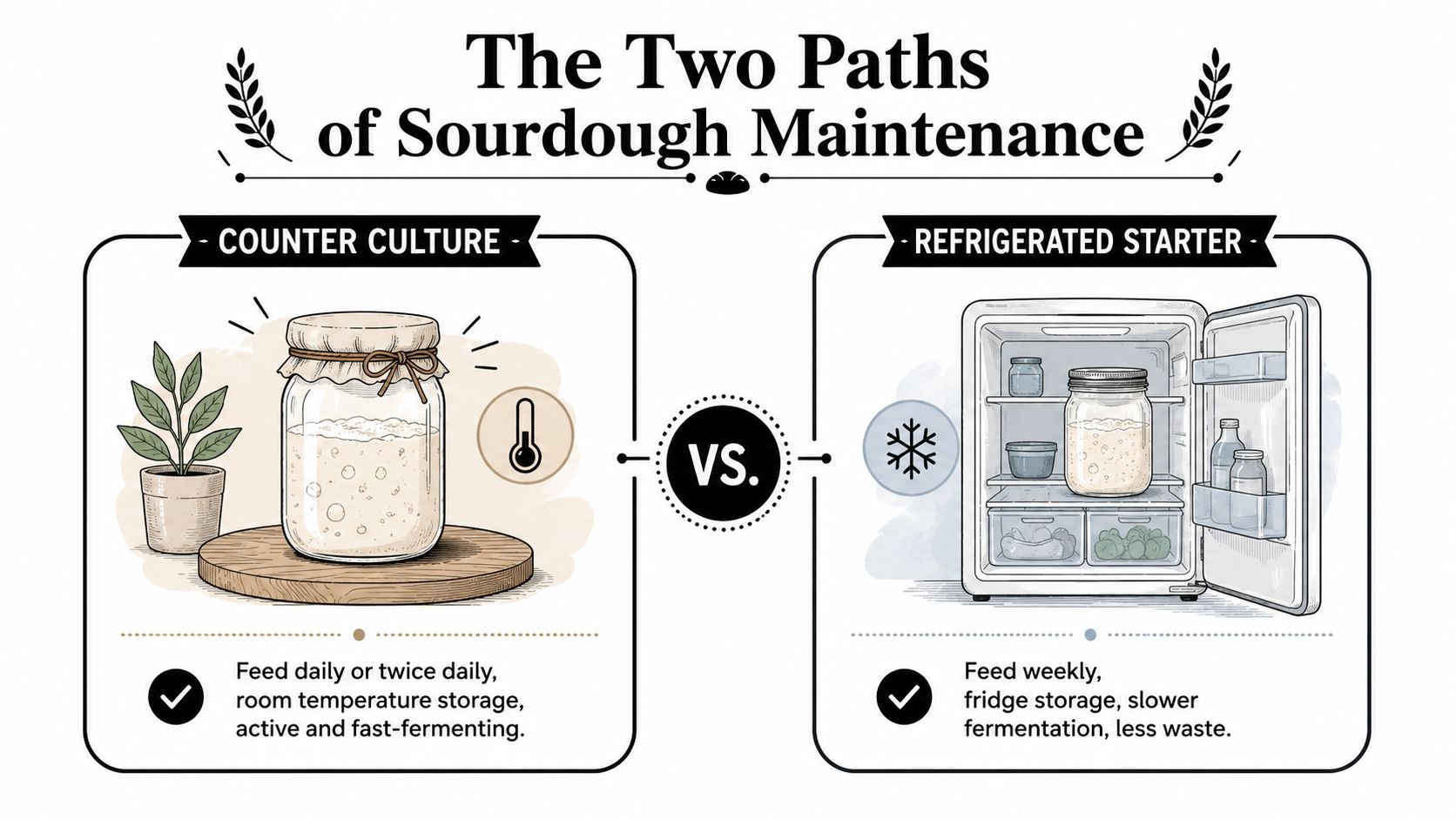
Counter culture
A countertop starter suits the baker who mixes dough often and wants the culture ready to move. In this mode, the starter behaves like a pet that expects regular meals. It rises, bubbles, becomes airy, then gradually collapses as it uses up available food.
A UK guide from Sourdough Explained on starter maintenance describes a common pattern clearly: a room-temperature starter is refreshed daily or twice daily, while a refrigerated one is fed weekly. That simple split is the backbone of practical starter care.
If you're keeping your starter warm and active, you might also find this daily maintenance routine for sourdough starter care useful for the hands-on rhythm of regular feeding.
Refrigerated starter
A fridge starter is different. It isn't dead or neglected. It's slowed down. This suits the baker who makes bread occasionally and doesn't want to generate extra discard every day.
Practical rule: Choose the routine you can keep, not the routine that looks most serious.
That matters because the wrong schedule usually comes from wishful thinking. People imagine they'll bake constantly, leave the jar out, then miss feedings and wonder why the starter turns sluggish or sharply acidic. If you bake once in a while, cold storage is often the more honest and more sustainable choice.
Here is decision:
- Bake often: keep the starter at room temperature and feed it regularly.
- Bake weekly or less often: keep it in the fridge and reactivate it before baking.
- Want less waste: cold storage usually makes that easier.
- Want instant readiness: countertop care gives you that, but it asks more of you.
How Temperature Controls Starter Metabolism
Why can one starter sit happily in the fridge for days while another on the counter seems hungry again by tomorrow?
The answer is metabolism. Your starter is a living ecosystem of yeast and lactic acid bacteria, and temperature changes how fast that ecosystem eats, grows, and acidifies its environment. Flour is the food supply. Water opens that food up. Warmth acts like a faster heartbeat for the jar.
A useful comparison is a small town with two main workers. Yeast produces the gas that helps the starter rise. Bacteria produces the acids that create sour flavour and shape the culture's balance. Both are always active, but they work at different speeds depending on how warm the jar is.
Warmth changes the pace
In a warm kitchen, your starter burns through its meal faster. It rises sooner, smells sharper sooner, and reaches its peak sooner. Then, just as important, it falls sooner because the easy food has already been used.
That is why a starter left on the counter often needs more frequent attention than one kept cold. The calendar matters less than the pace of the culture in front of you. A jar at 24°C behaves like a different organism from the same jar at 18°C, even if you feed both the same flour and water.
Cold slows activity without stopping it
The fridge does not switch your starter off. It turns the volume down.
Yeast and bacteria still consume sugars in the cold, but much more slowly. Acid builds up more gradually. The starter stays in its usable window longer. For a beginner, this is the key idea: refrigeration buys time, not immunity from feeding.
Your starter is always communicating. Temperature changes how quickly it speaks.
That communication shows up in simple signs. A warm starter may dome, double, and collapse in a short span. A cold starter may look quiet for days, even though slow fermentation is still happening under the surface.
Why this matters in practice
Many feeding mistakes come from treating starter care like a fixed timetable instead of a response to conditions. If your kitchen warms up, the ecosystem moves faster and needs fresh food sooner. If the room cools down, the same starter may stay balanced for longer.
This is also why minimal equipment works fine. You do not need special tools to understand metabolism. A clear jar, a spoon, flour, water, and your own observation are enough. Watch how quickly the starter rises, how long it stays rounded on top, and when the smell shifts from fresh and mildly tangy to noticeably sharp. Those changes tell you more than a rigid schedule.
Temperature sets the speed. Your starter's behavior tells you what that speed means for feeding.
Countertop and Refrigerator Feeding Schedules
A feeding schedule works best when it behaves like a response system, not a calendar rule. Your starter is a small ecosystem of yeast and bacteria. Feed it on the counter if you want frequent activity and quick access for baking. Store it in the fridge if you want to slow that activity and reduce how often you need to intervene.
A practical countertop routine
A room-temperature starter usually needs regular feeding because it burns through its food faster. In an active kitchen, that often means once a day. In a warm kitchen, or with a starter that peaks and falls quickly, twice a day may fit better.
The easiest way to adjust the pace is to change the feed size.
A ratio such as 1:2:2 gives the culture a moderate meal. It often suits bakers who want a predictable rise within the same day. A larger feed such as 1:5:5 gives the microbes more fresh flour to work through, so the rise usually takes longer and the starter stays balanced for more hours.
You can read those ratios like portion sizes for a busy household. A small meal gets eaten sooner. A larger meal lasts longer.
That leads to a simple pattern:
- 1:2:2 suits moderate room temperatures and starters you want ready sooner
- 1:5:5 can help in warmer kitchens or when you need more time before peak
- Frequent collapse after rising usually means the starter needs either more food, cooler conditions, or both
- Slow but steady growth often means the current feed is adequate
If you want a clear walkthrough of the mechanics, this guide to feeding a sourdough starter without killing it explains the process in simple, low-equipment terms.
A simple fridge routine
Fridge storage changes the job of feeding. On the counter, you are maintaining daily strength. In the fridge, you are preserving the culture between bakes.
For many home bakers, a weekly feed is a practical middle ground. Some starters stay happy with once or twice a week if the baker wants faster bounce-back on bake day. A mature, stable starter can sometimes stretch longer, but longer gaps usually mean more recovery feeding before it performs well in dough.
The useful question is not "What is the one correct fridge schedule?" The useful question is "How quickly do I need this ecosystem to wake back up?"
| Routine | Best for | Trade-off |
|---|---|---|
| Once or twice a week | Bakers who want a starter ready with less lag | More regular upkeep |
| Weekly | Home bakers who want convenience and dependable performance | A balanced option |
| Every two weeks | Mature starters stored carefully and used less often | More wake-up time before baking |
Before bake day
A refrigerated starter can be alive and still not be ready. Those are different states.
Cold storage keeps the ecosystem going at a low pace, like a town at night with only a few lights on. Before mixing dough, many bakers get better results by giving the starter one or two room-temperature feeds. That refreshes the yeast, balances the acids, and makes the jar's signals easier to read. If it rises well, smells clean and tangy, and holds its shape near peak, it is telling you it is ready.
Adapting Your Routine to Seasonal Changes
What if your starter is not being difficult at all. What if it is reacting to the room you put it in?
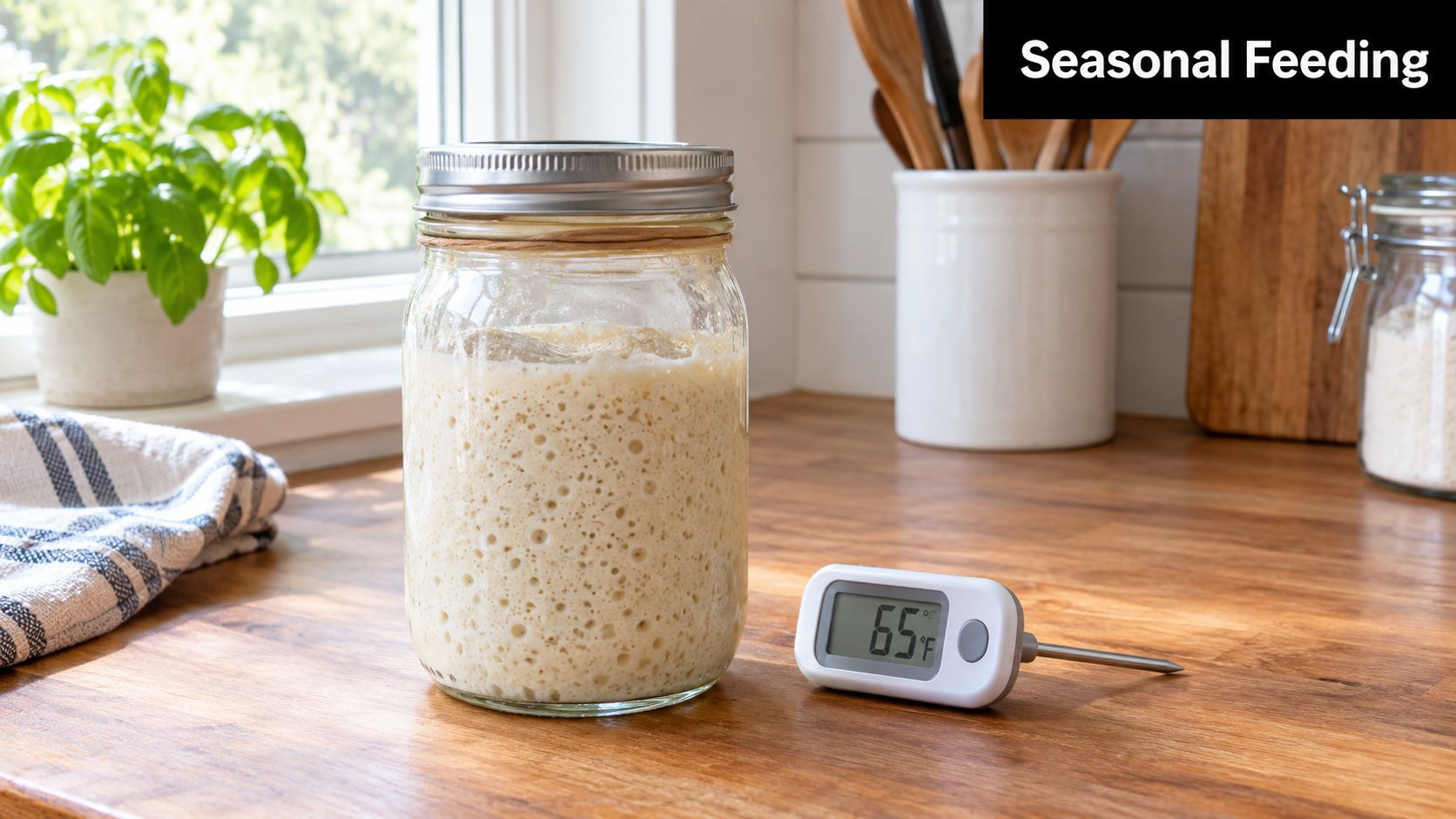
A sourdough starter is a small living ecosystem of yeast and bacteria. Temperature changes how fast that ecosystem eats, reproduces, and acidifies the jar. The flour and water may stay the same, but the pace does not. That is why a routine that worked beautifully in October can feel confusing in January or July.
The useful skill is reading behavior. Calendars help, but the jar gives better information.
In a cool kitchen
Cold slows metabolism, much like a sleepy morning slows a household. The microbes are still active, just less hurried. Your starter may take longer to rise, hold its shape longer near the top, and smell milder for more of the day.
Those signs often mean "slower," not "unhealthy."
Before changing your whole routine, make one small adjustment at a time:
- Peaks late: feed earlier if you need it ready later in the day.
- Barely rises: try a slightly warmer spot first, such as a room-temperature counter away from drafts.
- Stays domed for longer: read that as extended fermentation time, not weak fermentation.
This slow-season approach fits The Sourdough Cult style well. You do not need special gear beyond the basics. A jar, your senses, and a rough sense of room temperature are often enough.
In a warm kitchen
Heat speeds the whole ecosystem up. Yeast produce gas faster. Bacteria acidify the mixture faster. The starter can rise quickly, peak sooner than expected, and collapse while you are still planning dinner.
That quick rise can trick beginners. A fast starter is not always a stronger starter. Sometimes it is burning through its food sooner.
If summer heat makes the jar hard to catch at peak, adjust the conditions instead of forcing the same schedule year-round. You might feed at a cooler time of day, use a larger feeding ratio so the microbes have more fresh food, or keep the jar in a cooler part of the kitchen. In winter, you may make the opposite choices.
When your starter peaks too early or too late, the answer is usually a small environmental change.
Use behavior, not identity
Some home bakers feel pressure to keep a starter on the counter all year, as if that proves commitment. The culture does not care about appearances. It responds to food, temperature, and time.
A practical baker changes routines with the season. More counter time during cold months may help. More fridge time during hot months may make the starter easier to manage. If the jar becomes more predictable, your routine is working.
Your starter communicates through rise, smell, texture, and timing. Learn that language, and seasonal changes stop feeling random.
Sample Schedules for Different Bakers
The best feeding routine is the one that matches how you bake. Not how you hope you'll bake on an ambitious Sunday evening.
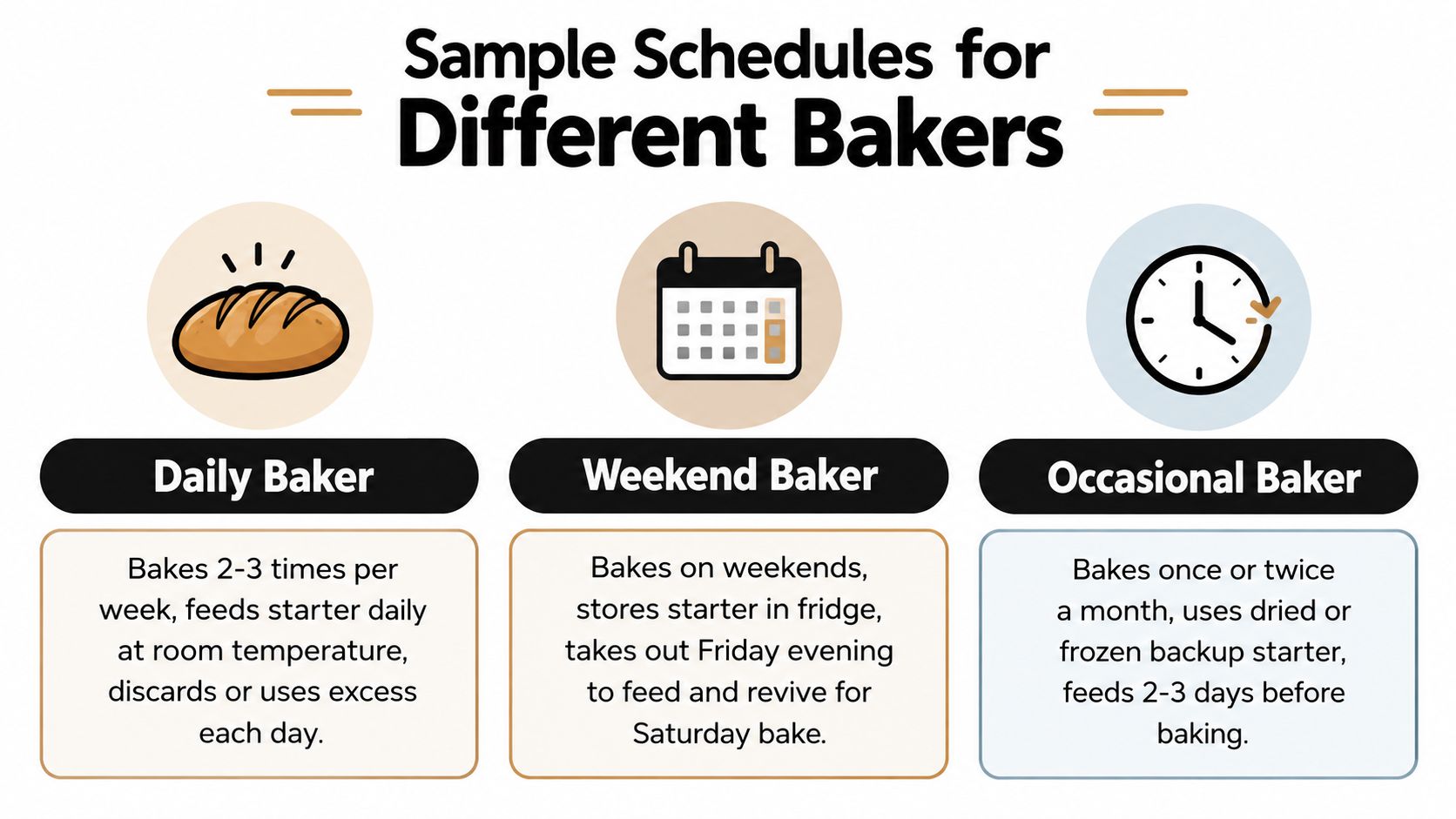
The frequent baker
You bake several times a week. Your starter stays on the counter because you want it ready and responsive.
A typical pattern looks like this:
- Keep it active: feed daily, or twice daily if the culture is moving quickly.
- Match feed size to timing: a stronger feed can help if you need the starter to peak later.
- Use the starter near peak: that's when it usually has the best lift for dough.
This kind of baker values readiness over low maintenance.
The weekend baker
You bake mainly on Saturdays or Sundays. The fridge is usually the better home for your starter.
A practical rhythm often looks like this:
- Store cold during the week to reduce waste and maintenance.
- Take it out before baking and give it a fresh feed.
- Give another feed if needed when you want stronger activity before mixing dough.
Many home bakers find this the easiest long-term balance.
A visual walkthrough can help if you prefer seeing the process in action.
If you also travel or leave your starter unattended for stretches, this guide to sourdough starter holiday care is useful for planning around absences.
The occasional baker
You bake now and then, perhaps for guests, holidays, or a monthly reset. In that case, your starter may spend most of its time in cold storage.
The key distinction is this:
A starter kept for survival maintenance isn't always ready for peak performance the moment you want to bake.
So the occasional baker often does best by planning ahead. Wake the starter with fresh feedings before bake day, watch how strongly it rises, and only then mix dough.
Which profile fits you
A simple comparison helps:
| Baker type | Where the starter lives | Main benefit | Main challenge |
|---|---|---|---|
| Frequent baker | Counter | Ready to use often | More feeding |
| Weekend baker | Fridge | Less waste | Needs revival before use |
| Occasional baker | Fridge | Lowest effort | Requires more planning before baking |
Reading Signs That Your Starter Needs Adjustment
A schedule gives you a starting point. Your starter's behaviour tells you whether that schedule still fits.
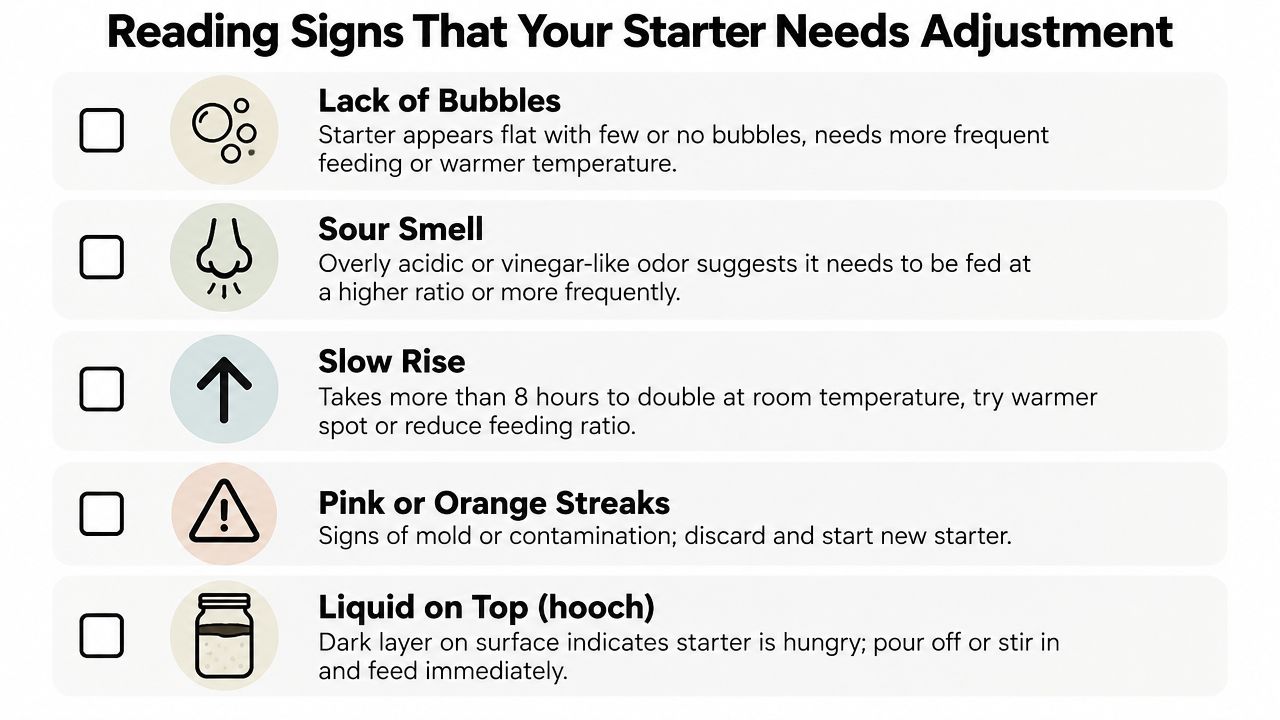
Signs of a hungry starter
A hungry starter often makes itself obvious. It may rise, then collapse and look flatter than before. The smell can turn sharper, more acidic, or more solvent-like. You may also see liquid on top, often called hooch.
When that happens, the message is usually straightforward:
- It peaked before you used it: feed earlier or use a larger ratio next time.
- It smells very sour: shorten the gap between feeds or cool it down.
- It keeps collapsing fast: the environment may be too warm for the current schedule.
Signs of a sluggish starter
A sluggish starter sends a different signal. It barely expands, shows limited bubbling, or seems thick and inert long after feeding.
That doesn't always mean the culture is damaged. It may need better conditions.
Try asking:
- Is the kitchen too cool?
- Did the starter come straight from the fridge and need another refresh?
- Am I expecting a fast rise from a culture that's still rebuilding strength?
Signs the schedule is working
The healthiest routine usually feels boring in the best way. The starter rises consistently, smells pleasantly tangy, and gives you a workable window for mixing dough.
Look for rhythm, not perfection.
A starter at or near peak often shows a rounded or lightly domed top, visible bubbles, and a texture that feels aerated rather than dense. Over time, you'll learn your own jar's habits. Some cultures peak high and dramatically. Others rise more modestly but still perform well.
When to stop troubleshooting and start over
If you ever see pink or orange streaks, or obvious mould, discard the starter. That's not a feeding-frequency problem. That's a contamination problem.
Everything else is usually a conversation about timing, temperature, or patience.
Common Misconceptions About Starter Feeding
What if your starter is not ignoring the schedule, but answering it?
Many beginners are taught to feed by the clock alone. That can help at first, but it also creates confusion. A sourdough starter is a small living ecosystem of yeast and bacteria. Like any ecosystem, it responds to warmth, food supply, and time. Its bubbles, aroma, and rise are forms of feedback.
Myth one, more feeding always means better bread
More frequent feeding does not automatically produce a better starter. It changes the environment the microbes live in.
A starter works a bit like a small herd on a pasture. Fresh flour is the new grass. If you keep adding more before the culture has used what it already has, you are not always making it stronger. You may just be resetting the cycle more often than your baking routine requires. For someone who bakes every day, frequent feeding can make sense. For someone who bakes on weekends, it often creates waste and a jar that never settles into a useful rhythm.
Maintenance and baking readiness are two different states. A starter can stay healthy on a lower-effort routine, then be refreshed to full strength before you mix dough.
Myth two, every starter should follow the same calendar
A calendar is a rough guide, not a law.
Two starters fed the same flour at the same ratio can still behave differently if one sits in a cool kitchen and the other lives near a warm oven. The organisms inside are eating, multiplying, and producing acids at different speeds. That is why a schedule that works beautifully for one baker can feel frustrating for another.
As noted earlier, temperature changes the pace of fermentation. Your baking frequency matters too. So does flour choice. A wholegrain-fed starter often moves faster than one fed only white flour. If your jar rises and falls on a different timetable than someone else's, that usually means your ecosystem has different conditions, not that you are failing.
Myth three, a sour smell always means failure
A tangy smell is often normal.
As the bacteria in starter digest sugars, they produce acids. That acidity is part of what protects the culture and gives sourdough its character. A sharper aroma often means the starter has eaten through much of its food and is asking for another meal. It does not usually mean the culture is ruined.
The better question is, "Does this smell match where the starter is in its cycle?" Mild and wheaty soon after feeding, then fruitier or sharper later on, is common. That pattern is communication.
Myth four, you need fancy gear to maintain a starter
You do not need a special pro setup to keep a starter healthy. A clean jar, flour, water, and something simple to mark the level are enough.
That fits the whole point of learning sourdough well. Clear observation beats extra tools. A rubber band on the jar can teach you more than a shelf full of gadgets if it helps you see how high the culture rose and how quickly it moved. Minimal equipment works because the skill is reading behavior.
A better way to think about feeding
The most helpful shift is to stop treating feeding as a fixed chore and start treating it as a response.
Your starter is not a machine with one approved setting. It is a living culture that shows you what it needs. When you learn to read rise, smell, texture, and timing together, feeding gets simpler. You stop chasing perfect rules and start building a routine that fits your kitchen, your baking habits, and your starter's own pace.
If you'd rather begin with a mature culture than build one from scratch, The Sourdough Cult offers live starter, practical kits, and straightforward guidance built for home bakers in the UK. Their approach fits this exact topic: keep the equipment simple, understand the feeding rhythm, and give bakers clear instructions you can use.


