

Most baking starter kits are sold on the wrong promise. A bigger box, more tools, several flours and a handful of specialist accessories may look impressive, but none of them will rescue a weak starter or confused feeding routine. For a first loaf, a mature live culture, accurate weighing, a clear jar and sensible instructions matter more than gadget count.
Sourdough is also not a passing UK novelty. Before commercial yeast became common in the nineteenth century, naturally leavened bread was the normal way to raise dough, and sourdough demand returned in the 1980s. UK regulations issued in 1993 helped define what could be sold as sourdough bread, another step in the method's modern revival, as outlined in this history of sourdough bread in the UK.
That history explains why the right kit feels less like a luxury appliance and more like a practical shortcut. It preserves a living culture, gives you a repeatable process and removes the avoidable guesswork. If you're buying your first set, resist the urge to buy everything. Buy the pieces that help you understand fermentation and use them consistently.
Table of Contents
- Why Most Baking Starter Kits Fail Beginners
- Essential Components of a Quality Sourdough Kit
- Matching Kit Types to Your Baking Experience
- Evaluating the Live Sourdough Culture
- Managing Temperature and Fermentation Variables
- The Case for Minimalist Kits and Intermittent Baking
- Navigating Your First Bake and Ongoing Care
Why Most Baking Starter Kits Fail Beginners
The popular assumption is simple: beginners need a complete box packed with equipment. I disagree. Most first-time bakers need fewer decisions, not more equipment.
A crowded kit can create three problems immediately. The baker has to work out which flour to use, which container is suitable, whether a dough whisk is necessary and how every accessory fits into the process. That mental clutter distracts from the two variables that decide whether the starter becomes useful, feeding consistency and temperature.
A starter kit also fails when it treats the culture as an afterthought. Dry powder, an immature mixture or vague instructions can leave a new baker waiting for activity without knowing whether the problem is the flour, the water, the room or the starter itself. A living culture should arrive with clear guidance about feeding, storage and what healthy activity looks like.
Practical rule: If a kit spends more space describing its accessories than explaining its starter, leave it on the shelf.
Marketing appeal versus kitchen value
Decorative jars, novelty scrapers and branded accessories can make a parcel feel generous, but they don't necessarily improve the loaf. A clear container that lets you see expansion is useful. A jar chosen only because it looks attractive is not. A lame that cuts cleanly has a purpose. A collection of duplicate scoring tools does not.
The same principle applies to ingredients. A kit shouldn't force you into a complicated flour system before you understand basic feeding. You need a flour that produces a lively culture, water that hydrates it consistently and instructions that tell you what to observe. Once your starter behaves predictably, you can experiment with stronger bread flour, wholemeal flour or blends.
The minimum viable setup
A dependable starter kit should help you answer four questions:
- What do I feed? The instructions should specify flour and water clearly.
- How much do I feed? Weighing by grams avoids unreliable volume measures.
- When is it ready? Rise markers and activity cues are more useful than a rigid clock.
- How do I store it? Countertop and refrigerator guidance should both be included.
The UK home-baking boom created a large audience for straightforward entry points. A National Association of British and Irish Millers survey found that 54% of 4,000 UK adults had baked a treat during the first lockdown, while The Grocer reported that take-home home-baking sales rose 18.3% to £900.7m, with volumes up 15.9% in the wider UK market. Those figures are documented in this report on how bakeries tapped into lockdown home baking. The lesson isn't that every baker needs a professional setup. It's that many people need a calm, well-curated introduction.
Essential Components of a Quality Sourdough Kit
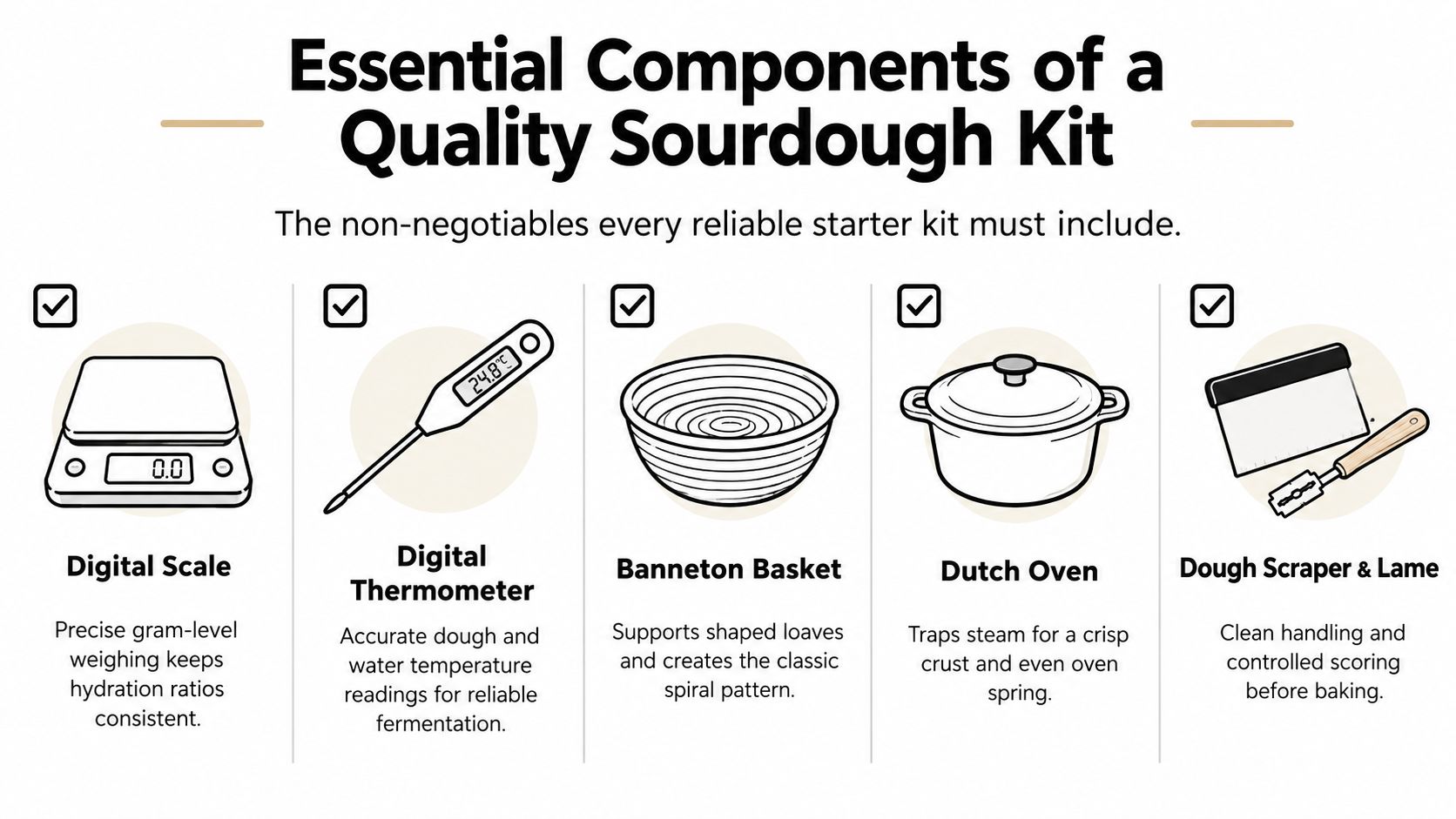
A quality kit should create a measurement workflow. Each component needs to solve a real problem, reduce uncertainty or protect the culture. If it doesn't do one of those things, it's probably filler.
The tools that earn their place
A digital scale is essential. Sourdough depends on consistent ratios of starter, flour and water, and grams give you repeatability. A spoonful of flour can vary depending on how tightly it's packed, while a scale lets you reproduce a feeding that worked.
A clear jar with a rise marker turns fermentation into something you can observe. Mark the starter's level immediately after feeding with a rubber band, tape or printed indicator. You're looking for a rise, a peak and a fall, not just a few surface bubbles. UK guidance commonly recommends feeding after the starter has peaked and fallen, with equal-weight feeding approaches such as 1:1:1. An established active starter should typically double within 4 to 8 hours, according to this UK sourdough feeding guide.
A thermometer earns its place in a UK kitchen. Water and dough temperature affect fermentation speed, acid development and timing. You don't need to obsess over every degree, but you do need a way to check whether your kitchen conditions are unusually cool or warm.
A dough scraper makes sticky dough manageable and keeps your worktop cleaner. It helps divide, lift and shape without adding unnecessary flour, which can change the dough's consistency.
A lame gives you control over the final score. A clean cut directs expansion during baking and is more reliable than using a blunt kitchen knife.
For the first loaf, a banneton supports the shaped dough and encourages a defined form. A Dutch oven traps steam during the early bake, helping the crust set properly and supporting oven spring. These items are worthwhile if you don't already own suitable alternatives, but they shouldn't distract from the starter itself.
What deserves a place in the box
Use this test before paying for a kit:
- Can the item be used during a normal bake? If not, it probably isn't essential.
- Does it improve measurement or handling? Practical benefits matter more than presentation.
- Would you buy it separately? If the answer is no, don't let it inflate the kit's perceived value.
- Does the instruction manual explain the tool? Good equipment is wasted when the baker doesn't know when to use it.
Flour deserves separate attention because it directly affects starter behaviour. Use this UK guide to choosing flour for a sourdough starter to compare sensible options without turning your first bake into a flour-buying project.
Matching Kit Types to Your Baking Experience
The right kit depends on what's already in your kitchen. Buying an all-inclusive box when you own a scale, jar and Dutch oven is wasteful. Buying only starter when you lack a way to weigh and shape dough leaves you with the same problem in a different form.
Start with an honest kitchen audit
Open your cupboards before you shop. A mixing bowl, kitchen scale and oven-safe lidded pot may cover more of the process than you expect. You can often substitute a clean glass jar for a branded vessel and a sharp razor for an expensive scoring handle, provided both are used safely.
The culture is the one component you can't fake with presentation. If your existing jar and tools are perfectly serviceable, a starter-only option may be the most sensible purchase. If you're giving a present, however, packaging and instructions matter because the recipient may not have any sourdough equipment at all.
| Kit Type | Best For | Includes |
|---|---|---|
| Beginner starter kit | First-time bakers who need a clear route to a first loaf | Live starter, jar or container, feeding guidance and core handling tools |
| All-in-one home setup | Bakers starting without suitable equipment | Live starter, marked jar, scale or measuring support, shaping and scoring tools, plus baking equipment where included |
| Starter-only option | Experienced bakers who already own jars, scales and utensils | Live culture, feeding instructions and storage guidance |
| Gift-ready kit | A recipient who needs a useful, presentable introduction | Live starter, practical essentials, printed guidance and protective packaging |
Choose by friction, not by status
A beginner should prioritise a kit that explains what to do on the first day, how to mark the jar and how to recognise a ready culture. A more experienced baker may care more about the culture's provenance, arrival condition and replacement policy than another dough scraper.
Gift buyers should avoid kits that look elaborate but demand specialist knowledge. A useful present has a clear starting point, sensible components and instructions the recipient can follow without searching through conflicting recipes. UK delivery and sturdy packaging also matter because a live culture needs to arrive in usable condition.
The Sourdough Cult offers several distinct formats, including The Initiation for beginners, The 1% as an all-inclusive setup and The Fresh Start(er) for bakers who already own their equipment. Its range also includes a live Cheshire family culture, a marked jar option and printed and digital care guidance, making it one practical example of how kits can be separated by need rather than padded with duplicate tools.
My buying recommendation
If you're new, buy the smallest kit that includes a mature live starter, a clear marked jar, accurate weighing support and instructions. If you already bake bread, buy the culture alone unless a specific tool in the larger package fills a genuine gap. For a present, choose a compact kit with a strong instruction set, not the biggest box.
Evaluating the Live Sourdough Culture
Tools are replaceable. The live culture is the asset that gives a starter kit its value. A reliable culture shortens the uncertain stage between opening the parcel and learning how your kitchen behaves.
A sourdough starter is a living mixture of flour and water containing naturally occurring yeast and beneficial bacteria. It needs food, warmth and time. A kit should make those requirements clear rather than presenting the starter as a decorative ingredient that works automatically.
What to check before buying
Look for four things in the product information:
- A clear description of the culture. The seller should explain whether it is live, active and ready to feed.
- A feeding protocol. You should know which flour and water to use, how much to retain and how to recognise progress.
- A viability policy. Live cultures travel through the postal network, so a replacement policy for a compromised arrival is sensible.
- A storage plan. Instructions should explain both room-temperature activation and refrigerator maintenance.
A mature, maintained culture offers a practical shortcut compared with building one from flour and water alone. Starting from scratch can work, but it asks you to interpret changing bubbles, smells and rise patterns before you understand the basics. A supplied culture removes that initial uncertainty, though it doesn't remove the need for consistent care.
Read this guide to live sourdough starter before ordering. It helps clarify what a living culture is, how it should be handled and why the starter's condition matters more than the jar's branding.
Judge activity by behaviour
Don't demand that a starter look spectacular the moment it arrives. Transport can alter its appearance, and a culture may need feeding before it resumes a strong rise. Follow the supplied instructions, keep the jar in a stable place and record what happens after each refreshment.
A healthy starter should show a repeatable pattern. It rises after feeding, develops bubbles throughout, reaches a peak and then begins to recede. The smell should be pleasantly fermented rather than sharply unpleasant. If you see mould or unusual discolouration, discard it rather than trying to rescue a contaminated culture.
Look for a pattern, not a performance. One dramatic rise doesn't prove that a starter is ready. Repeated activity gives you confidence.
Ask whether the seller tells you what to do if the culture arrives sluggish. Good support should include contact details, troubleshooting advice and a straightforward replacement process. A kit that leaves you alone after delivery isn't complete, regardless of how many tools sit inside the box.
Managing Temperature and Fermentation Variables
Temperature decides whether your starter seems lively or stubborn. UK-facing baking guidance generally places the useful room range around 20 to 24°C, while NHS-linked guidance supports keeping a starter warm at approximately 18 to 25°C for a strong bake-ready culture. These ranges are documented in the BBC sourdough guidance.
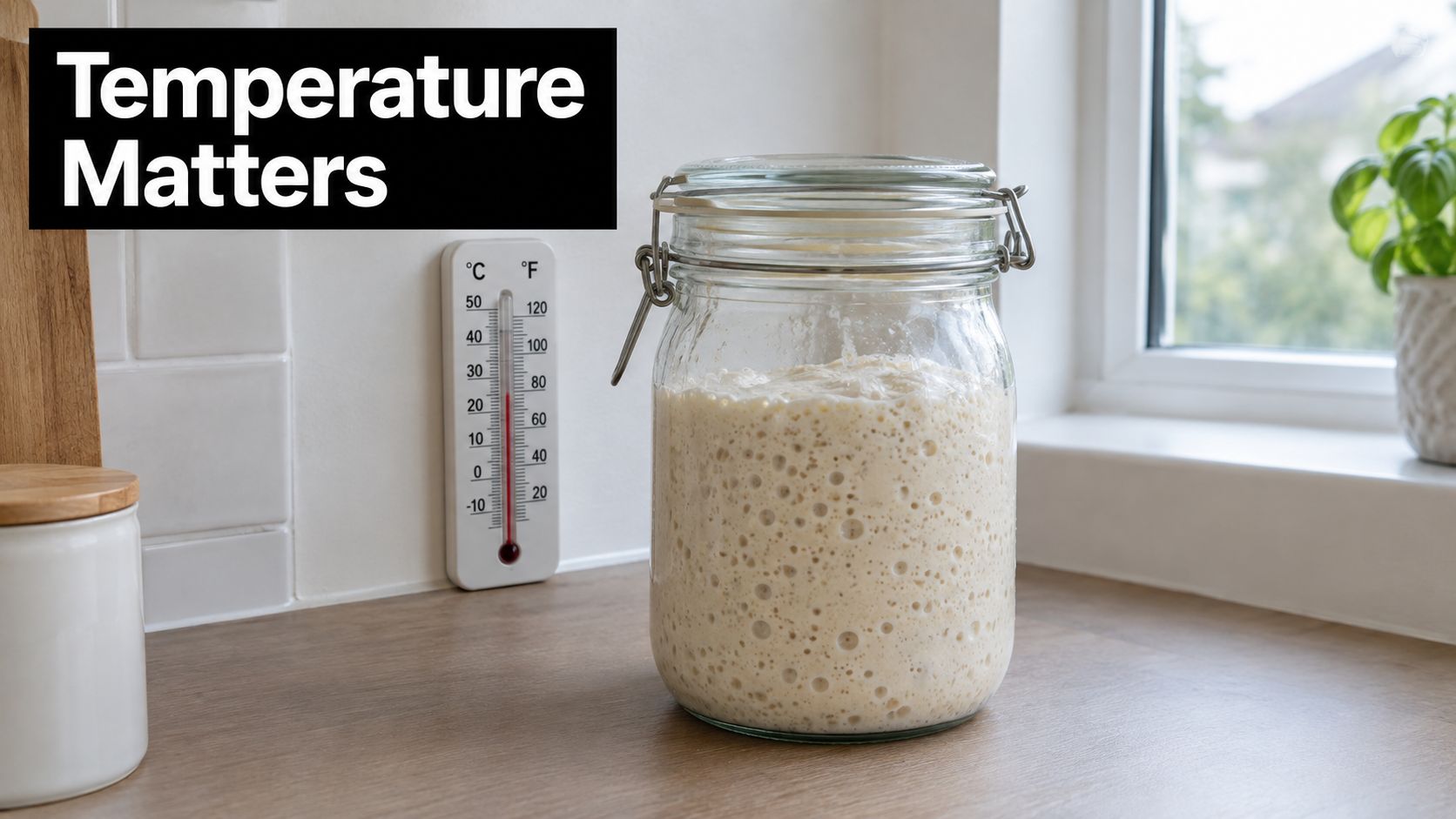
A cold windowsill can slow fermentation enough to make a recipe's timing misleading. A warm cupboard beside a radiator can accelerate it and leave the culture past its peak before you expect it. The answer isn't to force the starter into a fixed schedule. It's to measure the conditions and read the jar.
Build a stable routine
Keep the jar away from draughts, direct sunlight and sudden heat. A kitchen worktop can work well if the room stays reasonably consistent. During colder weather, a switched-off microwave or cupboard can provide shelter, but don't place the jar near an active heat source.
Use tepid water when refreshing the culture. Several UK recipes recommend water around 24 to 28°C, which keeps the mixture within a helpful microbial growth window without shocking it with cold hydration. A thermometer makes this easy, especially when your tap water feels colder in winter.
Mark the starting level immediately after feeding. When the starter rises, the marker shows the scale of activity. When it falls back, you know it has moved beyond its peak and needs attention before the next bake. This is more useful than counting bubbles because a starter can look active while still lacking a predictable rise.
A narrow feeding routine also protects against waste. Remove the amount required by your instructions, add the specified flour and water by weight, mix thoroughly and mark the new level. Don't keep adding flour to a large neglected jar without removing some first. That creates an oversized culture, consumes ingredients and makes the fermentation harder to interpret.
Check the visual rise before relying on the clock. A starter may take longer in a cool kitchen and peak sooner in a warm one. Your kit's jar, scale and thermometer work together, turning those changes into information rather than frustration.
If you want to see how the process looks in practice, this video provides a useful visual reference:
The Case for Minimalist Kits and Intermittent Baking
Daily sourdough baking is not the standard every home baker should aim for. Many people want fresh bread occasionally, not a second job that occupies the kitchen every morning.
AHDB-backed 2025 research found that 11% of people baked at least weekly and 20% baked at least monthly, indicating that intermittent baking is a substantial part of UK home-baking behaviour. The same evidence points to a practical maintenance question that many starter guides ignore, how to keep a culture healthy when you bake only once a week or less. The figures and market context are summarised in this sourdough market analysis.
Store the culture for the life you actually lead
If you bake infrequently, establish the starter first, then keep it in the refrigerator. Cold storage slows fermentation and reduces the need for constant feeding. Before baking, bring it back into your normal kitchen routine and refresh it until it rises reliably again.
The exact schedule depends on your starter, flour, room and intended bake. The principle is consistent: maintain a small culture, refresh it when you need it and avoid feeding a large jar just to keep it busy. Use discard in pancakes, crackers or other recipes when practical, but don't create extra discard to prove your commitment to the hobby.
For bakers who travel or pause during holidays, this guide to sourdough starter holiday care offers a useful storage mindset. A starter should fit around your life, not dictate it.
Why fewer tools suit occasional bakers
An equipment-heavy setup encourages the wrong behaviour. You may feel obliged to bake more often because you bought a proofing cabinet, multiple baskets and specialist containers. A minimalist kit lets you return to the process without a cupboard full of components waiting for attention.
Mintel reported that 25% of UK bread buyers bought sourdough at least monthly in 2025, up from 18% in 2024, while AHDB data showed weekly household baking occasions falling from 1.7 to 1.6, even as savoury baking rose from 1.4 to 1.5. Those figures appear in this UK bread market report from Mintel. The signal is clear enough for buyers: interest in sourdough doesn't automatically mean frequent baking.
Bake less, but remove the obstacles to baking well. A marked jar, dependable culture and clear instructions will serve an occasional baker better than a box of gadgets.
This is why essentials-only kits make better gifts too. The recipient gets a living culture and a manageable route to bread, without being burdened by equipment they may never use.
Navigating Your First Bake and Ongoing Care
The first bake should begin before you mix dough. Unpack the jar, read the feeding instructions and decide where it will live. Don't start by copying a random online schedule, because changing the flour, ratio and temperature at the same time makes every result difficult to interpret.
A sensible unboxing routine
Start by checking the culture and packaging. If the kit includes a rise marker, place it at the starter's initial level. If it includes a scale, use it from the first feeding rather than developing volume-based habits that you'll later need to unlearn.
Follow the supplied feeding protocol exactly for the first refreshment. Keep notes on the flour used, water temperature, room conditions and time taken to rise. You don't need a laboratory notebook. A few lines in your phone will show whether the culture is becoming more predictable.
Look for the signs of readiness rather than baking because a printed timetable says you should. A lively starter should rise consistently after feeding, show bubbles through the mixture and follow a visible rise-and-fall cycle. If it remains flat, check temperature, measurement and feeding consistency before blaming the flour or the kit.
Treat the first loaf as calibration
Your first dough may ferment more slowly or quickly than the recipe suggests. That's normal. The starter, flour, water and kitchen are interacting for the first time, so use the dough's volume, texture and strength as evidence rather than forcing it to meet an arbitrary deadline.
A useful first-bake sequence looks like this:
- Refresh the starter and mark its level.
- Wait for strong activity rather than using it immediately after feeding.
- Weigh the dough ingredients and record the dough temperature if possible.
- Mix and develop the dough according to the recipe.
- Watch the dough during bulk fermentation, particularly its expansion and elasticity.
- Shape with the scraper, place it in the basket and score with the lame.
- Bake with controlled steam, using a Dutch oven if your kit or kitchen setup includes one.
The result may not be perfect. A dense crumb can indicate an underactive starter or insufficient fermentation, while a collapsed loaf may point to over-fermentation or weak shaping. Change one variable at a time on the next attempt. That approach teaches you more than replacing half the kit.
Keep support close
Good instructions continue after the first loaf. You should be able to find guidance for refrigerator storage, starter revival, discard use and signs of contamination. FAQs and practical blog articles can be more valuable than another accessory because they help you respond to the problems that appear after the excitement of unboxing has passed.
Choose a kit that makes the next bake easier, not merely the first parcel more impressive. Your long-term setup needs a live culture you understand, a jar you can read, a scale you trust and a routine you can maintain.
If you want a practical starting point, explore The Sourdough Cult, which offers live sourdough starter, essentials-led kits and clear feeding and storage guidance for UK home bakers. Choose the starter-only option if you already own the tools, or select a beginner kit when you need a complete, uncluttered route to your first loaf.


