

You've probably found dried sourdough starter at the least glamorous moment. It's Saturday in Manchester, your loaf has collapsed, and the starter in the fridge has turned grey, sluggish and unconvincing. Then a friend mentions the packet of dried flakes she keeps in a kitchen drawer, ready for the day her own jar misbehaves.
That raises sensible questions. What's inside the packet? Will it bake like the starter you've been feeding? How do you bring it back to life, and is dried starter better than live starter for gifting, storage or travel?
There's no need to choose sides. Live and dried starter solve different kitchen problems. This guide takes you through the practical differences, the revival process, realistic storage expectations and the situations in which each format makes the most sense.
Table of Contents
- The Moment You Discover Dried Sourdough Starter
- What Dried Sourdough Starter Actually Is
- Dried Starter Compared to Live Starter
- How to Rehydrate and Revive Dried Starter
- Storage and Shelf Life That Actually Work
- Choosing the Right Format for Your Situation
- Common Myths About Dried Sourdough Starter
- Sourcing Dried Starter With Confidence
The Moment You Discover Dried Sourdough Starter
The packet looks rather unimpressive beside a jar of lively starter. Instead of a domed surface covered in bubbles, you have brittle flakes, perhaps pale brown or tan, sitting in a sealed pouch. It can feel more like a baking ingredient than a living culture.
That appearance causes much of the confusion. A live starter shows activity immediately because flour, water, yeasts and bacteria are already working together. Dried sourdough starter has been placed into a dormant state, so it needs moisture, fresh flour and time before it can ferment again.
A useful way to think about it: dried starter isn't a failed starter. It's a starter that has been put on pause.
The distinction matters particularly in the UK, where the modern sourdough tradition is younger than many people assume. Sustain's history of sourdough in the UK traces the earliest evidence of the modern revival to the early 1970s, while regulations defining what could be sold as sourdough bread were issued in 1993. Dried starter therefore belongs to a relatively recent commercial and home-baking culture, one that combines heritage methods with modern convenience.
For the baker with a tired jar, the attraction is obvious. A dried culture can sit in a cupboard, take up almost no space and provide a fallback when a live starter has been neglected. It can also travel more easily to a friend or relative than a wet jar that needs feeding and careful handling.
But dried flakes aren't an instant substitute for a ripe starter. You must rehydrate and feed them, then judge their activity rather than relying only on the packet or a calendar. The question isn't whether dried starter is universally better. It's whether you need immediacy or resilience.
What Dried Sourdough Starter Actually Is
A sourdough starter is a living mixture of wild yeasts and lactic acid bacteria, maintained with flour and water. The yeasts produce gas that helps dough rise, while the bacteria contribute acidity and much of sourdough's characteristic flavour.
To make dried sourdough starter, a portion of active culture is spread into a thin layer and allowed to dry thoroughly. Once the moisture has gone, fermentation stops and the culture becomes dormant. The brittle material can then be broken into flakes or chips and protected in an airtight pack.
Think of the difference between fresh and dried herbs. Fresh herbs are soft, fragrant and ready to use, while dried herbs are lighter, more concentrated and kept in a cupboard until needed. Dried starter is more delicate than a dried herb, because it contains living organisms, but the basic idea is similar. Drying changes the culture's condition without turning it into an inert flavour powder.
Inside the flakes, viable microorganisms are waiting for the conditions they need. They need water to rehydrate and flour to provide food. Drying doesn't sterilise the culture, but poor storage can expose it to moisture, heat, light or oxygen, all of which can reduce the chance of a successful revival.
You may notice a faint sour, fruity or flour-like aroma when you open a healthy packet. The flakes should feel brittle rather than damp or gummy. If they have absorbed moisture, they may clump, darken or develop an unpleasant smell.
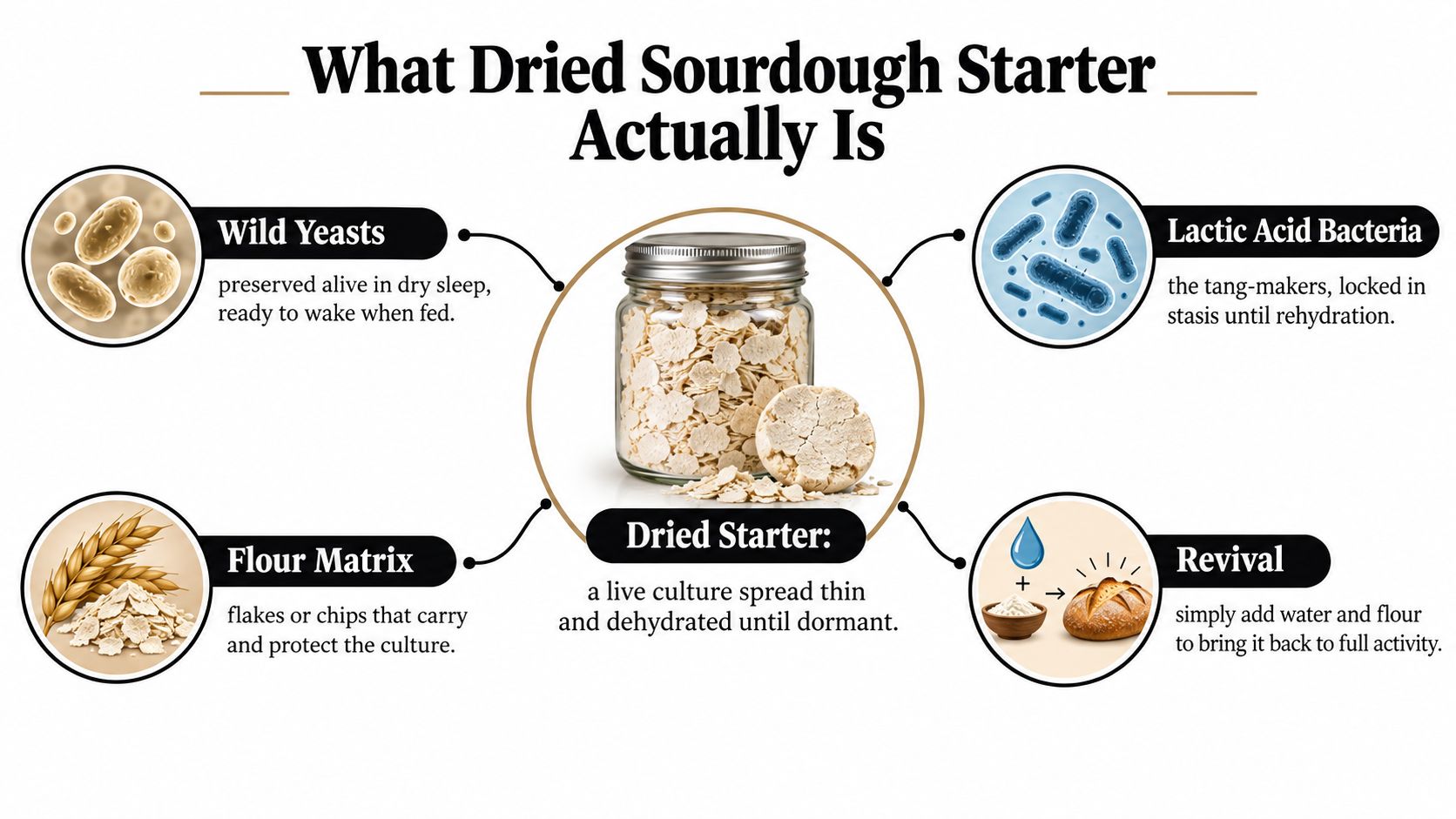
The shelf difference is the important practical point. A live starter needs regular attention, even when it lives in the fridge. Dried flakes need protection from humidity until you decide to use them. Once revived, however, they return to the familiar routine of feeding, observing rise and baking at the culture's peak.
Dried Starter Compared to Live Starter
A live starter is best understood as a working jar. It's already hydrated, fermenting and capable of being built towards a loaf. Dried starter is a preserved copy of that working culture, useful when you want to stop maintenance without giving up the option of baking later.
The choice becomes clearer when you compare the factors that affect an ordinary UK kitchen.
| Factor | Dried Starter | Live Starter |
|---|---|---|
| Viability over time | Designed for dormant storage, provided the flakes stay sealed, cool and dry | Requires ongoing feeding, even if cold storage slows activity |
| Day-to-day convenience | No feeding while stored and little cupboard space required | Ready for immediate maintenance and easier to use when already active |
| Kitchen storage | Fits in a drawer or cupboard and doesn't need refrigeration before use | Needs a jar, feeding space and a place where rise can be observed |
| Gifting and shipping | More practical for postal gifts, workshops and longer journeys because it doesn't spill or need feeding | Better for local handovers when the recipient wants to bake straight away |
| Baking performance | Needs revival and feeding before it can reliably leaven dough | Can be used as soon as it reaches a healthy peak |
| Flavour development | The revived culture can be developed through flour choice and fermentation | A mature, active jar already has an established feeding rhythm and flavour profile |
The UK has a useful historical example of why culture lineage matters. In 1990, Andrew Whitley brought sourdough from Russia to the Village Bakery in Cumbria for rye breads, retaining part of each batch to continue the culture. The starter was refreshed with organic rye flour and water and used repeatedly, a practical illustration of how a living culture can pass from bake to bake. The account of this lineage and its later dried-starter connection places dried culture within a real UK baking story rather than treating it as a novelty.
The market context also helps explain the format's appeal. The same source reports that World Bread Awards sourdough entries doubled over five years, with entries rising 40% year on year in a recent period. It also records retail sourdough sales increases of 98% at Marks & Spencer and 50% at ASDA in the cited year. Those figures don't prove that every baker needs dried starter, but they show why a convenient, shareable form of culture has found an audience.
For daily baking, live starter usually wins because you can maintain its rhythm and use it at peak activity. For occasional baking, emergency backup or gifting, dried starter earns its space. A fuller comparison of maintenance routines appears in this guide to live sourdough starter.
How to Rehydrate and Revive Dried Starter
Start with a clean small jar or bowl, a digital scale and the flour you intend to use for future feeds. Choose lukewarm water rather than hot water. Excess heat can damage a culture that is already in a vulnerable dormant state.
Follow the seller's instructions for the amount of flakes and water, because products differ in how finely they're dried and how concentrated the culture is. The aim is to soften every piece thoroughly, not leave dry chips floating on the surface.
Soften the flakes first
Place the flakes in the water and stir gently. Give them time to absorb the water and break down. A smooth paste is easier to feed than a mixture containing hard fragments, and complete softening helps you avoid mistaking undissolved flakes for inactive culture.
Add the first flour feed according to the product instructions. Stir until there are no dry pockets, scrape down the sides of the container and mark the starting level with an elastic band or washable pen. A marked jar makes small changes visible, especially when the first rise is modest.
Keep the jar at a steady room temperature, away from direct sunlight and cold draughts. Don't seal it so tightly that pressure can't escape. A loose lid or cover keeps dust out while allowing fermentation gases to leave safely.
Read the culture rather than the clock
Early signs of revival include small bubbles, a gently sour or fruity aroma and a looser texture. The mixture may rise slowly at first. That doesn't automatically mean it has failed, particularly if the flakes were stored for a long period or the room is cool.
If you see no change, move the jar to a slightly warmer, stable spot and give it another feed at the interval recommended by the seller. Use a clean spoon, keep the mixture covered and avoid repeatedly adding flour without removing some culture, because an ever-growing jar can become difficult to assess and increasingly unbalanced.
The culture is ready for bread when it behaves consistently after feeding. Look for a noticeable rise, bubbles through the mixture and an aroma that is pleasantly fermented rather than musty or rotten. Some bakers use a float test, dropping a small amount into water to see whether it remains buoyant, but treat that as a supporting sign rather than the only test. A culture that rises reliably in its jar gives you more useful information about its leavening strength.
For further help with a reluctant culture, use this practical guide to troubleshooting and revitalising a sourdough starter.
Don't judge the first loaf too harshly. The starter may be alive before it has developed the strength and predictable rhythm you remember from a mature jar. Build activity gradually, keep notes on feeding and rise, and bake when the culture repeatedly shows the same pattern.
Storage and Shelf Life That Actually Work
Dried starter lasts because moisture has been removed. It remains recoverable only when you prevent moisture from returning. The best storage habit is simple: keep the flakes in their sealed packaging or transfer them promptly to an airtight container, then store them somewhere cool, dark and dry.
UK guidance places the most reliable revival window at 12 to 18 months when dried flakes are protected from moisture and kept sealed, as explained in this advice on how long dried starter and flour last. Revival can still succeed later, but the longer storage period gives humidity, temperature changes and packaging quality more opportunity to work against you.
A kitchen cupboard is often more suitable than the fridge for unopened dried flakes. The fridge can introduce condensation when a cold pack is opened in a warm room, while a stable cupboard avoids repeated temperature changes. Keep the packet away from the kettle, dishwasher and hob, where warm, humid air regularly enters the surrounding space.
What to inspect before revival
| Storage condition | Expected viability | Packaging |
|---|---|---|
| Sealed, cool and dry cupboard | Most dependable within the stated revival window | Airtight, moisture-resistant pack |
| Opened packet in a dry cupboard | Less predictable as air and humidity enter | Reseal immediately or use a small airtight container |
| Warm or humid kitchen location | Reduced confidence, particularly if flakes clump | Move to a cooler, dry cupboard |
| Packet exposed to condensation or damp | Uncertain and more prone to failure | Discard if there is mould or a strong unpleasant odour |
Healthy flakes should remain dry and separate. Clumping suggests moisture has entered. Darkening, a musty smell or visible mould are warnings, not signs that the culture is becoming stronger. If a questionable packet produces no activity after careful rehydration and repeated feeds, it has crossed beyond a dependable backup.
Shelf-life labels vary between sellers and formats. UK listings include broad long-shelf-life descriptions as well as shorter windows of around 3 to 4 months, with freeze-dried products sometimes given different storage guidance, as noted in this UK dried-starter listing. Treat the packaging instructions as part of the product, not an optional detail.
Choosing the Right Format for Your Situation
The most useful decision isn't “Which starter is best?” Ask instead, “When do I need the starter to work?”
Gifting by post
Dried starter is usually the calmer gift. A sealed packet won't spill in a parcel, and the recipient can choose when to begin feeding it. Include clear instructions about the flour, water, container and signs of activity. A jar of live starter can be a lovely local gift, but it asks the recipient to understand feeding and timing almost immediately.
International shipping makes the difference more pronounced. Live culture travels as a wet, active food that may experience delays, temperature changes and rough handling. Dried flakes are dormant and compact, though the buyer should still check the destination's food-import rules and the seller's delivery policy.
Keeping an insurance copy
If you bake regularly, a dried portion is useful insurance. Your live jar remains the working culture, while the dried packet waits separately in a cupboard. That separation matters. If the live jar develops mould, gets knocked over or is accidentally discarded, the backup gives you another starting point.
Dried starter also suits people who return to baking in bursts. You can pause during a busy period without maintaining a jar, then revive the flakes when the oven and mixing bowl come back into use. The trade-off is that you need patience at the restart stage, so it won't replace a live starter when you want dough on the same day.
Supplying classes and workshops
For a bread class, dried starter reduces jar logistics. Each learner can receive a measured portion and begin from the same basic material, rather than sharing a single wet jar or transporting several active containers. The tutor still needs to explain that activity depends on correct feeding, flour and room conditions.
Daily bakers and established sourdough communities may prefer live culture. A mature jar is already integrated into the baker's routine, and local sharing can be immediate. Heritage cultures, including the lineage associated with Andrew Whitley's Cumbria work, may also be valued as active, ongoing traditions rather than just dormant material.
Use this rule when you're stuck: choose live starter for immediacy, and dried starter for resilience. If you bake often and enjoy feeding a culture, live is likely to feel natural. If you bake occasionally, give starters as presents or want a dependable backup, dried is often the more practical format.
Common Myths About Dried Sourdough Starter
Myth one, dried starter takes weeks to wake up. A carefully stored culture may show early activity sooner than that, but no responsible baker should promise a fixed revival time for every packet. Age, storage, drying method, flour and room temperature all matter. Watch for bubbles, aroma and rise, then continue feeding until the culture behaves consistently.
The UK guidance on dried starter explains that fully dried flakes can remain viable for years when kept airtight, while more specific advice identifies 12 to 18 months as the most reliable revival window under cool, dry, sealed conditions. This practical explanation of dried starter storage is useful because it treats drying as preservation, not magic.
Myth two, drying kills the culture. Proper drying places the culture into dormancy. It doesn't make the flakes immediately active, but it preserves the living organisms so they can be rehydrated and fed. Damp storage is the primary danger, because moisture can encourage unwanted changes before you're ready to revive the starter.
Myth three, bread made with revived starter must taste inferior. The format you stored the culture in isn't the main determinant of flavour once the starter is active again. Flour choice, hydration, fermentation time, dough temperature and the point at which you use the starter all shape the loaf.
There is one honest qualification. A dried culture needs time to regain a stable feeding rhythm, so the first bake may not reflect its full character. Once it rises predictably and smells pleasantly fermented, treat it as a functioning starter rather than a compromised imitation.
Dried starter is best understood as a different delivery method for the same type of living ecosystem. It doesn't remove the need to learn fermentation, but it can make preserving and sharing that learning easier.
Sourcing Dried Starter With Confidence
A packet tells you more than the product name if you know what to look for. Start with provenance. A seller should explain where the culture comes from, what flour has supported it and whether the product is a plain dried culture, a freeze-dried format or a blend intended for a particular flour.
Packaging deserves equal attention. Look for a sealed, moisture-resistant pack, a clear best-before date and storage instructions that tell you what to do after opening. Be cautious with claims of indefinite shelf life. Dried starter can remain viable for a long time under excellent conditions, but no packet is protected from damp handling forever.
A transparent seller should also explain revival rather than implying that flakes can go straight into dough. You want instructions for rehydration, feeding flour, room-temperature storage and what successful activity looks like. A replacement policy for culture that fails to revive can indicate that the seller is willing to stand behind its drying and packing process.
A practical buying checklist
- Check provenance: Look for a named lineage, bakery, mill or regional source rather than an unexplained strain name.
- Check the format: Confirm whether you're buying air-dried flakes, powdered culture or a freeze-dried product.
- Check the pack: Prefer airtight, humidity-resistant packaging with a clear date.
- Check the instructions: The seller should describe revival and feeding in plain language.
- Check support: Look for a clear contact route and a stated policy if the culture won't revive.
- Check suitability: Choose a culture that fits the flour you plan to use, especially if you bake with rye or need a gluten-free option.
UK mill websites, heritage grain projects, established bakery suppliers and sellers with verifiable customer feedback can all be sensible starting points. For a straightforward culture-focused option, you can also review The Sourdough Cult's dried starter and compare its instructions and format with your needs.
If you want a dependable UK culture with clear guidance, The Sourdough Cult offers live sourdough starter, dried starter and practical kits for establishing or restarting your home baking routine. Visit The Sourdough Cult to choose the format that suits your baking rhythm and get the support needed to feed, store and bake with confidence.


