

You've fed your jar, marked the level, and returned to the kitchen expecting a lively dome. Instead, the rye mixture has spread itself into a sticky paste, produced a few bubbles at the edges, and smells sharper than yesterday. In a cool UK kitchen, that can look like failure. Often, it's just a sign that you're judging rye by wheat-starter rules.
A rye sourdough starter needs a different reading. Rise matters, but so do acidity, aroma, gas production, temperature and the moment when the culture reaches its peak. This guide shows you how to build one, feed it sensibly, recognise functional readiness, troubleshoot the odd behaviour, and use fermentation benefits without turning them into exaggerated health promises.
Table of Contents
- Why Bakers Choose a Rye Sourdough Starter
- What a Rye Starter Actually Is
- Rye Starter vs Wheat Starter
- How to Build a Rye Starter from Scratch or by Conversion
- Feeding Schedules, Ratios, and How to Know It Is Ready
- Troubleshooting a Rye Starter That Misbehaves
- Baking with Your Rye Starter
- Rye Starter Questions UK Bakers Actually Ask
Why Bakers Choose a Rye Sourdough Starter
The jar on your worktop may be doing more than it appears to be doing. Rye flour usually makes a looser, darker and more aromatic culture than white wheat flour, so a starter that barely forms a dome may still be producing plenty of gas and acid. The useful question isn't “Is my starter alive?” It's, “Is it fermenting rye in a way that will support the bread I want to bake?”
Rye has a long history in Britain. Archaeobotanical evidence places its use in Britain and Ireland by at least the early Iron Age, and rye later became one of the important grains in Britain alongside barley, wheat and oats during the emergence of Anglo-Saxon crop husbandry in the 8th century. Its importance declined from the 1700s as wheat varieties and farming methods improved, then returned in practical form during the First World War, when restricted wheat imports contributed to dark-coloured “War Bread” made with domestic rye, as explained by the Real Bread Campaign's history of rye.
That background helps explain rye's character in the mixing bowl. Rye sourdough is associated with dense loaves, deep grain flavour and deliberate acidity, not the tall, elastic crumb many bakers expect from strong white flour.
A useful change of habit: read rye by its fermentation pattern, not by the height of its rise alone.
You'll find that the same culture can look sluggish in a cold kitchen, peak quickly after a warm feed, or collapse before you check it. Once you understand what the flour, microbes and acidity are doing, the jar becomes much less mysterious.
What a Rye Starter Actually Is
A starter is a living culture of lactic acid bacteria and wild yeasts held in hydrated flour. The bacteria create organic acids, while the yeasts produce carbon dioxide and other fermentation compounds. Rye flour supplies the food and minerals, and water creates the environment in which those organisms can multiply and move through the mixture.
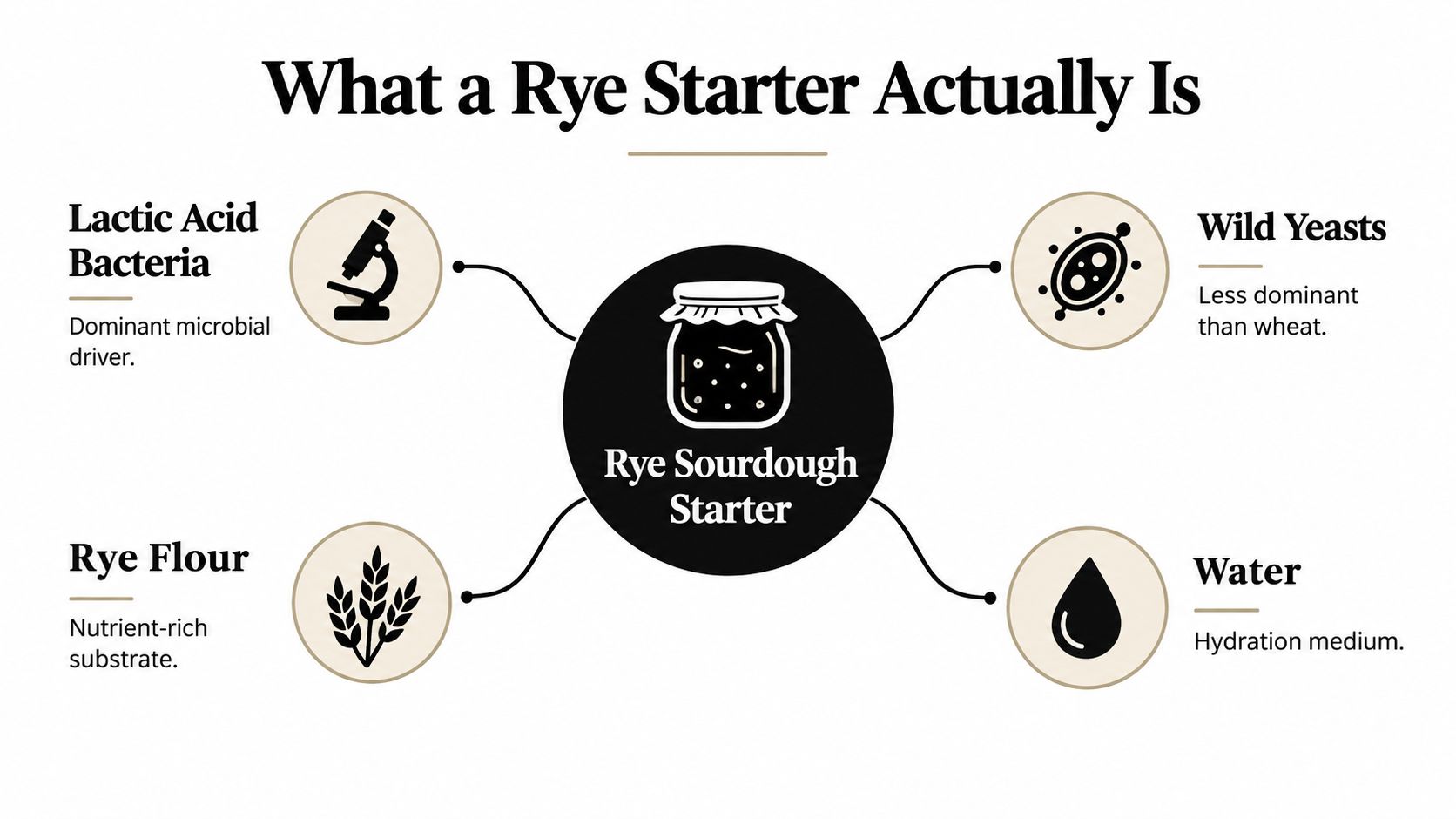
A wheat starter behaves a little like a balloon. Gluten-forming proteins help create a stretchy network that holds fermentation gases, so the mixture can rise visibly. Rye has much less gluten-forming capacity. Its pentosans and other water-binding compounds make the culture feel more like a sponge or thick paste, holding moisture without creating the same elastic framework.
That difference affects your observations:
- Texture: Rye starter may be sticky, porridge-like or surprisingly loose.
- Bubbles: Gas can be obvious at the sides and surface without producing a high dome.
- Aroma: A clean, sharp or fruity acidity is normal as the culture develops.
- Peak: Rye can reach its strongest point and begin receding before it has doubled dramatically.
Rye also needs purposeful acidification. Its relatively high buffering capacity resists changes in acidity, while alpha-amylase activity is particularly relevant in rye systems. Alpha-amylase is most active around pH 5.0 to 5.5, and fermentation progressively inhibits that activity as the pH falls. A practical rye-bread endpoint is approximately pH 3.8 to 4.2, which helps limit excessive starch breakdown during baking and reduces the risk of a gummy crumb, according to this technical guide to rye sourdough methods.
You don't need a pH meter to maintain a starter successfully, but you do need to respect the principle. A mature culture should smell cleanly acidic, show active gas production and be used before it has collapsed into an exhausted, separated mixture.
Rye Starter vs Wheat Starter
The easiest way to stop making incorrect judgements is to compare the cultures by behaviour rather than appearance.
| Property | Rye starter | Wheat starter |
|---|---|---|
| Texture | Paste-like, sticky or loose | More elastic and dough-like |
| Rise profile | May rise modestly, peak quickly and recede | Often forms a taller, clearer dome |
| Gas retention | Limited by rye's weaker gluten structure | Improved by gluten-based structure |
| Aroma | Often sharper, earthier or more pronounced | Can smell milder or wheaty |
| Fermentation reading | Bubbles, acidity and timing are important | Volume is often a more obvious guide |
| Bread effect | Supports close, moist, flavourful loaves | Supports lighter, more open structures |
These are useful tendencies, not laws. Hydration, flour extraction, temperature, inoculation and feeding frequency can change the way any culture behaves.
Texture and rise
A wheat starter often gives you a satisfying visual cue. It stretches as it fills with gas, rises above a mark and develops a rounded top. Rye can ferment vigorously while remaining comparatively flat because its structure doesn't trap gas in the same way.
That's why a rye culture may appear thinner after fermentation. Enzymes and acids alter the flour, while the mixture loses the firmness it had immediately after feeding. If you see bubbles throughout the jar and the aroma is pleasantly sour, a loose consistency may be a sign of maturity rather than weakness.
Flavour and fermentation
Rye commonly produces a more assertive grain and acid profile. That makes it valuable when you want a dark, dense loaf with a distinct fermented character. A wheat starter may suit a mild everyday loaf, while rye gives you a more expressive base for rye-wheat breads, crispbreads or a traditional-style tin loaf.
Rye can also move through its peak quickly, especially when kept warm or fed with a large amount of mature starter. A cool worktop slows that process, but the culture may still pass its peak while you're asleep. Marking the jar and noting the time of rise is more useful than relying on a universal timetable.
Why bakers keep both
There's no rule saying you must choose one flour forever. Some bakers maintain a rye culture for its reliability and flavour, then build a wheat levain for a lighter loaf. Others feed one mother culture with a blend, using more rye when they want stronger fermentation cues and more white flour when they want a milder, more elastic levain.
For a practical flour comparison before choosing your maintenance blend, see this UK artisan guide to flour for sourdough starters. The key is consistency. Once you know how your chosen flour behaves, you can recognise a change caused by temperature or feeding rather than mistaking normal rye behaviour for a problem.
How to Build a Rye Starter from Scratch or by Conversion
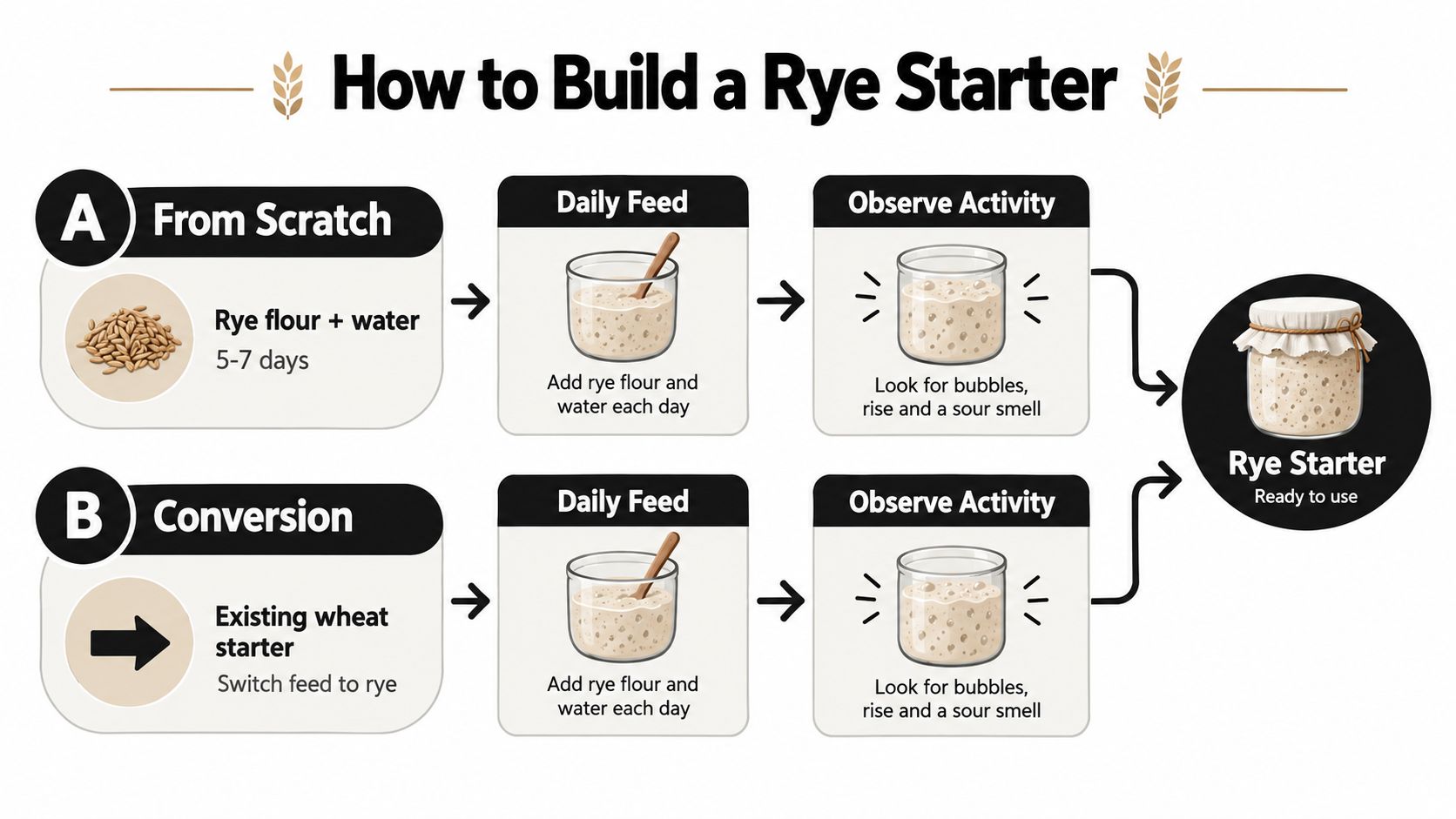
You can begin with rye flour and water, or convert a wheat starter that already ferments reliably. Starting from scratch gives you a new culture to observe. Conversion is quicker because the existing microbial community is already established.
Starting from scratch
Use equal weights of rye flour and water for a simple liquid culture. Keep the jar loosely covered, not sealed, and place it somewhere stable. A cool kitchen will lengthen the process, so treat the early schedule as a guide rather than a promise.
- Mix a small quantity of rye flour and water until no dry flour remains.
- Leave it undisturbed, then inspect it for bubbles and a developing tang.
- At the next refreshment, retain a small amount and add fresh rye flour and water.
- Repeat daily, adjusting the interval if the culture peaks and collapses sooner.
- Mark the jar after every feed so you can see small changes that your eye may miss.
A practical maintenance refreshment is 1:5:5 by weight, meaning one part starter, five parts rye flour and five parts water. A target environment near 24 to 26°C generally supports a useful balance between bacterial acid production and yeast gas production, while cooler UK rooms will slow maturation. The research summary for sourdough technology and culture maintenance also emphasises controlled refreshment and temperature rather than age alone.
Converting a wheat starter
Keep a small amount of your established wheat starter and feed it with rye flour and water. Repeat the rye feed for several refreshments. The culture may change texture and aroma immediately, but give it time to settle into the new flour.
Don't judge conversion by one feed. Look for a repeatable pattern, such as bubbles appearing at a similar stage after each refreshment and a clean acidic smell rather than a random burst of activity.
For a visual demonstration of the two approaches, watch this short rye sourdough starter building video.
A mature live culture can also remove the uncertain early stage. Whether you build from flour or begin with an existing culture, the important test is repeatability. A starter that behaves consistently across several feeds is more useful than one that produces one dramatic rise.
Feeding Schedules, Ratios, and How to Know It Is Ready
A feeding ratio controls how much fresh food the culture receives and how long it has before the next refreshment. For a rye starter on the worktop, 1:5:5 is a useful starting point. Keep one part mature starter, add five parts flour and five parts water, then record what happens.
At room temperature, many bakers refresh between every 12 and 24 hours, but your jar decides the exact timing. In a warm spot, a smaller inoculation can extend the window. In a cold kitchen, the same feed may need longer before it reaches peak activity. A fridge reduces feeding frequency, but it doesn't remove the need for regular refreshment when you want to bake.
Mark the level immediately after feeding. Write the time beside it, then check at intervals. You're learning:
- When bubbles first appear, which shows fermentation has begun.
- When the mixture expands most strongly, even if the increase is modest.
- When the aroma turns cleanly sour, rather than harsh or solvent-like.
- When the surface begins to flatten or recede, which marks the end of the peak window.
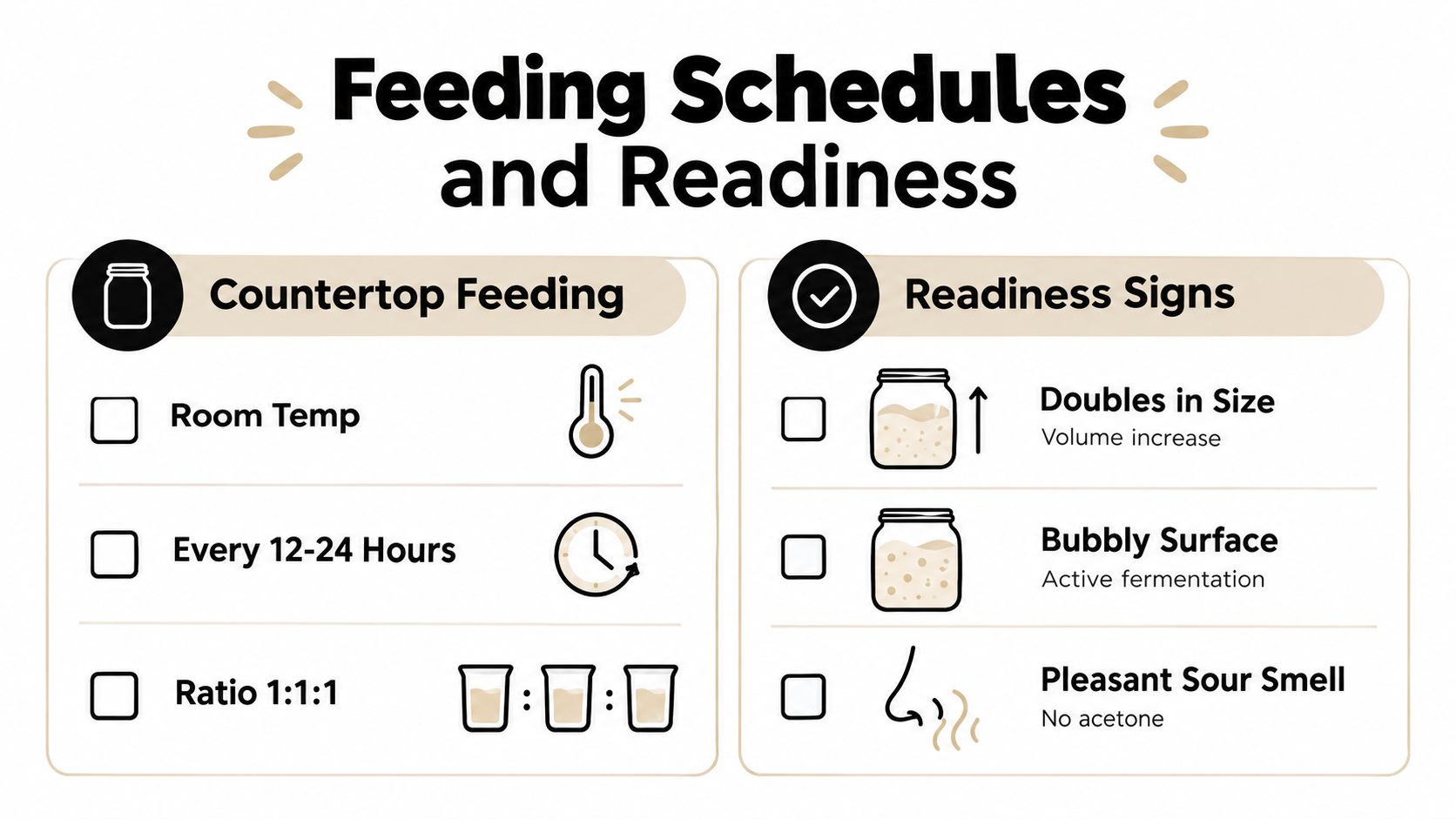
“Doubled” is a convenient wheat-starter shortcut, not a universal rye rule. A rye starter may be ready when it has expanded, aerated, loosened and reached its strongest aroma, even if the level never reaches twice its starting height.
Use this checklist before mixing dough:
- The starter contains bubbles through the mixture, not only a few marks on top.
- The aroma is pleasantly acidic, grainy or fruity, without a strong solvent note.
- The mixture has expanded or become visibly aerated.
- The surface is at, or just approaching, its peak rather than fully sunken.
- The timing matches your previous feeds at a similar temperature.
For more guidance on adapting feeding frequency to your routine, use this UK sourdough starter feeding guide. A pancake batter can tolerate a starter that is past its prime. A dense rye loaf benefits from a culture whose acidity and gas production are both strong, so peak timing deserves more attention.
Troubleshooting a Rye Starter That Misbehaves
Rye starters often look dramatic. They can become runny, smell sharp and collapse soon after reaching their most active point. Those signs don't automatically mean the culture is dead.
Read the symptom before changing everything
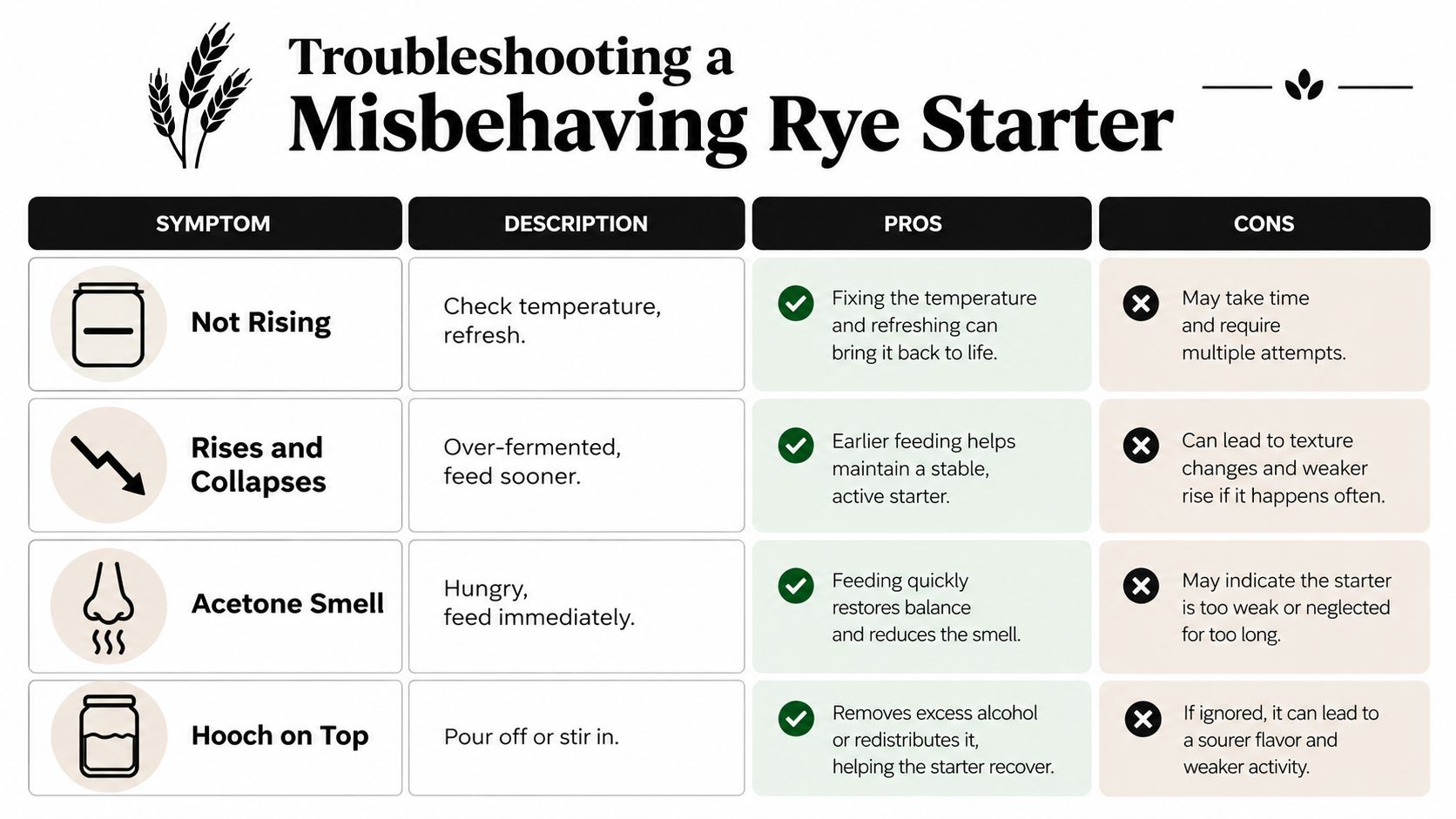
It barely rises: Check the room temperature, the flour and the timing. A cool kitchen may be slowing the culture. Refresh with a smaller amount of old starter, keep the jar somewhere steadier and look for bubbles rather than waiting for a tall dome.
It rises and collapses quickly: The culture has probably exhausted its fresh food before you checked it. Use a larger refreshment, reduce the carryover, or feed sooner. A collapse tells you that fermentation happened, even if the timing wasn't convenient.
It smells of acetone or nail polish: The starter is hungry or over-fermented. Refresh it promptly, retain only a small amount and give it more fresh flour and water. A clean sharp acidity is different from a harsh solvent smell.
There's liquid on top: A brownish or grey liquid can appear when the culture has fermented past its comfortable feeding window. Stirring it in or pouring it off are both practical options, followed by a refreshment. Watch whether the same separation keeps returning.
It turns pink, orange or visibly mouldy: Don't try to rescue a culture with unusual colours or mould. Discard it, clean the jar thoroughly and begin again with fresh flour and water.
It becomes sticky and paste-like: That may be normal rye behaviour, especially after fermentation has softened the mixture. Judge the paste alongside bubbles, aroma and timing. If the crumb of the bread is also gummy, focus on stronger acidification and the dough process rather than just adding more flour.
Keep going when: the culture smells cleanly sour, produces gas and responds predictably to refreshment.
Start over when: you see mould or unusual colour, or the smell remains putrid after a fresh feed.
For a broader care routine, consult this guide to revitalising a sourdough culture. Change one variable at a time. If you alter flour, temperature, ratio and feeding interval together, you won't know which change solved the problem.
Baking with Your Rye Starter
You have a lively rye starter on the worktop and a first loaf planned for a cool UK kitchen. It does not commit you to a 100% rye loaf. Treat it as a fermented base whose texture and flavour you can direct through the levain you build from it.
For a first rye loaf, try 30% rye and 70% strong white flour. Rye contributes flavour, colour and fermentation character, while wheat supplies more structure and makes the dough easier to handle. Once that feels familiar, move towards a fully rye loaf with a stiffer levain and a controlled souring stage. A rye-wheat boule sits between the two, giving you enough wheat structure for shaping while keeping rye's grain character clear.
Choose the levain for the loaf
A liquid rye levain is easy to stir into a soft dough. It suits lighter rye-wheat breads and tin loaves. A stiff rye levain contains less water, which can help you make a denser, more traditional loaf with a concentrated fermented flavour.
For a substantial rye dough, set aside wheat-dough expectations. Rye's structure comes mainly from starches and water-binding compounds, not from a strong gluten network. Repeated kneading and forceful shaping will not create the same elasticity. Mix thoroughly, allow the dough to ferment, then shape it with restraint.
Rye dough also needs enough acidification. Alpha-amylase can remain active at higher pH, so an under-acidified dough may bake with a sticky or gummy crumb. Use the starter's aroma, acidity and peak timing as practical clues. Where possible, measure acidity as well. A long fermentation is not automatically a better one.
Separate evidence from health claims
Sourdough fermentation can reduce phytic acid in rye systems. One study reported a reduction of roughly 100% within 24 hours under its test conditions, with the result depending on acidity and enzyme activity, as described in this research on lactic acid bacteria and phytate degradation. A review of rye sourdough bread reported maximum reductions of about 85.5% under specific conditions. Results varied with temperature, duration, pH, flour and process, as discussed in this review of sourdough fermentation and nutrition.
Those findings describe particular fermentation systems, not every loaf made at home. They also do not show that every rye sourdough is easier for everyone to digest. Rye contains gluten and is unsuitable for people with coeliac disease. Rye sourdough cannot automatically be called gluten-free or low-FODMAP. The nutritional effect depends on the flour, portion, acidity and complete dough fermentation, not on starter care alone.
Keep the equipment simple
A digital scale, a marked jar and a banneton cover most of the work. A pH meter can help if you bake rye regularly, but it is not needed to learn your culture's rhythm. Record the flour, water, temperature, feeding ratio and peak time in a notebook. Those notes are particularly useful while you establish a routine in a cool kitchen.
UK supermarket sourdough sales have grown sharply since 2024, so more home bakers are meeting rye for the first time. The increased attention makes practical guidance useful: a loaf's label or popularity does not tell you whether its fermentation was suitable for your flour and method.
UK bakers also have an established supply of rye. In 2024, UK rye consumption was reported at approximately 193,000 tonnes and domestic production at about 186,000 tonnes, with roughly 43,000 hectares harvested, according to this UK rye market overview. These market estimates are not the same as official government agricultural statistics, but they indicate that rye flour is an accessible ingredient rather than one dependent entirely on specialist imports.
Rye Starter Questions UK Bakers Actually Ask
Which jar works best?
Choose a wide-mouth glass jar with enough room for expansion and a loose-fitting lid. The opening should let you stir a thick rye paste without scraping your knuckles against the glass, and the sides should make bubbles easy to inspect.
Avoid sealing an actively fermenting starter tightly. Mark the level after feeding with an elastic band, a piece of tape or a washable pen, then write the feeding time beside it.
How do I revive one from the fridge?
Take the jar out, inspect the surface and allow the culture to warm gradually. Retain a small amount, feed it with fresh rye flour and water, and watch for a clear response rather than expecting the first refreshment to be bake-ready.
If the starter has been neglected for a while, repeat the feed when it reaches peak activity or begins to recede. A cool kitchen may require patience, while a warmer spot will shorten the interval. Start with a small bake once the culture shows repeatable bubbles, acidity and gas production.
Can I gift or share a rye starter?
Yes. A live culture is straightforward to share in a clean jar with feeding instructions, while a dried culture is useful when transport or storage time makes a live paste impractical. Give the recipient the flour type, refreshment ratio and temperature guidance you've been using, because a starter changes as it adapts to a new kitchen.
To share safely, use a clean utensil and separate jar. Don't dip a used spoon into the mother culture after touching another flour or starter. Include the date of the last feed and a simple note explaining what healthy activity looks like.
A reliable starter gift should include practical instructions, not just a jar of paste. For UK bakers, delivery, packaging and replacement arrangements can matter as much as the culture itself, particularly when the recipient is new to fermentation.
If you want to skip the uncertain early days, The Sourdough Cult offers live Cheshire sourdough starter, beginner kits, jars and clear feeding guidance for UK home bakers. Choose the starter or kit that matches your equipment, then use the rise tracker and peak-time checks from this guide to build a dependable rye baking routine.


