

Under UK rules, organic white bread flour may contain added folic acid, while organic status still requires at least 95% organic agricultural ingredients. For sourdough, the flour's published protein content and water absorption matter more than the organic label alone.
You've chosen a bag of organic strong bread flour, mixed your dough carefully, and expected a tall, open loaf. Instead, it spreads across the baking tray, feels sticky during shaping, and comes out with a close, heavy crumb. The frustrating part is that the flour may be perfectly good. It may just not suit the hydration, fermentation time, or loaf style you're using.
Organic flour can be an excellent choice for sourdough, but certification describes how the wheat was produced, not how strongly the flour will hold a wet dough. Once you separate those two questions, the bag becomes easier to assess. Look for protein information, flour type, milling details, and the dough's behaviour in your kitchen. Treat “organic” as one useful part of the decision, not the whole specification.
Table of Contents
- The Organic Label That Doesn't Tell You Everything
- What UK Organic Certification Guarantees
- Protein Levels and How Organic Flour Behaves
- How to Choose the Right Organic Bread Flour
- Substitution and Baking Adjustments for Sourdough
- Making Organic Flour Work for Your Sourdough
The Organic Label That Doesn't Tell You Everything
A familiar baking mistake starts in the flour aisle. You see “organic strong white bread flour”, assume it will tolerate a generous sourdough hydration, and follow a recipe designed around a different mill's flour. The first mix feels promising. After fermentation, though, the dough has lost tension, the folds don't build much structure, and the shaped loaf relaxes before it reaches the oven.
The organic certification hasn't failed. It has answered a different question.
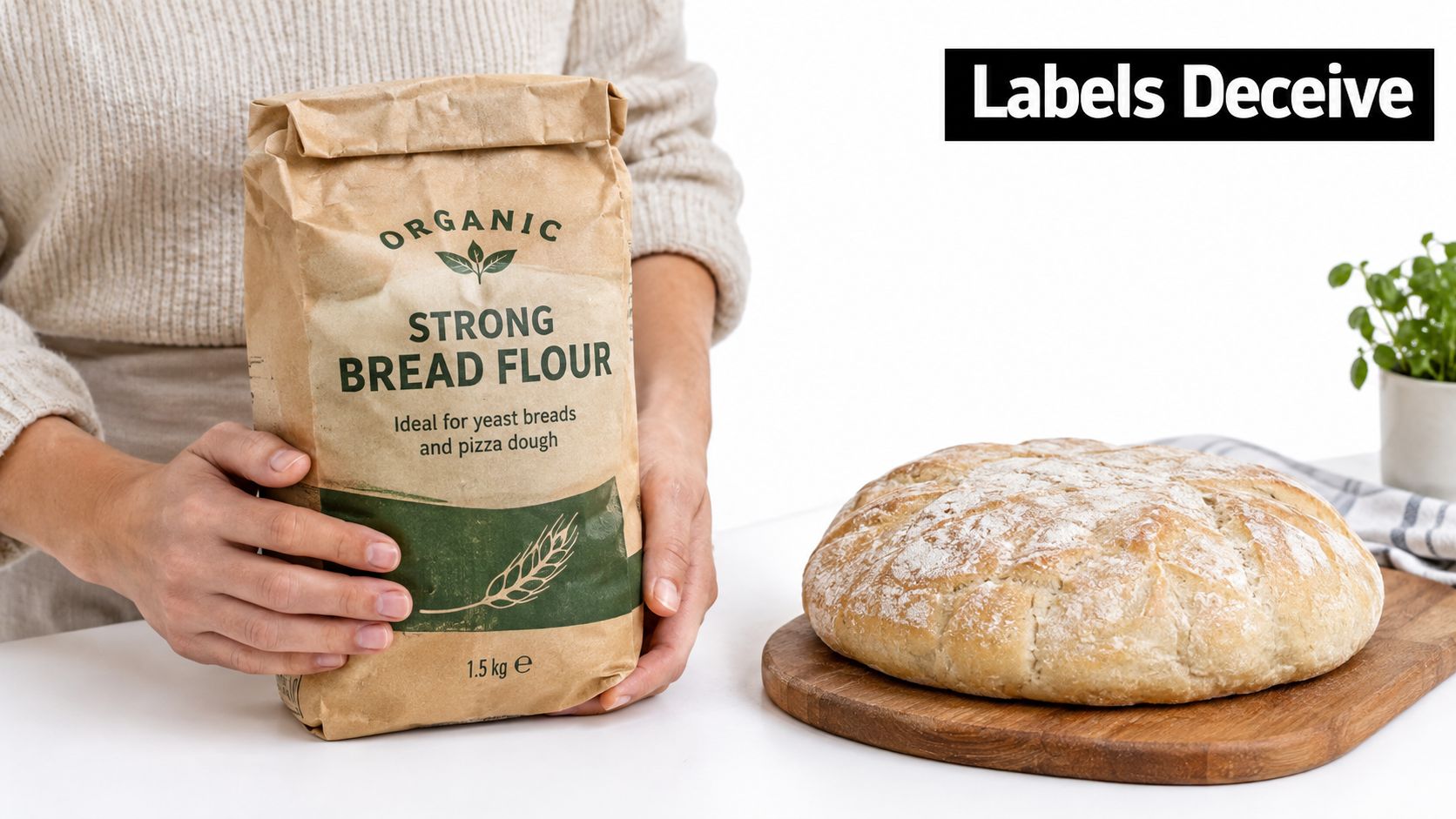
Farming system versus baking specification
The word organic refers primarily to the production system and the rules governing the agricultural ingredients. It doesn't guarantee a particular gluten strength, absorption level, extraction rate, crumb softness, or oven spring. Two certified organic bread flours can therefore behave very differently in the same sourdough formula.
Protein is a useful starting point, but even protein alone doesn't tell the whole story. Protein quantity interacts with protein quality, starch damage, moisture, bran, fibre, and milling. A flour with a respectable protein figure can still produce a slack dough if it absorbs less water than your recipe assumes or if its gluten network doesn't tolerate extended fermentation.
Practical rule: Choose organic flour for its production standards, then choose its baking role from the specification and your own dough tests.
The label “strong” is also less precise than many home bakers realise. It may indicate a flour intended for bread, but it doesn't always reveal the protein value or the mill's preferred hydration. If the packaging gives no useful specification, contact the mill or retailer rather than guessing from the front of the bag.
What a successful test tells you
A small test bake is more informative than a premium-looking package. Mix conservatively, hold back some water, and watch whether the dough gains strength during rests and folds. A flour that produces a manageable dough with good elasticity at a slightly lower hydration may be a better everyday choice than one that promises strength but turns sticky when pushed.
The most reliable approach is spec-first selection. Check the protein percentage, identify whether the flour is white or wholemeal, note the milling information, and then match the flour to your fermentation schedule. Organic certification can align with your farming and sourcing priorities, but it shouldn't be used as a shortcut for predicting loaf performance.
What UK Organic Certification Guarantees
A bag of organic white bread flour can meet UK organic requirements and still behave differently from another flour in your sourdough. Certification sets a production baseline. A product may use the organic label only when it follows the relevant organic-production requirements and contains at least 95% organic agricultural ingredients, as set out in the UK organic food labelling rules. That threshold gives useful information about the ingredients and farming system, but it does not guarantee flour strong enough for every recipe.
Organic standards also do not mean that every organic white flour contains only naturally occurring substances. The important UK exception is folic acid fortification. The 2024 amendment to the Bread and Flour Regulations requires folic acid in most non-wholemeal wheat flour sold in the UK, with compliance required by 13 December 2026. The requirement covers certified organic flour as well as conventional flour.
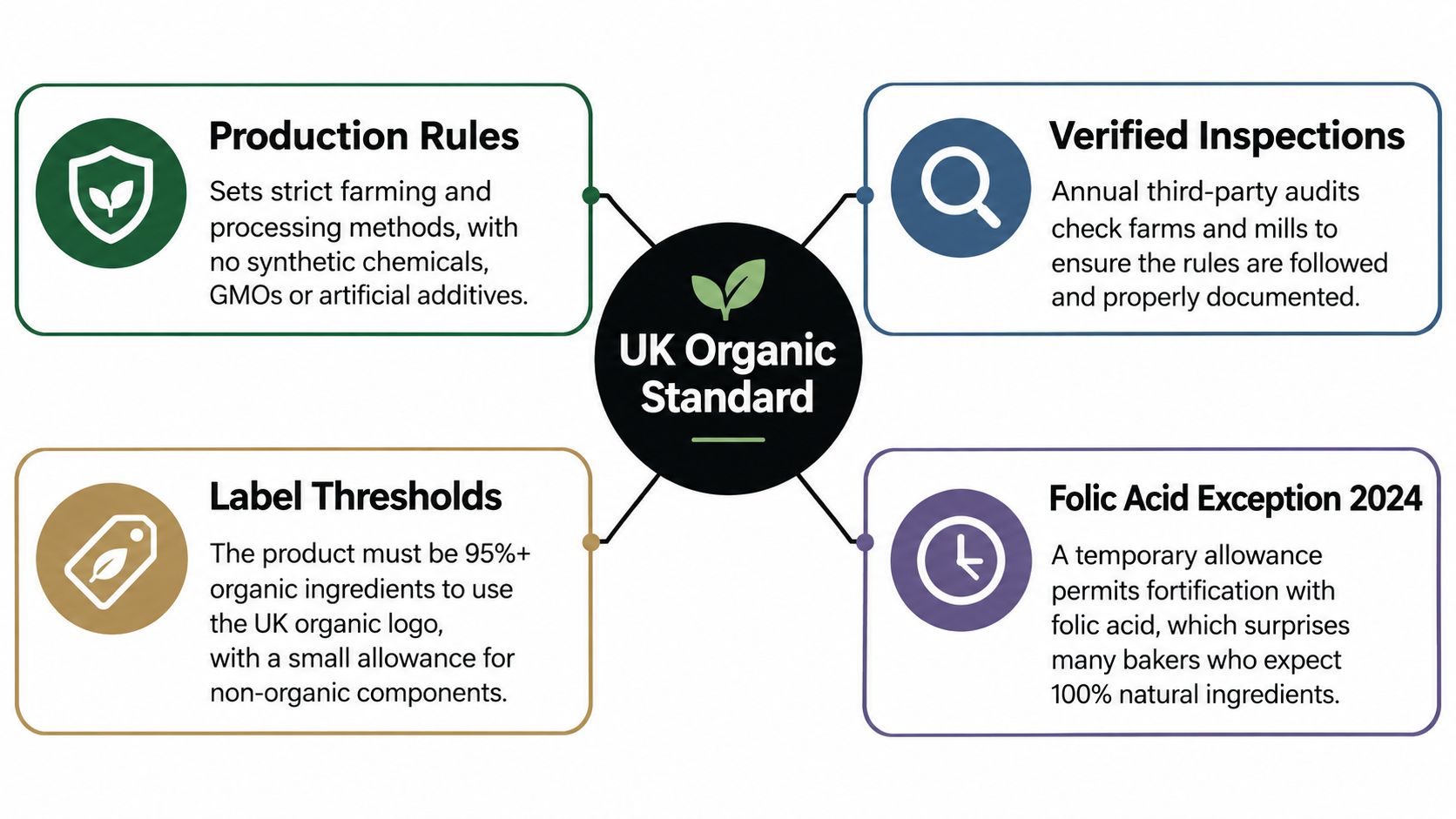
The folic acid exception
Organic standards generally restrict fortification unless legislation requires it. As a result, organic white bread flour may legally contain added folic acid and still qualify as organic. This legal exception does not reflect on the flour's suitability for sourdough. It matters when you want to know precisely what is in the bag.
Wholemeal wheat flour is not subject to the same folic-acid requirement. Check the ingredients panel alongside the flour description. Organic, white, and wholemeal identify different features of the product. An organic logo does not confirm that flour is unfortified, and white flour does not necessarily contain only nutrients naturally present in wheat.
A specialised supply base
Organic wheat comes from a comparatively limited agricultural system. In 2023, the UK had 498,000 hectares of organically farmed land, representing 2.9% of total farmed area. Cereals occupied approximately 50,000 hectares, or 10% of organic land. Organic wheat covered approximately 19,500 hectares, including fully converted and in-conversion land, equal to about 1.1% of the UK's total wheat area. These figures are reported in the 2023 UK organic farming statistics.
England accounted for the largest share, with 43,200 hectares of organic cereals and 18,200 hectares of organic wheat that year. Organic flour therefore relies on a specialised supply base before entering the wider national milling and distribution chain. In practical terms, that can affect availability, batch-to-batch consistency, and how much detail a mill can provide about grain sourcing.
Protein Levels and How Organic Flour Behaves
Protein is the specification I check first when I'm choosing an organic flour for sourdough. It doesn't provide a complete prediction, but it gives you a better starting point than the word “organic” or “strong” printed on the front of the packet.
UK wheat protein can vary roughly from 10% to 15%, while the protein target associated with bread-making is about 13% in grain, corresponding to approximately 11% in flour, according to the review of UK wheat and nitrogen relationships in the Journal of Experimental Botany. The same review explains why protein can be a complicated agricultural target, since the nitrogen input that supports bread-making protein isn't necessarily the same input that maximises yield.
Moderate protein for flavour and control
A moderate-protein organic white flour can make excellent sourdough when the dough is mixed and hydrated with restraint. It may feel soft and extensible rather than powerfully elastic, which can suit a loaf with a close, even crumb and a more relaxed fermentation schedule.
The trade-off appears when you use a wet formula, a long bulk fermentation, or a very warm kitchen. The dough may spread sooner, and the baker has less room for error during shaping. Holding back water and building strength gradually often works better than adding more folds after the dough has already become slack.
Higher protein for demanding doughs
A higher-protein organic bread flour generally offers more support for doughs that need to retain gas through fermentation and shaping. That doesn't mean it will automatically produce a better loaf. If you add water until the dough becomes loose, a high protein figure won't rescue poor process control.
Protein quality matters as well as protein quantity. UK research indicates that a higher proportion of glutenins can improve dough elasticity even when wheat is grown with lower nitrogen inputs. The Chorleywood Bread Process commonly specifies approximately 13% protein for factory bread production, but a home sourdough baker shouldn't treat that industrial benchmark as a compulsory target for every loaf.
| Flour choice | What you may notice | Best response |
|---|---|---|
| Moderate protein | Softer dough with less tolerance for excess water or prolonged fermentation | Begin with restrained hydration and finish bulk fermentation by dough strength |
| Higher protein | More resistance and elasticity, especially during shaping | Add water gradually and avoid assuming the flour can absorb unlimited hydration |
| Wholemeal organic flour | Bran and fibre absorb water and can interfere mechanically with gluten development | Allow thorough hydration and expect a different crumb and handling routine |
Protein tells you where to start. Dough strength, absorption, and fermentation tell you when to stop.
The useful comparison isn't “organic versus conventional”. It's flour specification versus recipe demand. A strong, well-specified organic flour can be a sensible choice for open-crumb sourdough, while a lower-protein flour may suit a denser loaf or a blend. Test the flour at the hydration you can handle, not the hydration you hope it will tolerate.
How to Choose the Right Organic Bread Flour
Start with the back of the bag, not the organic logo on the front. A useful flour specification should tell you whether you're buying white, wholemeal, or another extraction type, and it should ideally publish protein content. If the mill also gives absorption or milling information, you have a much stronger basis for adapting a recipe.
A practical buying checklist
- Read the protein value: For a sourdough white flour, a published value in the stronger bread-flour range gives you a more useful starting point than an unqualified “strong” claim. Don't use the figure as a guarantee of loaf volume.
- Identify the extraction level: White flour and wholemeal flour don't behave as interchangeable ingredients. Bran and fibre alter water demand and can disrupt gluten development, so wholemeal usually needs a different method.
- Check the mill information: A milling date can help you compare batches and understand changes in fermentation or absorption. Fresh flour may behave differently from flour that has been stored for longer, so keep notes rather than changing several variables at once.
- Ask about absorption: Water absorption depends on protein, starch damage, moisture, and other flour characteristics. A mill that can provide useful technical information makes recipe adjustment easier.
- Match the flour to the loaf: Choose a flour with enough structure for a high-hydration, open loaf, or select a gentler flour when you want easier handling and a more even crumb.
- Buy a manageable quantity: A small bag lets you test mixing, bulk fermentation, shaping, and proofing before you commit to a larger supply.
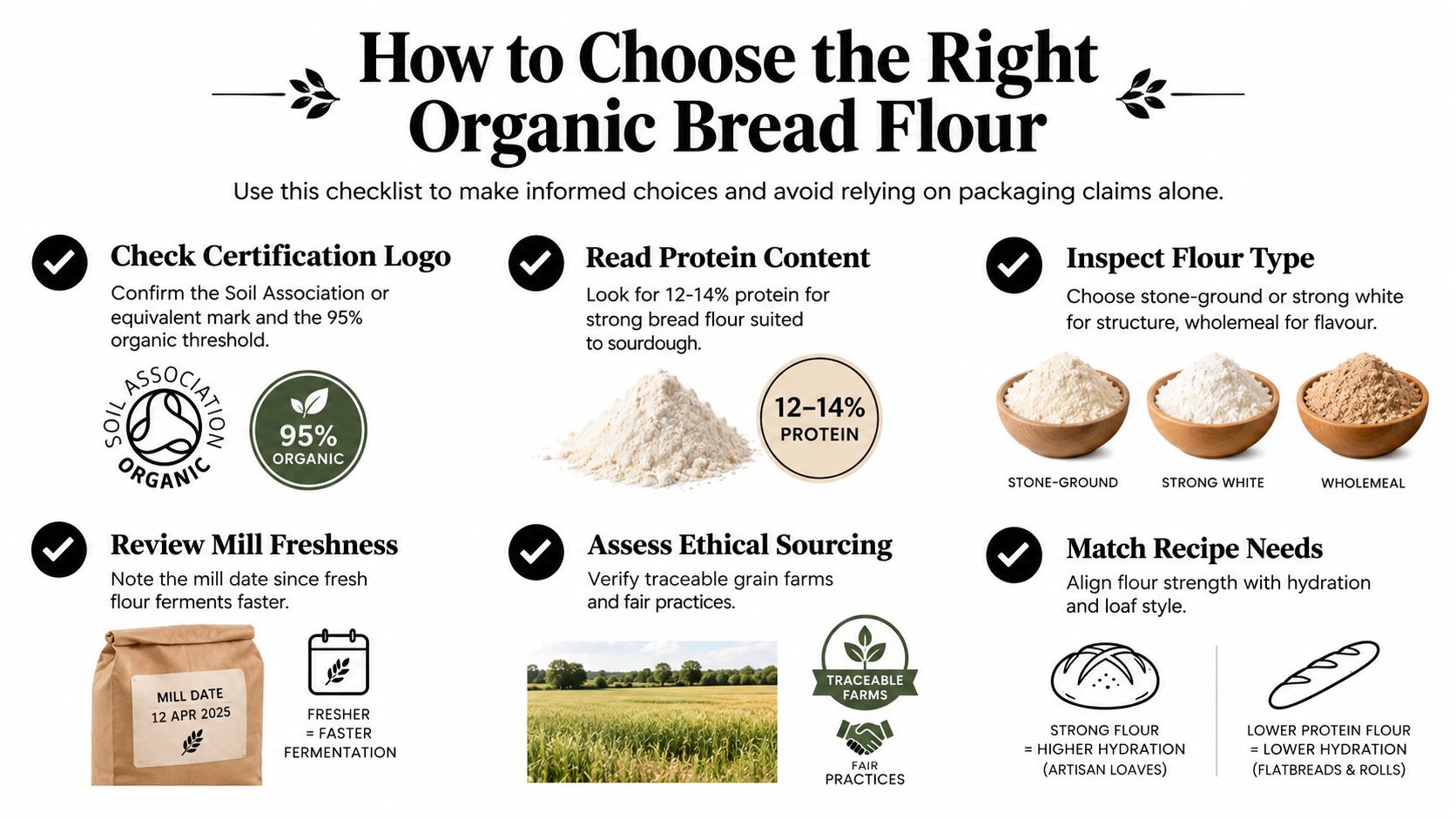
Test hydration instead of copying the packet
AHDB describes water absorption as a major determinant of bread-making performance. Its analysis of UK wheat datasets from 2013, 2016, 2017, and 2018 found that the Farrand equation, using protein, starch damage, and moisture, explained 74.9% of the variation in flour water absorption. The full technical discussion is available in AHDB's analysis of UK wheat flour water absorption.
You don't need a laboratory to use that principle. Mix the flour and starter with most of the planned water, leave the dough to rest briefly, then add the reserved water only if the dough has enough strength to accept it. This staged approach prevents a low-absorption flour from becoming liquid before gluten development has started.
For a practical sourdough reference, compare your flour choice with this guide to the best flour for a sourdough starter in the UK. The point isn't to find one universally superior bag. It's to understand how flour type and protein affect the routine you already use.
Substitution and Baking Adjustments for Sourdough
Switching from conventional flour to organic flour isn't always a one-for-one substitution. The visible change may be a softer dough, but the cause could be different protein quality, altered absorption, more bran, or a different milling profile. Treat the first bake as a calibration rather than proof that the flour is good or bad.
Control the water first
Reserve 5% to 10% of the recipe water, mix the flour and starter, and add the rest after a short hydration period if the dough still has strength. This practical benchmark comes from the AHDB guidance cited earlier. It gives you control at the point where many doughs go wrong, before excess water makes the gluten network difficult to build.
Wholemeal organic flour needs particular care. Bran and fibre compete for water, but they can also cut gluten strands. Wholemeal flours generally require gluten fortification to reach loaf volumes equivalent to white flour from the same grain, so replacing white flour with wholemeal and keeping every other variable unchanged usually produces a tighter, heavier loaf.
Adjust fermentation by observation
A dough with less structural support may appear to ferment quickly because it spreads, not because the starter has suddenly become unusually vigorous. Look for a combination of aeration, elasticity, volume development, and a dough surface that still holds tension. Don't extend bulk fermentation merely because the dough hasn't formed the shape you expected.
Stretch-and-folds should strengthen the dough, not punish it. Use gentle folds early, then leave sufficient resting time for the dough to organise itself. If the dough tears repeatedly, reduce the water in the next bake or blend the flour with a stronger white flour rather than adding constant mechanical work.
Keep your starter out of the blame
A healthy starter can ferment dough made with many flour types, but the dough's hydration and mineral content affect how active it looks and how quickly it peaks. Feed and use the culture consistently while you test the new flour. The guide to feeding a sourdough starter without killing it is useful when you need to separate starter maintenance from dough troubleshooting.
Dough test: If the starter rises normally but the loaf spreads, investigate flour strength, hydration, and proofing before assuming the culture is weak.
For wholemeal, allow enough time for the bran to hydrate before judging the dough. For white organic bread flour, a shorter initial rest may be enough, but the correct choice depends on absorption and flour freshness. Shape when the dough has sufficient strength, not when the recipe clock says it should be ready.
Making Organic Flour Work for Your Sourdough
The baker who gets consistent results with organic flour usually changes one habit first: they stop treating the organic label as a performance guarantee. A bag marked organic can still be the right choice, but the decision becomes more reliable when protein, flour type, absorption, and dough behaviour guide the recipe.
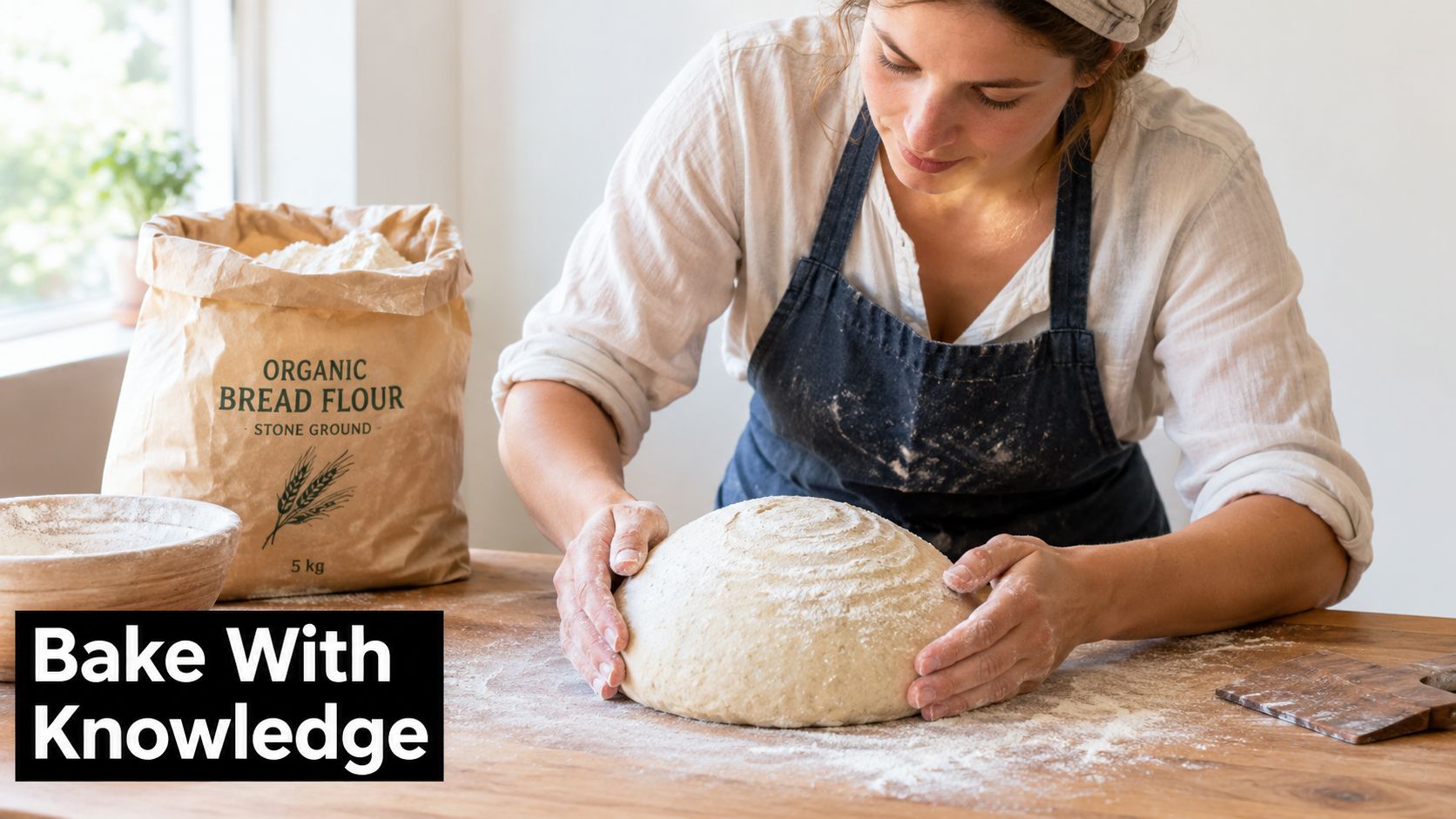
A useful kitchen routine is simple. Record the flour name, protein value, flour type, water added, room conditions, bulk fermentation, and final result. The next time the dough feels sticky or the loaf lacks height, you'll know whether to reduce hydration, shorten fermentation, strengthen the flour blend, or change the shaping point.
Ask the miller direct questions. Find out whether the flour is white or wholemeal, what protein value they publish, whether they can describe absorption, and how they identify the milling batch. If you're buying from a retailer, keep the packaging until you've baked at least one loaf. That information is more useful than a vague promise of “artisan” performance.
A flour sieve can also help when you're blending extraction levels or removing some coarse bran from a wholemeal flour. Use it as a way to control the character of the dough, not as a cure for weak fermentation. Details on choosing a sifter for flour can help you decide whether that tool suits your method.
The baker with the flat loaf hasn't necessarily chosen badly. They may only have added water too quickly or trusted a generic recipe. Once they reserve some water, check the protein specification, and finish fermentation by dough strength, the same organic flour can produce a far more dependable loaf.
A final reminder helps keep expectations realistic. Organic certification is about production standards. Protein and absorption are about baking behaviour. Read the label for both, then let the dough make the final decision.
This short video can be useful alongside your own test bakes, particularly when you're comparing shaping and dough strength:
If you're testing a new organic white flour, begin with a conservative formula and hold back water. If you're working with wholemeal, give the fibre time to hydrate and expect a different structure. Keep the starter routine steady, change one variable at a time, and trust repeatable dough cues over the name printed on the packet.
The Sourdough Cult supplies live, active sourdough starter from a long-maintained family culture in Cheshire, along with practical starter kits, jars, tools, and clear feeding guidance for UK home bakers. Visit The Sourdough Cult to find a dependable starter and simple equipment that will help you test organic flour with greater consistency.


