

You've shaped a lovely batard, tightened the surface, and placed it on the worktop for its final rise. A few minutes later, the dough has relaxed sideways. Instead of a neat, elongated loaf, it looks broad and low, with the carefully created tension already fading. That is exactly when an oval banneton basket earns its place.
A banneton doesn't bake the bread. It supports the dough while it completes its final rise, giving the loaf a defined shape and helping the surface dry in a controlled way. That support can make the difference between a batard that holds its form and one that spreads before it reaches the oven. UK bakery suppliers continue to sell oval cane and wood-pulp bannetons as standard artisan-bread equipment, including formats intended for 1 kg loaves and smaller dough weights. CooksInfo's banneton guide describes the basket's role and notes common UK retail pricing, including around £9.75 for a triangular cane basket.
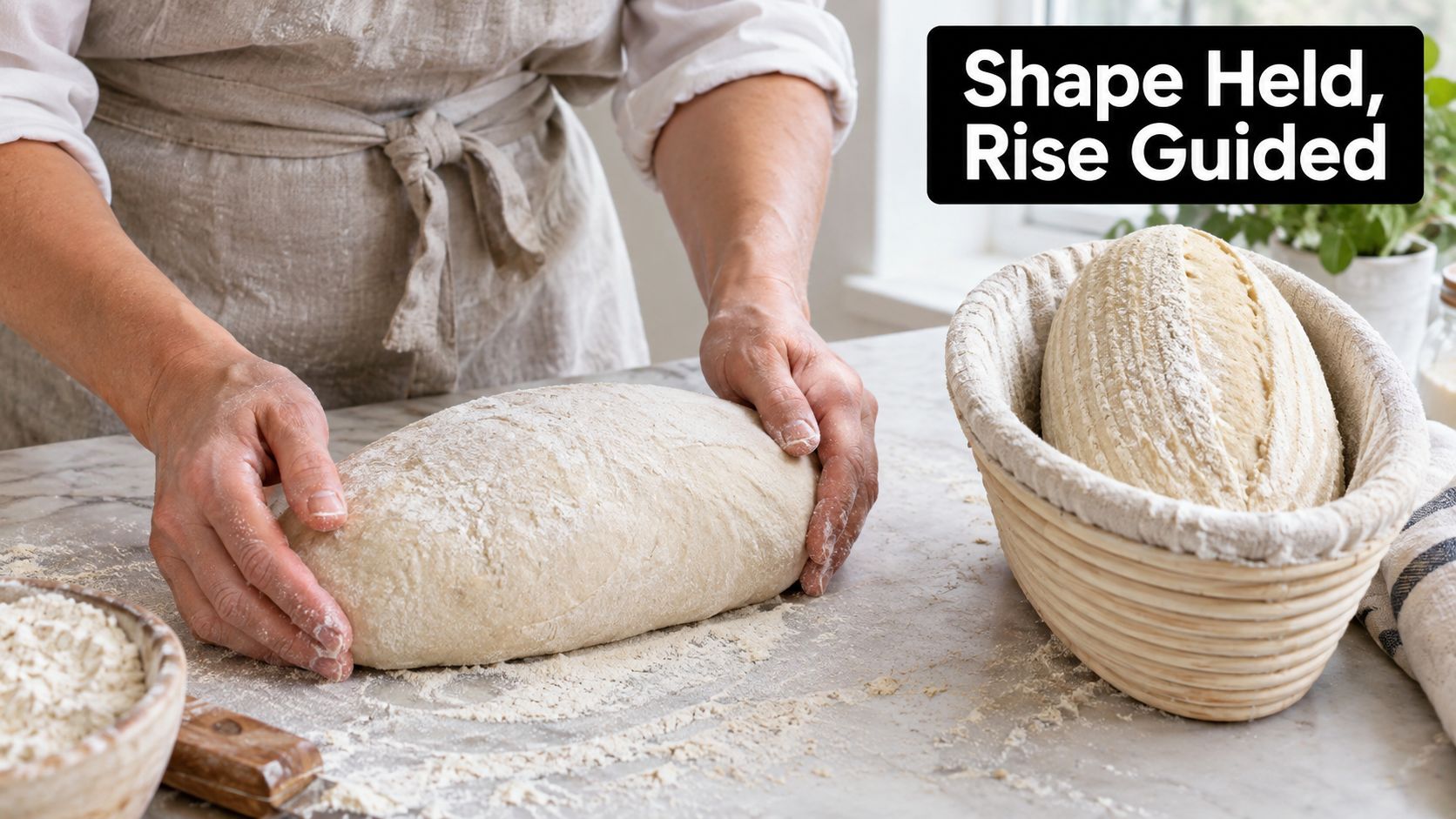
Table of Contents
- Introduction to Oval Banneton Baking at Home
- What an Oval Banneton Basket Is and How It Works
- How Oval Shape Affects Proofing and Crumb Structure
- Choosing the Right Size by Dough Weight and Hydration
- Liners Flouring and Everyday Care That Prevents Sticking
- Smart Buying Tips for UK Bakers and Gift Givers
- Your Next Bake With Confidence Using an Oval Banneton
Introduction to Oval Banneton Baking at Home
The oval shape suits a batard, the elongated loaf that many home bakers choose for toast, sandwiches and easy slicing. Unlike a round basket, it gives the dough a longer centre line and gently supports the sides, so the loaf can rise upwards instead of relaxing across the counter.
That doesn't mean every oval basket will suit every recipe. A basket needs to match the dough's total weight, its hydration and the way you plan to bake the loaf. A small basket can compress the dough, while an oversized one can leave too much room for sideways spread. The most useful decision is therefore functional, not decorative.
This guide is designed for a first-time baker buying a dependable basket, an experienced baker refining batard shaping, or someone choosing a practical gift for a sourdough enthusiast. You'll learn what the basket does, why oval geometry helps, how to read size labels, when to use a liner and how to keep cane dry between bakes.
The UK kitchen matters, too. A basket must work with the space available in your fridge, the shape of your proving setup and the Dutch oven or baking surface used for the final bake. It should also produce a loaf that fits the way your household eats bread. For many families, that means an elongated loaf with practical sandwich-sized slices rather than a round boule.
The aim isn't to buy the most attractive basket on a product page. It's to choose one that gives your dough enough room to expand while still providing the support needed for a confident transfer and a well-shaped loaf.
What an Oval Banneton Basket Is and How It Works
A banneton is a proofing basket, not a baking tin. You place shaped dough inside it for the final rise, then turn the dough out before baking. Think of it as a fabric hammock with firm sides. The hammock doesn't flatten the dough, but it stops the dough from sagging while fermentation continues.
Natural rattan or cane is common in UK oval banneton listings. Wood-pulp versions are also sold for larger loaves. The basket's walls support the dough, while the spiral weave leaves a pattern on the surface. That pattern is one reason bakers value a bare cane basket, although appearance is only part of its usefulness. BakeryBits' oval cane banneton listing presents the oval format as a batard-shaped proofing tool sized by dough weight.
What happens during the final rise
The process is simple:
- Shape the dough into a firm batard with surface tension.
- Dust the basket, or fit a suitable linen or cotton liner.
- Place the dough inside with the seam positioned according to your shaping method.
- Leave it to complete its final proof.
- Turn it out onto baking parchment, a peel or another prepared surface.
- Score and bake.
During this time, the basket's sidewalls limit lateral movement. The dough can expand, but it has less opportunity to flow broadly across a flat surface. This is especially helpful when the dough contains enough water to feel soft and mobile after shaping.
The cane also encourages a slightly drier dough surface than a sealed container would. That drier skin can help the loaf hold its shape, accept scoring and develop a stronger crust during baking. The basket's breathable construction supports air movement around the dough rather than trapping it against a smooth, wet surface.
Why oval means batard
A round banneton encourages a boule, with a compact, circular profile. An oval banneton encourages a batard, with a longer body and a more practical slicing shape. The basket's spiral weave may leave curved flour lines across the crust, but those marks are a by-product of the structure. The benefit is the way the walls hold the loaf's length and width during proofing.
UK suppliers sell oval baskets in formats associated with batards and different dough weights, which shows that the shape is treated as a working specification rather than a novelty. CooksInfo's explanation of bannetons also places the tool within ordinary artisan bread-making, rather than presenting it as specialist equipment reserved for professional bakeries.
How Oval Shape Affects Proofing and Crumb Structure
An oval basket changes the direction in which dough can move. On a flat worktop, a soft dough can relax in every direction. Inside an oval banneton, the sidewalls gently constrain that movement, so the dough has a better chance of retaining its length and building height.
This matters most with medium-to-high hydration doughs. Wetter dough contains more free water and often feels less willing to stay in the shape created during preshaping. The basket doesn't strengthen the gluten network by itself, and it can't rescue dough that's badly fermented, but it provides physical support while the dough finishes rising.
The same dough in two settings
Take a freshly shaped batard and leave it on a floured board. At first, it may look firm and elegant. As the dough rests, gravity pulls it outward. The surface tension gradually softens, the ends lose definition and the loaf becomes wider.
Place a similarly shaped dough in an oval banneton and the experience is different. The basket supports the sidewalls, keeps the loaf's length visible and gives the dough a defined boundary. When you turn it out, the loaf may still relax slightly, but it has a stronger starting shape for scoring and baking.
Practical rule: Use the basket to preserve good shaping, not to replace it. A banneton is support for structure you've already created.
The relationship between the basket and the crumb is indirect but important. When the dough holds its form, expansion during baking can be directed more effectively upwards. That can support a lighter, more open crumb, provided fermentation, shaping and oven heat are also well managed. It's better to think of the basket as one part of a chain than as a guaranteed crumb-making device.
Surface drying and crust development
The woven cane allows the surface to exchange moisture with the surrounding air. That helps the dough skin become slightly drier during proofing, which can make it less prone to tearing when scored. The surface may also develop enough strength to support a more pronounced ear or controlled opening along the cut.
The result isn't always a dramatic spiral imprint. A liner will soften or hide the basket pattern, while bare cane can leave a clearer impression. Both approaches can produce a well-shaped loaf. The choice depends on whether you prioritise easy release or a stronger visual pattern.
Choosing the Right Size by Dough Weight and Hydration
The most common sizing mistake is comparing the basket with the recipe's flour quantity. The useful figure is the total dough weight, which includes flour, water, starter and salt. A recipe made with 500 g of flour can produce considerably more dough once those other ingredients are included, so a basket labelled for 500 g may not be the right match.
UK sellers commonly offer oval bannetons for 250 g, 500 g, 750 g, 1 kg, 1.5 kg and 2 kg dough formats. BakeryBits' banneton range reflects this weight-based approach. The label is more useful than the basket's appearance because it tells you how much dough the maker expects it to hold.
A practical sizing table
| Basket Size | Dough Weight | Best For |
|---|---|---|
| Small oval | 250 g | Small individual batards and test bakes |
| Medium oval | 500 g | Smaller household loaves |
| Mid-sized oval | 750 g | Everyday batards |
| Standard large oval | 1 kg | Family loaves and sandwich-friendly batards |
| Extra-large oval | 1.5 kg | Large household loaves or substantial bakes |
| Largest listed format | 2 kg | Very large loaves or divided production |
These categories should be treated as buying guidance, not an excuse to ignore the manufacturer's dimensions. Basket depth and width vary between suppliers, even when the dough-weight label looks similar.
What hydration changes
Hydration affects how much support your dough needs. A relatively firm dough may hold its shape well during proofing, while a wetter dough benefits from closer sidewall support and a liner that makes release easier. If your dough is soft, sticky or still difficult to shape, choose a basket whose recommended dough capacity is close to your actual total dough weight rather than buying a much larger model.
A basket that's too small can press the dough against the sides, leave little room for expansion and make release awkward. The dough may rise against the rim instead of developing a balanced profile. A basket that's too large gives the dough excess room to spread, which can lead to a broader, flatter loaf and weaker surface tension.
Sizing rule: Match the basket to total dough weight first, then use hydration and baking vessel fit to choose between nearby options.
The 30 cm question
A 30 cm oval basket may look like a sensible choice for dough made with 500 g of flour, but flour weight alone doesn't answer the question. Calculate the finished dough weight, then compare it with the seller's capacity guidance. A 500 g-flour dough may need a basket intended for a larger total dough weight than the flour number suggests.
Also check the destination. If the loaf will bake in a Dutch oven, measure the usable interior and account for handles, walls and the room needed to lower the dough safely. A basket that fits the fridge may still produce a loaf too long for the baking vessel. A slightly shorter batard that sits comfortably inside the Dutch oven is more useful than a large one that has to be folded, squeezed or transferred awkwardly.
Keep a dough scraper nearby for lifting and shaping, and choose a model that gives you control without cutting the dough. This silicone dough scraper guide can help when you're building a compact home-baking toolkit.
Liners Flouring and Everyday Care That Prevents Sticking
A liner is not merely a comfort blanket for beginners. Linen or cotton changes the contact between the dough and the basket. It lowers friction, makes release more forgiving and moderates moisture exchange around the dough surface. UK product descriptions consistently include liners for oval bannetons for these reasons, particularly when the dough is hydrated or the baker is still developing shaping confidence. Sourdough by the Sea's oval rattan basket listing describes the liner and the slightly humid environment created during proofing.
Choose the surface for the dough
Use a linen or cotton liner when:
- The dough is wet: The cloth reduces direct contact with the cane and supports a cleaner release.
- Your shaping is still developing: A liner gives you more margin for error during the turn-out.
- You're baking a practical everyday loaf: Easy release matters more than a strong spiral imprint.
Use bare cane when:
- You want a pronounced basket pattern: The weave can press a characteristic design into the dough.
- The dough has a reliable skin: A well-shaped, appropriately floured loaf is easier to release.
- You're comfortable judging moisture: Bare cane exchanges moisture more directly with the surface.
Neither choice is permanently binding. Many bakers use a liner for challenging doughs and bare cane when the dough is firmer or the basket is well seasoned.
Flour with coverage, not decoration
Dust the liner or basket before every use, paying attention to the sides and the grooves in the weave. You're creating a complete release layer, not scattering flour only across the centre. If bare cane is catching dough, work flour into the grooves with a dry brush and let the basket dry fully before brushing away loose excess.
Don't soak the basket after baking. Cane and rattan need to remain dry, and trapped moisture can encourage mould. Shake out loose flour, remove crumbs with a dry brush and leave the basket in an airy, dry place.
A simple after-bake routine
- Turn the basket upside down and tap out loose flour.
- Brush away dried dough with a clean, dry brush.
- Inspect the grooves and rim for trapped residue.
- Leave the basket exposed to air until completely dry.
- Store it somewhere dry, rather than inside a sealed damp container.
A cloth cover can help protect a basket from kitchen dust, but it shouldn't trap residual moisture. If you use a bowl cover during proofing, choose one that leaves enough room for expansion and doesn't press on the dough. This elastic bowl cover guide is useful when you're organising a covered proving setup.
Smart Buying Tips for UK Bakers and Gift Givers
The best oval banneton basket is the one that fits your dough, your oven and your eating habits. A batard is often more practical than a boule for a UK household because its elongated shape produces slices that work naturally for toast and sandwiches. That doesn't make oval universally superior. It makes the format a strong default when you want one basket for freestanding artisan bread and everyday lunch-making.
The Federation of Bakers reported sourdough crusty baguettes at +55.4% in its 2025 market review, a sign of continuing interest in artisan-style formats in the UK. The Federation of Bakers' 2025 market overview provides that market context. It also helps explain why a practical batard shape deserves more attention than a simple round-versus-oval style comparison.
Check the oven before the basket
Measure the usable baking space before ordering. Include the interior length of your Dutch oven, the width of its base and the clearance needed to lower the dough without touching the sides. The basket itself can be slightly longer than the baked loaf's footprint, but the shaped dough must ultimately fit the vessel without being forced into position.
For a gift, ask what the baker already owns. A beautiful basket that duplicates an existing size is less useful than a liner, a dough scraper or a suitable cover. If the recipient has only round equipment but regularly makes long sandwich-friendly loaves, an oval basket can add capability without requiring a complete collection of gadgets.
A sensible purchase checklist
- Capacity: Confirm the stated dough-weight range, not just the physical length.
- Material: Choose natural rattan or cane for the classic breathable structure, or wood pulp where that format suits the recipe.
- Liner: Include linen or cotton if the baker works with wetter doughs or values easy release.
- Destination: Check the Dutch oven, baking steel or tray before choosing a long basket.
- Maintenance: Look for a basket that can be brushed dry and stored easily in the available cupboard space.
- Household use: Favour an oval shape when longer slices, toast and sandwiches are part of the plan.
One versatile basket often earns more counter space than several decorative sizes. Prioritise the dough you bake most frequently, then choose the nearest capacity that supports expansion without leaving a large empty perimeter.
Your Next Bake With Confidence Using an Oval Banneton
Before the next bake, make the decision in this order. First, calculate the total dough weight rather than relying on the flour quantity. Next, compare that weight with the oval basket's stated capacity. Then consider hydration. Softer dough usually benefits from closer support and a liner, while a well-shaped dough with a good surface skin can work beautifully against bare cane.
Check the baking destination before proofing begins. Your batard should fit the Dutch oven or tray without being compressed during transfer. This guide to Dutch ovens for bread baking can help you think through vessel choice alongside basket size.
During the final rise, look at the dough rather than following the clock blindly. The basket should hold the sides while the dough expands, not press it tightly against the rim. When you turn it out, move decisively, score the surface and transfer it with as little handling as possible.
After baking, judge the result as useful information. A broad loaf may need a smaller or better-matched basket, while a cramped loaf may need more capacity. If release was difficult, improve flour coverage or use a liner next time. With those small adjustments, an oval banneton becomes a dependable partner for repeatable, sandwich-friendly batards.
The Sourdough Cult offers live, active sourdough starter from a long-maintained family culture in Cheshire, along with practical starter kits and clear feeding guidance. If you're pairing a reliable culture with the right oval banneton basket, visit The Sourdough Cult to find a straightforward starting setup for your next bake.


